Christopher Watkin
Lecturer Monash University, Australia
The Bible as a Tool for Changing Culture
Wednesday, February 14, 2024, 4:00 PM
Live Video Recording
Abstract
The question of the relationship between Christianity and culture increasingly takes centre stage in debates both within and outside the church today. This talk reflects on how a constructive, nuanced and—to many modern ears—fresh vision for contemporary society can be drawn from a rich engagement with the Bible’s storyline, guided by Augustine’s magisterial work City of God. What might it look like to reimagine Augustine’s mode of engagement with late Roman society in our own cultural moment of late modernity?
Biography
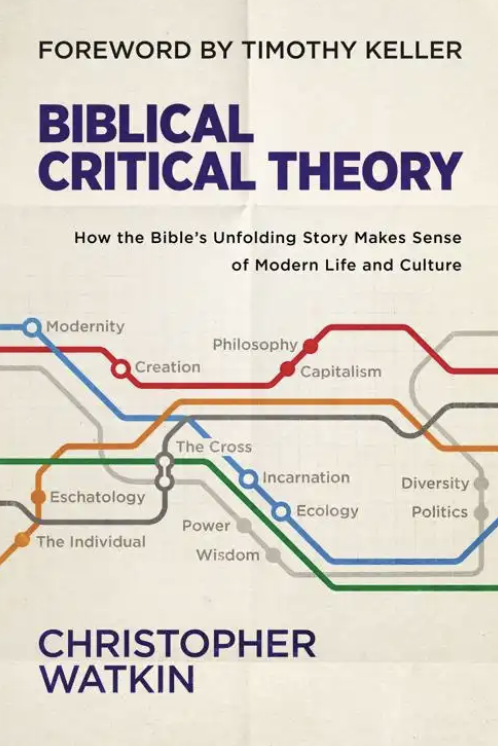
Christopher Watkin (PhD, University of Cambridge) is senior lecturer in French studies at Monash University in Melbourne, Australia. He is a scholar with an international reputation in the area of modern and contemporary European thought, atheism, and the relationship between the Bible and philosophy. His published work runs the spectrum from academic monographs on contemporary philosophy to books written for general readers, both Christian and secular, and include Difficult Atheism, From Plato to Postmodernism; Great Thinkers: Jacques Derrida. His recent impressive 2022 tome with Zondervan Academic is Biblical Critical Theory: How the Bible’s Unfolding Story Makes Sense of Modern Life and Culture.
Companion Volume: Towards an Incarnational Spiritual Culture
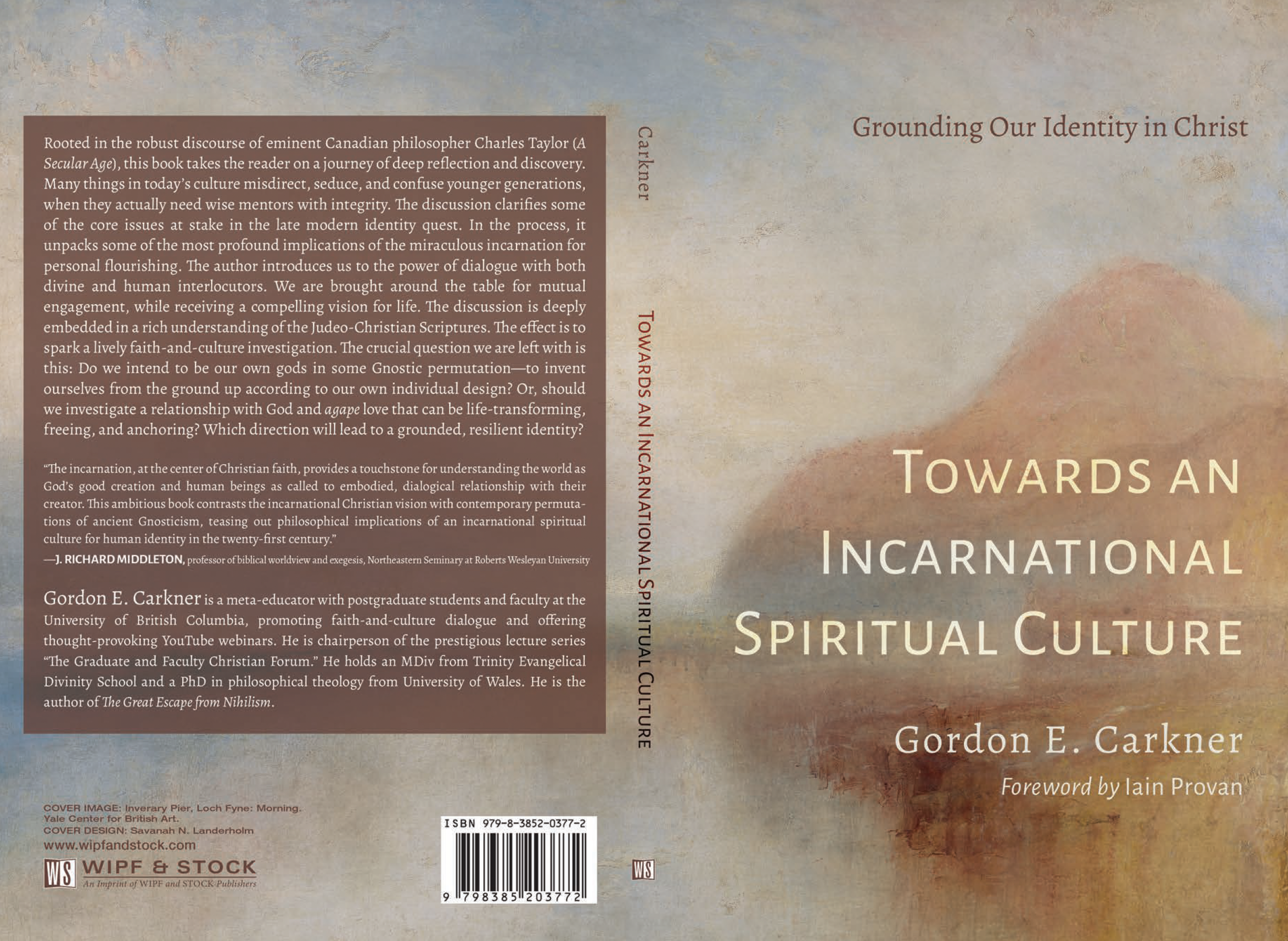
Now available on Amazon and local Bookstores.
The paradigm of the gift places us in the posture of recipients. We receive existence, we receive meaning, and we receive love. To be sure we are creative recipients, as we shall see in the chapters that follow, and receiving the gift of the universe certainly does not make us passive. But the fact remains that we are recipients nonetheless. The one thing we should not do with a gift is pretend we bought or made it ourselves. The giver is usually thanked, so our fundamental orientation to existence in the paradigm of the figure of gratuity is one of praise and thanksgiving.
To live and die by the dynamics of “making a name for ourselves” is to submit to a court of a public opinion which only allows certain achievements to count, and it is to give a warped view of life in which value is ascribed to our words and deeds according to the fickle tastes of the crowd.
Over the past century or so, as values of duty, collective identity, and conformity have been overtaken by a premium on nonconformity and what philosopher Charles Taylor calls “expressive individualism,” we have been increasingly told that we live our best life when we go our own way, in the face of what “they” tell us to do. And so we obediently obey this ubiquitous social command to be our own master and blaze our own trail. (Christopher Watkin, Biblical Critical Theory)
The incarnation acts as the pinpoint focus to which all time before it is drawn, and from which all time after it radiates out…. At the incarnation, the narrative that began with the heavens and the earth converges on a single baby as it “sharpens at last into one small bright point like the head of a spear”…. As we move forward in time past the incarnation, we will witness not a further restriction but an explosion in the scope of the narrative as, by the end of the Bible, God’s plans are again seen to encompass the whole universe…. The incarnation is an event that splits time in two…. Of all the biblical events that irreparably alter the course of history and create an indelible “before” and “after,” the incarnation is perhaps the one that has left the deepest mark on modern culture. It gives rise to today’s most widely celebrated Christian festival, Christmas, and the contrasting juxtaposition of almighty deity and fragile newborn has captured the minds of countless artists and poets, as well as the hearts and imaginations of many believers…. “What makes the form of Christ attractive,” writes William Cavanaugh, “is the perfect harmony between finite form and infinite fullness, the particular and the universal.”… Christ bridges Lessing’s ditch with his own universal particularity, forever uniting the immediate and the ultimate, life and reality, experience and truth. (C. Watkin, Biblical Critical Theory, 349-51)
 ubcgcu
Leave a comment