Universities arguably exist to make the universe legible (readable) and intelligible (understandable). In Christian tradition, what the Second Helvetic Confession calls the “Book” of nature is as readable as the book of Scripture, for both ultimately precede through the Logos in whom all things hang together. The “book” of culture, human history, is similarly legible, because it is written by those created in the image of the Logos. Modern secular universities, however, struggle to make sense of these three documents. What Hans Frei termed the “eclipse” of biblical narrative led to a “great reversal” in hermeneutics in which the biblical narrative gave way to other frames of reference. This presentation argues that the prevailing metaphysical frames of reference used today in the natural and human sciences, as well as in biblical studies, are ultimately unable to read rightly their respective texts. Brief examples from each of the three books – the laws of nature; human dignity; the historical Jesus – illustrate both the problem and also the way forward. This involves a retrieval of a theological frame of reference that privileges biblical narrative and enables faith-fuelled scholarship to gain a deeper understanding of reality.
Response: Jens Zimmermann, PhD University of British Columbia, PhD Johannes Gutenberg University. He is the J.I. Packer Chair of Theology at Regent College. Trained in both Comparative Literature and Philosophy, his research focusses on theological anthropology and epistemology, of who we are and how we know. Among other works, he has published books on university education (The Passionate Intellect: Incarnational Humanism and the Future of University Education, with Norman Klassen, Baker Academic 2006), the importance of humanism for Western culture (Humanism and Religion: A Call for the Renewal of Western Culture, Oxford University Press, 2012), hermeneutics (Hermeneutics: A Very Short Introduction, OUP 2014), and the theology of Dietrich Bonhoeffer (Dietrich Bonhoeffer’s Christian Humanism, OUP 2019).
Biography
Kevin J. Vanhoozer (Ph.D., Cambridge University on Paul Ricoeur) is Research Professor of Systematic Theology at Trinity Evangelical Divinity School. Previously, he served as Senior Lecturer in Theology and Religious Studies at the University of Edinburgh, Scotland (1990-98) and as Blanchard Professor of Theology at the Wheaton College Graduate School in Chicago (2009-2012). He is the very articulate author of twelve books, including The Drama of Doctrine: A Canonical-Linguistic Approach to Christian Theology; plus Faith Speaking Understanding: Performing the Drama of Doctrine, and his impressive 2024 volume Mere Christian Hermeneutics: Transfiguring What it Means to Read the Bible Theologically. He is presently at work on a three-volume systematic theology. In 2017, he chaired the steering committee and drafted A Reforming Catholic Confession to mark the 500th anniversary of the Reformation. He is currently Senior Fellow of the C. S. Lewis Institute. He is an amateur classical pianist, and finds that music and literature help him integrate academic theology, imagination, and spiritual formation.
Kevin Vanhoozer on Framing the Discussion on a Mature Bible Reading Culture:
In Mere Christian Hermeneutics: Transfiguring What It Means to Read the Bible Theologically (2024), Kevin Vanhoozer uses the concept of “framing interpretation holistically” to address the diverse “frames of reference” that shape how different interpretive communities (e.g., denominational, historical, disciplinary, or global) approach Scripture. He argues that these frames often lead to fragmented or partial readings, reflecting the “plurality of reading cultures.”
Vanhoozer proposes framing interpretation holistically within a unified, eschatological, and christological perspective — what he calls a “mere” Christian hermeneutic (echoing C.S. Lewis’s Mere Christianity). This holistic frame views the Bible not in isolation but as part of God’s broader economy of revelation, centered on the person and work of Jesus Christ.
The key elements include:
Grammatical-eschatological interpretation — Attending to the literal (grammatical-historical) sense while “thickening” it through figural or spiritual reading.
Transfiguration as a model — Drawing from the Gospel accounts of Jesus’ transfiguration, Vanhoozer describes holistic interpretation as “transfiguring” the text: the literal sense is glorified (not denied or distorted) in the light of Christ, revealing its fuller theological meaning and telos (purpose) in the gospel.
Canonical and catholic context — Reading individual texts within the whole canon, informed by the historic Christian tradition (“reformed catholic” paradigm), to achieve unity amid legitimate diversity.
This approach integrates exegesis, theology, and church practice, ensuring interpretation does justice to Scripture’s divine-human authorship, its communicative action, and its ultimate aim: forming readers to know God and bear witness to Christ.
In essence, framing interpretation holistically means rejecting narrow or “immanent” frames (e.g., purely modern historical-critical or postmodern subjective ones) in favor of an overarching theological vision that sees all Scripture pointing to and illuminated by Jesus, leading to transformative understanding. This is central to Vanhoozer’s call for reading cultures that foster both unity and diversity among Christians.
As we rediscover the economy of light in the Bible with Kevin Vanhoozer, we break through the glass ceiling of modernity’s immanent frame (Charles Taylor, A Secular Age) and open ourselves to a thicker, richer social imaginary—towards a more expansive frame of reference. When we interpret the Bible properly and live it incarnationally, the light of Christ shines brighter in the world. We become a mature, responsive reading culture. We expose ourselves to God’s light, his interpretation of us and our destiny. We read the Bible christoscopically: Jesus Christ is the unexpected fulfilment of the promise that lies at the heart of the Old Testament. We are called as a people out of darkness into this wonderful light, into community and communion (1 Peter 2:9).
Epiphanies are suggestive of transcendence–something other worldly and yet present at hand in our experience. Michael Morgan (1994, 56f)) points out that Charles Taylor sees a parallel between the epiphanies of art and poetry in the nineteenth and twentieth centuries and the I-Thou epiphany of religious encounter with the divine. Taylor elaborates the idea of epiphanies (1989, 419f, especially 490-93). He sees Post-Romantic and modernist art as oriented to epiphanies, episodes of realization, revelation, or disclosure. Epiphanies and epiphanic art are about a kind of transcendence, about the self coming in touch with that which lies beyond it, a ground or qualitative pre-eminence. One might call it a gift of the imagination, or even a re-enchantment of reality.
Taylor reviews various ways of articulating epiphany in Sources of the Self (1989, 419-93). He articulates how God, inserted into this idea of epiphany, fits as a moral source (Sources of the Self, 449-52). Epiphanies can be a way of connecting with spiritual and moral sources through the exercise of the creative imagination: sources may be divine (Taylor), or in the world or nature (Romantics like Thoreau), or in the powers of the imaginative, expressive self (Michel Foucault).
These epiphanies are a paradigm case of what Taylor calls recovering our contact with moral sources in an amoral society. A special case of this renewal of relationship between the self and the moral source is religion and the relation to God, which he sees articulated well in the work of Fyodor Dostoyevski. The relationship to art parallels the relationship to religion. The self is oriented in the presence of the inaccessible or sublime, that which captures one’s awe, for example, when one’s eyes are riveted to a certain painting like Monet’s Lillies, or our inner emotions are deeply moved by a poem. One is taken beyond oneself, in an experience of transcendence; the experience involves elements of both encounter and revelation.
When Mary hears from an angel that she is to become the vessel of a most profound turn of events in history, she is in awe, overwhelmed. She cannot understand what is happening; she can only magnify the Lord.
It is truly an epiphany, an I-Thou encounter with radical alterity. Heaven and earth reach out to each other at this juncture and something dramatic happens. This news changes her life. Time stands still in this kairos moment. She allows transcendence and immanence to intermingle within her body, and then her life narrative. Mary’s story is punctuated by the incursion of the eternal into the temporal, informed by the descent of transcendence within the immanent time-space world. We know it as the incarnation, the most profound identification of the divine with humanity. D. Steven Long writes in Speaking of God (309): “The purpose of the church is to recognize and acknowledge those conditions by which we can, like Mary, say yes to God and in so doing make Jesus present to the world. Those conditions are the way of holiness and that assumes the transcendentals—truth, goodness and beauty.”
BeautifulAdvent Guides
Isabelle Hamley, Embracing Humanity: A Journey Towards Becoming Flesh.
Darrell Johnson, Awaken Wonder: Devotional Readings for Advent.
Malcolm Guite, Waiting on the Word: A Poem a Day for Advent, Christmas, and Epiphany.
Refugee by Malcolm Guite
We think of him as safe beneath the steeple,
Or cosy in a crib beside the font,
But he is with a million displaced people
On the long road of weariness and want.
For even as we sing our final carol
His family is up and on that road,
Fleeing the wrath of someone else’s quarrel,
Glancing behind and shouldering their load.
Whilst Herod rages still from his dark tower
Christ clings to Mary, fingers tightly curled,
The lambs are slaughtered by the men of power,
And death squads spread their curse across the world.
But every Herod dies, and comes alone
To stand before the Lamb upon the throne.
Gord’s Christmas Reads 2025
Quentin Genuis, Recovering People: Addiction, Personhood, and the Life of the Church. Cascade, 2025. (March GFCF speaker)
The New Testament in Color: A Multiethnic Bible Commentary, IVP Academic (eds. Esau McCaulley, Janette H. Ok, Osvaldo Padilla, and Amy Peeler)
Miraslov Volf et al, Life Worth Living: A Guide to What Matters Most (perfect Gen Z resource).
Chris Watkin, The State of Nature and the Shaping of Modernity: Tracing the Roots of Colonialism, Secularity, and Ecology (one of the great minds of our time).
Alex Sosler, A Short Guide to Spiritual Formation: Finding Life in Truth, Goodness, Beauty, and Community. Baker Academic.
Nilay Salya, Professor of Political Science and International Relations, Nanyang Tech University, The Global Politics of Jesus (Harvard Divinity School Lectures).
David P. Gushee, Defending Democracy from its Christian Enemies.
Paul Kingsnorth, Against the Machine: On the Unmaking of Humanity.
Sejong Chun, Paul’s New Creation: Vision for a New World and Community.
Richard Bauckham, Jesus and the Eyewitnesses, 2nd edition (on the Gospel accounts of Jesus).
Michael McEwan, The Devil Reads Nietzsche: A Public Theology for the Post-Christian Age..
Tim Keller, Go Forward in Love: A Year of Daily Readings from Tim Keller.
David S. Dockery & Trevin K. Wax (eds.), Christian Worldview Handbook.
Graham Tomlin, Blaise Pascal: The Man Who Made the Modern World.
Lucy Ash, The Baton and the Cross: Russia’s Church from Pagans to Putin.
Thomas Albert Howard, Broken Altars: Secularist Violence in Modern History.
Jonathan Linebaugh, The Well That Washes What it Shows (an accessible introduction to the Bible).
Robert Bowman, et al., The Incarnate Christ and His Critics: A Biblical Defense
International Authoritarian Challenges to Democracy
Contact: gfcfevents@gmail.com if you would like to be added to the mailing list for future lectures
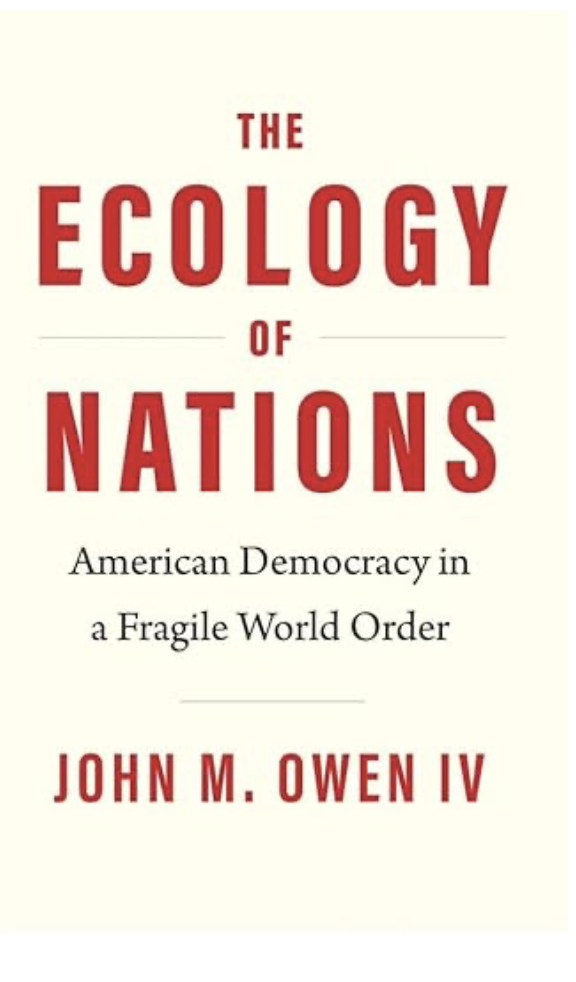
Abstract for John Owen
Democracy is wobbling in a number of countries at once. This is no accident, because no democracy is an island: countries share a complex social environment that, depending on its content, can “select for” either democracy or authoritarianism. One reason why the environment has lately come to favour authoritarianism is the rise and reassertion of the authoritarian giants, China and Russia. Dr. Owen will discuss the effects of these countries and their policies on world politics, recent developments in the United States, and finally why Christians today ought to cherish constitutional democracy and work for a world that enables its flourishing.
Response to John Owen Paul Freston is emeritus professor in Religion and Politics in Global Context at the Balsillie School of International Affairs and Wilfrid Laurier University, Canada. He is also professor colaborador on the post-graduate programme in sociology at the Universidade Federal de São Carlos, Brazil. A naturalized Brazilian of British origin, he has worked mainly on religion and politics, the growth of popular forms of Protestantism in Latin America, and questions of religion and globalization. His books include Evangelicals and Politics in Asia, Africa and Latin America (Cambridge University Press, 2001); and (co-edited) The Cambridge History of Religions in Latin America (Cambridge University Press, 2016).
With regard to additions to what I said in response to John Owen’s talk, here are two possibilities.
“Christian Political Reserve” by Dr. Paul Freston, Professor Emeritus Wilfrid Laurier University.
The Christian treatment of political differences is extremely important. The Christian community will never be completely united on these questions. Political diversity is normal and positive within the Christian community. It is positive because any uniformity would only exist if it was imposed by an authoritarian political leadership; without that, there will always be a diversity of Christian political opinions. And it is normal because Christian political unity is impossible, for three reasons.
Firstly, because of the absence of a biblical political recipe. The Bible does not exist to substitute for reflection on social, political and economic life, nor to substitute for creatively improving institutions in these areas. While Judaism has the Mosaic law and Islam has sharia law, Christianity has no comparable law. This absence of law is significant for the Christian task in social life. We have no ready-made political recipe applicable anywhere and anytime. Instead of this intellectual short-circuit, we have to constantly go through the hard work, with faithfulness and humility, of relating biblical revelation to the socio-political realities of our own context.
Secondly, Christian political uniformity is impossible because of the distance between the biblical worlds and our world. The New Testament was written for a small transnational community which controlled no territory and had no political power. As for the Old Testament, no country today is in the position of Old Testament Israel; and, in any case, the main principle of Christian interpretation of the Hebrew scriptures is that they should be read in the light of the coming of Christ. The enormous length of the hermeneutical bridge makes it impossible to arrive at a definitive political recipe.
Thirdly, Christian political uniformity is impossible because of the nature of politics. As the famous (pseudo) definition says, politics is the art of the possible. This means that two equally devout Christians, who reach similar conclusions from their reading of the scriptures, can still diverge radically in what each one regards as possible and advisable to attempt today, in this country.
The result of all this is a certain lack of political “self-confidence” in Christianity; a certain hesitation in producing political “recipes” in the name of the faith; a certain “reserve”, a non-dogmatism, an ample space for legitimate disagreement between faithful believers.
Due to this Christian political reserve, the politicization of the faith is disastrous, because it tries to charge a political “toll-fee” of those who wish to travel on the way of faith. This politicization is also idolatrous, because it confuses the absolute and the relative. Even while we affirm the importance of politics and the duty of Christians to participate in it, even passionately, we should always remember that our political opinions belong to the sphere of the relative and not of the absolute, and should never be placed on the same footing as those convictions which form the heart of the Christian faith.
Because of all this, we need democracy. While liberal democracy is insufficient and always disappoints, it is still irreplaceable. Democracy doesn’t exist to guarantee the victory of our side and of our vision of society. It exists to allow the ongoing defence of diverse projects for society, including our own.
Role of Churches & Christian Leadership in Politics
Firstly, it is important that those who hold official leadership positions (pastors, priests, bishops), while of course exercising their prerogatives as citizens, should preserve a certain public aloofness with regard to partisan politics in democratic contexts. Certainly, they should not be candidates for public elective office, as long as they are exercising pastoral roles.
Nevertheless, it is part of their responsibility as teachers to give instruction regarding all dimensions of discipleship, including the political dimensions. Besides specific implications, this also includes encouraging the political vocations of some members, and the responsible citizenship of all members.
During election campaigns, churches should consider encouraging debates among members, with serious defenders of each proposal, whether church members or not. The focus should be both on the importance of the questions involved, but also on the ability to debate civilly and to disagree without breaking off relations.
It is important that Christians refrain from giving way to political hatreds, but instead give an example to society of a community which is not politically united (which would be undesirable, since it could only be the fruit of manipulation), but of a community united in the Christian treatment of political differences. We remember the biblical exhortations to love everyone, but especially brothers and sisters in the faith (e.g. John 13:34-35, in which the ability of Christians to love each other is the most important factor in their reputation before the world; and Galatians 6:10, in which “to do good” is recommended above all to those who share the same faith). It is especially tempting to nurture an antipathy for those who are closest to us, but who nevertheless disagree with us! If Christians are not capable of living this ethic of love, inside the Christian community and in the midst of the political torment, we have nothing to contribute to society.
_______________________________
New Commentary on November 25 Discussion:Why Should Christian Support Democracy? Christians may support democracy for a variety of theological, ethical, and practical reasons, drawing from biblical principles and historical Christian thought. While Christianity does not explicitly endorse any specific form of government (the Bible describes monarchies, theocracies, and other systems), many believers argue that democratic systems align well with core Christian values such as human dignity, justice, and communal responsibility. Below, I’ll outline key reasons based on common arguments from Christian ethicists, theologians, and thinkers. Note that not all Christians agree—some prioritize other governance models—but these points represent widespread perspectives. This piece is AI generated, but I, Dr. Gordon E. Carkner, approve of these points. Read also Glenn Tinder, The Political Meaning of Christianity; Larry Siedentop, The Invention of the Individual; and David P. Gushee, The Christian Enemies of Democracy.
1. Democracy Promotes Justice and Protects the Vulnerable Christianity emphasizes caring for the marginalized, as seen in teachings like the Sermon on the Mount (Matthew 5-7) and calls to “do justice, love mercy, and walk humbly” (Micah 6:8). Democratic participation allows Christians to advocate for policies that uplift the poor, immigrants, and oppressed, fostering solidarity and service to others. By voting, organizing, and engaging in civic debate, believers can work toward a society that reflects God’s concern for equity and human flourishing, rather than leaving power concentrated in the hands of a few.
2. It Aligns with Biblical Principles of Human Dignity and Equality The doctrine of imago Dei—that all humans are created in God’s image (Genesis 1:27)—implies inherent worth and equality, which undergirds democratic ideals like one person, one vote. Democracy provides a framework where individuals can exercise free will, self-governance, and accountability, echoing the fruit of the Spirit such as self-control (Galatians 5:22-23). In contrast, authoritarian systems can suppress this dignity, making democracy a practical way to honor God’s design for humanity.
3. Democracy Enables Faithful Civic Participation and Discipleship In democratic societies, Christians have a unique opportunity to “salt and light” the world (Matthew 5:13-16) by influencing laws and culture ethically. This includes protecting religious freedom, promoting family values, and building social safety nets—elements often associated with Christian democratic movements in Europe and elsewhere. Engaging in politics isn’t just optional; for many, it’s an extension of loving one’s neighbor and stewarding God’s creation.
4. It Serves as a Bulwark Against Authoritarianism and Division History shows that authoritarian regimes often restrict religious expression and target minorities, which contradicts Christian calls for freedom and peace. Christians can protect democracy through prayer, education on authoritarian tactics, and fostering healthy dialogue to counter polarization. In divided times, believers are called to heal societal wounds, modeling reconciliation and unity as part of their witness. However, some Christians have contributed to democratic erosion by embracing reactionary or nationalist ideologies, highlighting the need for self-reflection within the faith community.
Ultimately, support for democracy among Christians often stems from a desire to create systems that reflect kingdom values like love, truth, and communal well-being, even if imperfect. Debates on this topic continue in forums like Reddit, where users discuss how faith intersects with governance. If you’re exploring this from a specific denominational or cultural angle, more details could help refine the discussion.
“Open liberalism … is shaped by what Charles Taylor calls an ‘ethic of authenticity’: the understanding of life … that each one of has his/her own way of realizing our humanity, and that it is important to find and live out one’s own, as against surrendering to conformity with a model imposed on us from outside, by society, or by the previous generation, or religious or political authority (aka expressive individualism).” John Owen, The Ecology of Nations, 90.
“Open liberalism prizes markets and private enterprise for the power they bring to the individual, regardless of where she lives. It tells people that they are primarily consumers of the goods of capitalism rather than the producers of them. It seeks complete openness, a world without legacy boundaries to human interaction and fulfillment.” John Owen, The Ecology of Nations, 91.
In The Ecology of Nations, Owen’s analysis blends IR theory, history, and biology for a lucid, provocative take on why democracy feels besieged—and how to fight back strategically. The book won the 2025 Grawemeyer Award for Ideas Improving World Order.
Summary of The Ecology of Nations: American Democracy in a Fragile World Orderby John M. Owen IV. John M. Owen IV’s 2023 book applies an ecological metaphor to international relations, framing regimes (democracies vs. autocracies) as “species” that actively “engineer” their global environment to favor their survival and spread. Drawing on Woodrow Wilson’s idea of making the world “safe for democracy,” Owen argues that liberal democracies are currently losing this competition due to internal flaws and aggressive autocratic strategies. The book critiques the overextension of liberal ideals while advocating for a more resilient, community-focused liberalism. Below are the main points, structured thematically:
1. The Concept of “Ecosystem Engineering” in Global Politics
Nations, like keystone species in biology (e.g., beavers building dams or ants creating nests), intentionally reshape the international “ecosystem” (norms, institutions, alliances, and trade rules) to suit their regime type.
Democracies engineer for openness, multilateralism, and human rights to reinforce liberal values at home; autocracies engineer for stability, hierarchy, and control to sustain authoritarian rule.
Historical example: Post-WWII U.S.-led order (e.g., Bretton Woods, NATO) created a democratic-friendly environment that boosted liberal stability worldwide.
2. Why Democracies Are Losing the Competition
Liberalism has evolved into a disruptive force emphasizing perpetual openness, individualism, and global intervention, which undermines domestic cohesion and exposes democracies to backlash (e.g., polarization, inequality).
Autocracies like China and Russia are more effective “engineers”: China exports surveillance tech and economic dependencies; Russia spreads disinformation and supports illiberal allies, tilting the global environment toward autocracy.
Democracies’ “great delusion”: The unrealistic belief that they can universally convert autocracies into liberals, leading to failed interventions (e.g., Iraq, Afghanistan) and fatigue.
3. Interdependence of Democracies and the Fragility of U.S. Democracy
American democracy’s health depends on a global network of fellow democracies; isolation or a autocracy-dominant world erodes U.S. institutions through contagion (e.g., via migration, media, or economic ties).
Owen emphasizes that internal U.S. challenges (e.g., polarization) are exacerbated by external pressures, making ecosystem engineering a matter of national survival.
4. Recommendations: Reimagining Liberalism for Resilience
Shift liberalism from disruption to commitment, community, and country: Prioritize domestic renewal (e.g., reducing inequality, fostering civic bonds) over endless global promotion.
Long-term goal: Bias the international order toward democracy without overreach, ensuring a “safe” global habitat for liberal species.
Owen’s analysis blends IR theory, history, and biology for a lucid, provocative take on why democracy feels besieged—and how to fight back strategically. The book won the 2025 Grawemeyer Award for Ideas Improving World Order.
See also Anne Applebaum, Autocracy, Inc.: The Dictators Who Want to Run the World, Signal, 2024.
Timothy Snyder, The Road to Unfreedom.
Jason Stanley, How Fascism Works.
David P. Gushee, Defending Democracy from its Christian Enemies.
Dr. Gordon E. Carkner’s PhD Dissertation: A Critical Examination of Michel Foucault’s Concept of Moral Self-Constitution in Dialogue with Charles Taylor.
Dr. Gordon E. Carkner’s 2006 PhD dissertation, submitted to the University of Wales (Oxford Centre for Mission Studies), offers a rigorous philosophical-theological analysis of Michel Foucault’s late ethical thought (late 1970s–early 1980s). Drawing primarily from Foucault’s The Use of Pleasure and The Care of the Self (1984a, 1984b), as well as his Collège de France lectures and interviews, Carkner examines Foucault’s proposal for “moral self-constitution”—a deliberate, reflective process of shaping the self through ancient Greco-Roman practices of self-care (epimeleia heautou). This “aesthetics of existence” positions the self as both artist and artwork, emphasizing autonomous aesthetic freedom: creative self-stylization as resistance to modern power structures, normalization, and domination.
Michel Foucault, French Poststructuralist Philosopher
Carkner appreciates Foucault’s recovery of subjectivity and agency amid late modernity’s “malaise” (e.g., moral fragmentation, nihilism, atomism, disenchantment, and the “nova effect” of overwhelming moral options, per Charles Taylor). However, he critiques its radical individualism and norm-skepticism as risking solipsism, relativism, narcissism, and ethical violence.The dissertation unfolds as a three-way dialogue across paradigms: Foucault’s post-Romantic aesthetic constructivism, Taylor’s moderate moral realism (rooted in communal horizons of the good), and a trinitarian theological extension via D. Stephen Long, Christoph Schwöbel, and Alistair I. McFadyen. This synthesis proposes “redeemed freedom”—self-constitution within relational, transcendent structures of goodness, neighborly love, and divine agape—addressing modernity’s crisis of affirmation and offering a trajectory toward communal flourishing. Methodologically, it employs close textual exposition, interdisciplinary moral philosophy, and theological retrieval, avoiding broader debates like Foucault’s historical accuracy or political implications.
The thesis advances three propositions: (1) Freedom requires horizons of significance for moral orientation; (2) Self-constitution thrives in intersubjective relations, not isolation; (3) Trinitarian goodness grounds ethics in a paradigm of love, redeeming autonomy from domination.
Abstract: The abstract frames Foucault’s ethics as an aesthetic turn from power/knowledge critiques to individual self-formation, rejecting codes and prohibitions for positive self-elaboration via “technologies of the self” (e.g., askesis, parrhēsia). It highlights interplay among power relations, “games of truth,” and subjectivity, yielding a bold ethic for modernity. Taylor praises its creativity but faults its “ontology of freedom” for evading the good, fostering amoralism or self-loss. The theologians extend this via Taylor, advocating a “transcendent turn” to trinitarian paradigms, where self-constitution emerges from communion and complementary relations. Three paradigms are contrasted: autonomous aesthetic self-making, moral horizons of community, and goodness-freedom in agape. The conclusion posits redeemed freedom as situated in the good, the neighbor, and divine relationality, exemplified in Jesus’ life.
Key Quote: “Freedom is the ontological condition of our ethics; but ethics is the deliberate form assumed by freedom.” (Foucault, 1984e, p. 4)
Chapter One/Introduction of the Discourse: Modernity’s Malaise and the Question of the Crisis of the Moral Self. Carkner diagnoses late modernity’s ethical disorientation through Taylor’s lens (The Malaise of Modernity, 1991): instrumental reason erodes meaning, the “buffered self” isolates individuals, and biopower stifles agency. Foucault’s genealogy exposes these pathologies, proposing self-care as therapeutic resistance. The chapter previews the dialogue: Foucault recovers freedom via aesthetics but denies transcendent goods; Taylor insists on moral frameworks for authentic selfhood (moral realism); theologians thicken this move with trinitarian relationality. Core concepts are defined—moral self-constitution as ongoing praxis, aesthetic freedom as subversive stylization—the thesis is positioned as a “positive critical reception,” affirming Foucault while seeking more expansive corrective horizons.
Charles Taylor, Canada’s Philosophical Grande Pensée
Chapter Outlines with Key Arguments The dissertation alternates exposition, critique, and synthesis across eight chapters, building from Foucault’s ontology to theological redemption. Below is a structured table summarizing each chapter’s focus, arguments, and contributions.
Chapter
Title/Focus
Key Arguments and Sections
Theological/Dialogue Contributions
Key Quote
2
The Place of Freedom in Foucault’s Moral Self-Constitution
Freedom as ontological telos: negative (freedom from domination) and positive (toward self-mastery). Sections: Nominalist anthropology (self as fluid, anti-essentialist); norm-skepticism (ethics as agent-centered stylization); transgression via agonisme (perpetual struggle); practice of freedom (eleutheria as non-slavery); power-subjectivity-truth interplay (power as productive relations, truth as modifiable “games”). Counters malaise by expanding horizons but risks relativism without communal anchors.
Sets up Taylor’s critique: Freedom needs moral orientation to avoid amoral ontology and personal dissolution.
“From the idea that the self is not given to us, I think that there is only one consequence: we have to create ourselves as a work of art.” (Foucault, 1983a, p. 351)
3
Technologies of the Self: The Technical Dimension of Foucault’s Ethics
Self-technologies (epimeleia, askesis) as reflective practices (e.g., writing, diet, gaze) for self-governance. Sections: Historical retrieval from antiquity; erotics of truth (pleasure as ethical pursuit); fusion of spiritual-political ethos. Addresses subjectivation crisis by fostering autonomy amid biopower.
Taylor: Technologies require horizons of the good; isolated, they yield narcissism. Theologians: Echoes Christian askesis but lacks divine telos.
(focus on praxis over aphorism).
4
Foucault’s Ethics as an Aesthetics of Existence
Self as artwork: From Greco-Roman moderation (sophrosyne), to Baudelairean modernity (darker/more radical). Sections: Part 1—Nature of aesthetic self-making (erasing art-ethics boundaries); Part 2—Taylor dialogue (appreciates creativity, critiques evasion of good, risks violence/self-loss). Foucault responds to disenchantment via the “beautiful life” but ignores relational embeddedness.
Taylor: Aesthetic freedom is “thin,” needing communal significance; theologians: Points to incarnational beauty in trinitarian love.
“The idea of the bios as a material for an aesthetic piece of art is something that fascinates me.” (Foucault, 1983b, p. 341)
5
Charles Taylor’s Moral Framework: A Critique of Foucault
Taylor’s realism (Sources of the Self, 1989): Inescapable moral horizons ground authenticity; critiques Foucault’s constructivism as “paleo-Darwinian” (reductive, norm-denying). Sections: Malaise diagnostics (atomism, buffered identity); strong evaluation (ranking goods); dialogical self-constitution. Affirms Foucault’s agency but insists on communal/transcendent goods.
“There is no priority of the individual’s sense of self over society: our most primordial identity is as a new player being inducted in an old game.” (Taylor, A Secular Age, 2007, p. 559)
6
Taylor’s Concept of Freedom and the Moral Self
Freedom as situated in hypergoods (e.g., benevolence, justice); sections: Narrative identity; crisis of affirmation (modern doubt in worth); recovery via moral footing. Critiques Foucault’s transgression as unstable without relational discernment.
Schwöbel/Long: Extends to trinitarian perichoresis (mutual indwelling), redeeming freedom from solipsism.
7
A Trinitarian Theological Perspective: Long, Schwöbel, and McFadyen
Transcendent turn: Goodness-freedom paradigm via agape. Sections: Long (narrative theology against nihilism); Schwöbel (loss of summum bonum, recovery in God’s glory); McFadyen (relational ontology, self via neighbor). Counters Foucault’s autonomy with theonomous communion.
Synthesizes dialogue: Trinitarian love contextualizes self, defines freedom as participatory in divine relations; addresses affirmation crisis.
“The self is constituted in and through its relations to the good, the neighbor, and the triune God.” (Adapted from McFadyen/Schwöbel synthesis)
8
Synthesis: Redeemed Freedom and the Moral Self
Propositions for integration: Self-constitution in fecund relations; aesthetics redeemed by goodness; trajectory of love. Responds to malaise via dialogical, incarnational ethics.
“Ethics is not about following rules but about becoming a subject capable of love.” (Carkner, synthesizing Foucault/Taylor)
Main Critiques and Dialogues
Foucault-Taylor Dialogue: Taylor values Foucault’s anti-disciplinary ethos but also diagnoses “normative confusions”—aesthetic freedom evades moral ontology, yielding a “thin” self vulnerable to power’s return (e.g., Foucault contra Taylor: Whose Sources? Which Self?). Carkner mediates: Foucault excels in micro-resistance but falters without Taylor’s “strong evaluations” (ranking a hierarchy of goods).
Theological Extensions: Long critiques postmodern nihilism via narrative; Schwöbel laments lost transcendence, proposing God’s goodness as a key horizon for ethical balance; McFadyen emphasizes neighbor-relations, echoing Levinas on responsibility for the other. Together, they offer a “trinitarian agape” paradigm, where self-constitution is participatory (perichoretic), countering Foucault’s solipsism with relational teleology.
Conclusion: Carkner concludes that Foucault’s aesthetics vitalizes ethics but requires Taylor’s communal grounding and theology’s transcendent orientation for sustainability. Redeemed freedom—dynamic, intersubjective, and agape-driven—resolves modernity’s malaise, fostering affirmation, justice, and promoting an “incarnational spiritual culture.” The thesis invites ongoing dialogue, affirming Foucault’s provocation while advocating thicker moral ecologies. Overall, it contributes to philosophy of culture by bridging post-structuralism, moral realism, and trinitarian thought, emphasizing self-constitution as relational artistry toward the good.
Dr. Gordon E. Carkner, Meta-Educator, Author of Towards an Incarnational Spiritual Culture
Scholarly Lectures of the UBC Graduate & Faculty Christian Forum
“The incarnation, at the center of Christian faith, provides a touchstone for understanding the world as God’s good creation and human beings as called to embodied, dialogical relationship with their creator.” ~J. Richard Middleton, theologian.
Loren Wilkinson explains how creation is a work of love and self-giving in his book, Circles and the Cross: Cosmos, Consciousness, Christ, and the Human Place in Creation. On pages 270-73, Wilkinson tags John Polkinghorne’s edited volume, The Work of Love: Creation as Kenosis. “God’s self-giving creates space for each creature to be its own self….. Polkinghorne would also agree with Julian of Norwich that without God, creation would become nothing. But he identifies creation as the work of both power and love–and love looks sometimes like powerlessness…. The picture of a controlling Creator is corrected by the incarnation: The Logos of creation became flesh and moved into the neighbourhood. (John 1:14). Creation is “safe” because God never stops loving it”
Grok, operating as my research assistant, replied to my inquiry as follows: In Circles and the Cross: Cosmos, Consciousness, Christ, and the Human Place in Creation (2023), Loren Wilkinson—a professor emeritus of philosophy and interdisciplinary studies at Regent College—presents a lifelong theological and personal reflection on humanity’s relationship to the created world. Drawing on over 50 years of teaching, writing, and hands-on environmental engagement (including life on Galiano Island, British Columbia), he weaves together science, philosophy, poetry, biblical exegesis, and autobiography to argue that Christian faith demands a profound ethic of creation care. Central to this is the Celtic cross as a unifying symbol: the circle evokes the repetitive, interconnected cycles of the natural cosmos (birth, death, renewal), while the cross—intersecting and extending beyond it—represents Christ’s disruptive, redemptive intervention into those cycles through incarnation, suffering, and resurrection. Wilkinson relates the incarnation (God’s self-emptying kenosis in becoming human flesh, as in Philippians 2:5–8) to creation care by emphasizing its cosmic scope and ethical implications. He critiques Enlightenment-era anthropocentrism and linear “progress” narratives, which he sees as fostering human domination over nature and exacerbating ecological crises. Instead, the incarnation reveals God’s intimate solidarity with all creation—not just humanity—as vulnerable, interdependent stardust within the vast cosmos. This “deep incarnation” (echoing theologians like Elizabeth Johnson, though Wilkinson grounds it biblically) means Christ enters not only human history but the entire web of life, sharing in its beauty, pain, and finitude. As Wilkinson writes, the incarnation holds together divine transcendence (God beyond the circle) and immanence (God within it), affirming creation’s intrinsic value as a gift from a loving Creator.
This theological vision motivates creation care as an extension of Christ’s incarnate love. Humans, as image-bearers, are called to “step into the cycles of nature” with empathetic, self-emptying actions—mirroring Jesus’ precarious vulnerability on the cross—that disrupt destructive patterns and foster life-giving renewal. Wilkinson illustrates this through personal stories (e.g., his family’s stewardship of land) and figures like Gerard Manley Hopkins, whose poetry celebrates “pied beauty” in creation’s diversity. The cross’s hope breaks the circle’s potential despair (endless ecological decay), offering resurrection as a promise of cosmic healing, but it demands active participation: reducing consumption, restoring habitats, and pursuing justice amid climate grief. In essence, for Wilkinson, the incarnation isn’t an abstract doctrine but a mandate for embodied hope. It liberates Christians from escapist eschatology (fleeing a doomed earth) toward a “cross-shaped” vocation of healing the planet, as one reviewer notes: a “compelling case for how Creation Care…should be a central concern for Christians.” This relational ethic counters modern alienation, inviting wonder at the “miracle of the cosmos” and our conscious place within it, all illuminated by Christ’s light.
I agree with this analysis, having read the entire book recently, and with great enthusiasm, for our lecture with Martin de Wit from South Africa. The book is a real statement of hope in an age heavily influenced by nihilism. I do, however, disagree with Wilkinson’s use of Richard Rohr, who is actually a panentheist, and not a trinitarian theist. He should at least have made a footnote in this regard. One final quote from Loren Wilkinson: “The whole cosmos could never have arisen if the self-giving love of God–which resulted in the incarnation, crucifixion, death, and resurrection of Christ–had not been at the centre of the universe” (Loren Wilkinson, Circles and the Cross, 309).
~Dr. Gordon E. Carkner, Graduate & Faculty Christian Forum at University of British Columbia, author of Towards an Incarnational Spiritual Culture. Find upcoming lectures at https://ubcgfcf.com.
Feel free to write gord.carkner@gmail.com if you want to be added to the Graduate Christian Union information list
Professor of Environmental Governance at Stellenbosch University
Responsible Creation Care in an Age of Conflicting Perspectives
Thursday, October 2, 2025, @ 4:00 PM
Response: Dr. Loren Wilkinson, Professor Emeritus Interdisciplinary Studies, Regent College; Author of: Circles and the Cross: Cosmos, Consciousness, Christ, and the Human Place in Creation. Cascade Books, 2023.
Abstract
Based on a rigorous understanding of the biblical discourse, there is no credible evidence to support the claim that authentic Christian spirituality conflicts with a responsible view of creation care. Some scholars do agree, however, that a critique is called for: This includes certain perspectives on God’s relationship with creation, on humankind’s spiritual, but also earthly, bodily and material value, on the implications of salvation for all of creation, and on certain future escapist expectations. Biblically, the narrative clearly articulates this world as God’s creation from Genesis to Revelation. Guidelines for an effective response are that creation care needs to arise from the core of Christian faith and that Christians cannot responsibly act as if there is any part of creation or human action that falls outside the scope of the gospel as revealed in Scripture.
Biography
Martin de Wit is Professor of Environmental Governance at Stellenbosch University, South Africa and coordinates the School of Public Leadership’s Postgraduate Diploma and Master’s Programmes in Environmental Management. His research work focuses on care for creation, the interactions between the economy and the environment (notably climate, ecosystems, energy, and waste), and on the place of the human person in environmental governance and social order. His latest book, written in Afrikaans, is called Skeppingsorg: ‘n Aanset tot interpretasie van sekere Bybeltekste oor die mens se verhouding tot die natuurlike omgewing [Creation Care: An Onset to Interpreting Certain Biblical Texts on Humanity’s Relationship to the Natural Environment] (Durbanville: AOSIS, forthcoming). He serves on the Board of Directors of the creation care organization A Rocha.
UBC Graduate & Faculty Christian Forum,
&
Canadian Science & Christian Affiliation
Thanks to UBC Murrin Fund
Martin de Wit:
“A theology and ethics of creation care is a whole-gospel issue, but with a specific entry-point in the person and work of Jesus Christ. A Christian ethic of responsible stewardship, earthkeeping or creation care needs to start with a high christology as the revelation of God’s will has reached its finality in the revelation through his Son.”
“In its critique, the aim of a theology and ethics of creation care would not be to be novel in the first place, but to bring improved clarity to the Christian faith confessed by the church throughout the ages and to living in this spectacular “universe [that] is before our eyes like a beautiful book in which all creatures, great and small, are as letters to make us ponder the invisible things of God.”[1]
“A reformational approach is proposed, which starts with the authority of God’s Word, and the holy, catholic, Christian churches’ faithful confession of that Word. A central feature of a reformational approach is that it is Christocentric and Trinitarian. These are not abstract theological doctrines but deeply affects Christian lives. Christian identity formation in Christ challenges the natural desires of the human being through the text and calls for a renewal of our minds.”
Build Your Own Reading List on Creation Care
Steven Bouma-Prediger, For the Beauty of the Earth
Steven Bouma-Prediger, Earth-Keeping and Character: Exploring a Christian Ecological Virtue Ethic.
R. J. Berry & Laura S. Meitzner Yoder, John Stott on Creation Care.
Loren Wilkinson, Circles and the Cross: Cosmos, Consciousness, Christ, and the Human Place in Creation.
Darrel Falk, On the Divine Origin of Our Species.
Dennis Hollinger, Creation and Christian Ethics: Understanding God’s Design for Humanity and the World.
Faith Skinner, Living Green, Loving God: A Christian Guide to Creation and Conservation.
We live in a world marked by crises of various kinds, but perhaps most deeply and fundamentally by a crisis as to the nature of our humanity. What does it mean to be human?
For example, are human beings essentially minds, trapped temporarily and regrettably in physical bodies? Certainly many artificial intelligence enthusiasts see the world in precisely this way. Marvin Minsky, for example, believes that the mind is all that is really important about life, over against that bloody mess of organic matter that is the body. Out of this conviction arises another: that mind machines represent the next step in human evolution. We ourselves, in our godlike state, ought to create this new species—Machina sapiens instead of Homo sapiens—passing the torch of life and intelligence on to the computer (Rudy Rucker). Our ultimate goal is the conversion of “the entire universe into an extended thinking entity . . . an eternity of pure cerebration” (Hans Moravec).
From this single example we gather what should already be obvious to us in any case: that our governing ideas about human nature inevitably have significant consequences. They matter individually, affecting how I look at myself, what I agree to do to myself or have done to me, and the goals I set for myself. They also matter communally, affecting how I look at and treat other people, and what kind of society I am trying to help build. In fact, the answer to this question about humanness affects everything else that matters in life. And this means that arriving at good rather than bad answers to the question is a high-stakes game. It means that arriving at the truth of the matter is crucially important. Is it really true, for example, that we are essentially minds that happen to possess bodies that we may or may not consider satisfactory? If we can manage it, should the physical body be discarded like a piece of clothing in pursuit of something more glorious, with the help of technology?
Read: AI Snake Oil by Arvind Narayanan for deeper insights into the world of AI, the good and not-so-good implications, the true and false claims of what it can offer.
It is into the very centre of this kind of contemporary discourse that Gordon Carkner has inserted this new book Towards an Incarnational Spiritual Culture, with a view to encouraging readers to ground their identity in Christ, rather than somewhere else. He invites us to consider the great difference between incarnational spiritual culture, on the one hand, and both ancient and modern anti-material Gnosticisms, on the other—rejecting the latter in favor of the former. He explores the incarnation of Christ as the center point of history, giving dignity to embodied persons everywhere, and enabling us to rethink human wisdom and knowledge. He pursues the implications of this incarnation for human community and communion, contrasting the contemporary will-to-uniqueness that tears us apart to the will-to-community that reintegrates us. And he discusses, finally, the transformative nature of divine goodness, and its necessity for healthy human freedom.
We need all the help we can get in remaining human in these markedly inhumane times. This volume draws on deep and varied resources in offering such help, and I know that many people will benefit from reading it.
~Dr. Iain Provan Founder of the Cuckoos Consultancy; Author of Cuckoos in Our Nest: Truth and Lies about Being Human.
See also: Miraslov Volf et al, Life Worth Living: A Guide to What Matters Most, Open Field, 2023.
Dr. Thomas Fuchs, a psychiatric expert from Germany, gave an excellent lecture on September 25 at Green College, UBC on the contrast between a disembodied, narcissistic, post-humanist AI Utopian Self of the Singularity, and the concept of Humanistic Embodiment of Merleau-Ponty (conviviality, inter-corporeality, ecological and personal connectedness). It was entitled: “What is to Become of the Human Being?: A Plea for the Embodied Personhood.” ~sponsored by the Houston Centre for Humanity and the Common Good.
GCU, Graduate Christian Union, exists to help you reach your full potential as a graduate student, and to discover your best self–within community. You can help us build a network and a friendly learning community among postgrad and postdoc students. We respond to those pursuing the deeper life, those who want to grow in character as well as academically. We would be delighted to meet you and hear about your journey, your passion and your area of research inquiry. This is an active group of curious people from around the globe. We love the view from the cutting edge of thought and culture. Are you looking for community with other like-minded graduate students?
Dr. Gordon E. Carkner, PhD University of Wales
A Service of Outreach Canada’s Campus Work & Dialogue to Support Young Scholars and Scientists
I am really enjoying the wisdom of Dr. Loren Wilkinson, Professor Emeritus Regent College, in his capacious discussion on science, religion, and personhood:Circles & the Cross: Cosmos, Consciousness, Christ, and the Human Place in Creation. Cascade, 2023. Loren has a tremendous grasp of a wide range of scholarship and handles controversial subjects with grace and acuity. This is a must read for anyone interested in the big and small picture of cosmos and Creator. I once spent two full years studying this subject and I find this refreshing and positive. He shows the birth of the environmental movement and his personal part of the narrative. ~Gordon
The Kindle version of this Wipf & Stock book will be available on Amazon for FREE ($0) Summer, 2025. Take advantage of this special deal and tell your friends. Buy a copy for a friend.
Gordon E. Carkner’s Towards an Incarnational Spiritual Culture: Grounding Our Identity in Christ (2024, Wipf and Stock Publishers) is a philosophical and theological exploration of human identity in late modernity. Drawing on thinkers like Charles Taylor, Hans Urs von Balthasar, and James Davison Hunter, Carkner critiques contemporary cultural trends and proposes an “incarnational spirituality” as a robust alternative. The book argues that grounding personal and communal identity in the Incarnation of Christ fosters flourishing amid fragmentation, offering both intellectual rigor and practical wisdom for engaging culture.
Main Points: Here are the core arguments and themes, distilled from the book’s structure and key contributions:
Diagnosis of the Late Modern Identity Crisis: Carkner identifies a pervasive “cultural identity crisis” driven by modern revivals of ancient Gnosticism, such as expressive individualism, the “will to uniqueness,” and a disembodied quest for autonomy. These lead to fragile, truncated selves vulnerable to manipulation, isolation, and nihilism. Influenced by Taylor’s analysis of authenticity and the buffered self, the book unpacks how these ideologies prioritize self-expression over relational depth, resulting in fragmented communities and a loss of transcendent meaning.
The Incarnation as the Epicenter of Identity: At the heart of the book is the Christian doctrine of the Incarnation—God entering embodied human life in Christ—as the foundation for a “thick” identity. This contrasts Gnostic dualism (spirit over body) by affirming the integration of spiritual and physical realities. Identity is rooted not in isolated autonomy but in an I-Thou relationship with a speaking God, where grace nurtures resilience, perspective, and moral depth. The Incarnation provides explanatory power for personal flourishing, reading “backwards into history and forwards into our future.”
Six Pillars of Incarnational Wisdom: Building on von Balthasar, Carkner outlines six interconnected pillars that embody this wisdom:
Embodied Relationality: Marrying spirit and body in covenantal bonds, rejecting disembodied spirituality.
Transcendent Speech and Dialogue: God’s communicative action through Christ invites ongoing moral conversion and “moral language skill.”
Faithful Presence: Echoing Hunter, this calls Christians to incarnate wisdom in culture through humble, engaged witness rather than withdrawal or dominance.
One-Anotherness: Shifting from individualism to embodied communities that foster stability, hospitality, and mutual sacrifice.
Grace-Circulated Vitality: The Holy Spirit as the source of dynamic goodness, enabling love of self and world despite inherent brokenness.
Sacramental Outlook: Viewing creation and human life as signs of divine glory, participating in re-creation.
Practical Implications for Spiritual Culture: Incarnational spirituality demands radical praxis: self-sacrifice for community, hospitality rooted in transcendent goodness, and a “resounding yes to life” (per Jürgen Moltmann). It equips readers for cultural critique and engagement, promoting moral intelligence, resilience, and epiphanic encounters with grace. Carkner emphasizes “infrastructure” for faith—plausibility conditions like dialogue and presence—that counters reductionism and fosters flourishing in personal, communal, and societal spheres.
Vision for Human Flourishing: The book culminates in a hopeful alternative to postmodern fragility: an incarnational ethos that restores dignity, vitality, and purpose. By rooting identity in Christ, individuals and communities access “abundantly more” through arts, ethics, and relationships, ultimately glorifying God amid late modern challenges.
Carkner’s dense, provocative style—packed with philosophical dialogue—makes the book ideal for reflective readers seeking intellectual and spiritual depth. It positions the Incarnation not as abstract doctrine but as a transformative horizon for 21st-century life.
If you like this book, you will also treasure David P. Gushee & Glen Stassen, Kingdom Ethics: Following Jesus in Contemporary Context; and also Life Worth Living by Miraslov Volf et al https://www.youtube.com/watch?v=K5cnbY6xO0U
Jesus Cares About Who We Are, How We Think, and How We Live
The Moral Teachings of Jesus: Radical Instruction in the Will of God
by David P. Gushee
You Will Become Salt, Light, & Good Deeds
Jesus’s moral teachings are an ongoing message of our living Lord, the best account we have of the will of God; its constitutes a way of life that respects the broader discourse of Scripture. Christians are meant to be those who commit to obey/incarnate, to give voice to and defend these teachings. How can we embody the Gospel in our daily lives? Sadly, it seems that the moral teachings of Jesus are too poorly emphasized in many of our churches: sometimes morality and spirituality are shockingly taught as contestants. There are historical reasons but no excuses. This has proven disastrous to the moral health of the church and society at large. Our culture and our campus communities are also in serious need of these teachings: We grapple with a fragmented society of relativism, contestation, and polar ideological extremes that seek to divide us.
Below are some imaginative, life-inspiring/life-saving quotes from David P. Gushee that capture the momentum and pertinence of Jesus’s powerful moral teaching in the Four Gospels, but especially in Matthew 5-7, The Sermon on the Mount. Jesus shows a wise, transcendent brilliance as he interweaves key elements of human flourishing with the will of God: knowledge, truth, holiness, justice, grace, and love. As historian Tom Holland notes, this teaching and Jesus’s exemplum are the foundation of Western ethics of human rights, sanctity of life, justice, and dignity. David P. Gushee is distinguished university professor of Amsterdam. The elected past-president of the American Academy of Religion and the Society of Christian Ethics, Gushee is the author or editor of twenty-nine books. He has an international reputation as one of the leading Christian moral thinkers of this era. McGill University philosopher-emeritus professor Charles Taylor also reveals the inescapable nature of moral frameworks in his brilliant tome, Sources of the Self, Harvard University Press, 1989 (pp. 3-107). It helped me deal with issues of moral/spiritual identity and self-creation in French philosopher Michel Foucault in my University of Wales PhD work in philosophical theology. Can we avoid a moral lobotomy in our day? Let’s hope so.
~Dr. Gordon E. Carkner, Meta-Educator, Blogger, Author, YouTube Webinars
The Church’s Incarnational Stance(Salt, Light, & Deeds): 52. We let our light shine by living in such a way that people see (perceive, discern, experience) our good works and that motivates them to give glory to God…. Through our lives we point people to God so clearly that they honor God’s name because of what they have seen in us…. In short, followers of Jesus constitute an alternative community (salt), living towards the reign of God, distinct from the world but engaged in a caring, constructive way within the world (light), with our deeds of obedience to Christ the greatest evidence of our identity and of God’s glory.
32. For Jesus, it is most often sins against neighbor, against the poor, against children, against widows, against the outcast, against the vulnerable, that attract his greatest attention—as in the [Hebrew Scriptures] prophetic tradition.
53. Jesus refuses to declare himself an abolisher of the Law of Moses or of the prophets whose main job was to exhort Israel to keep God’s Law truly…. His teachings represent a fulfillment rather than a negation of Jewish Law…. He wants to show people how to obey the Law from the heart. Jesus sternly warns against any loosening or weakening of God’s Law. His goal is not to set aside God’s will but to do it, obey it, and teach it to others. (Matt 5:20)
56. Jesus cares about the state of our hearts, the deepest recesses of our motives, thoughts, and feelings. Example: Jesus wants us to prioritize a life path of peace-making, which is the answer to the escalating patterns of anger and hate, together with its destructive, death-dealing power.
72. Jesus says that it is God rather than people who sets the agenda for how God will relate to people, and God’s agenda is love. He is inviting us to enter this sublime freedom of love, rather than allowing the worst actions of others to entice the worst in us.
73. People who are determined to love their enemies are the freest and the most powerful people in the world. They set their own agenda, and no one can distract them from it—making the journey through fear, through anger, even through hate, all the way to love. This is what we see in Jesus.
80. Jesus routinely appears to make God’s forgiveness of us contingent on our forgiveness of others. 81. God’s perspective: We are loved, we are understood, we are forgiven, and we are called to higher ground.
86. Mammon(Worship of Money as an End in Itself) entails turning wealth into an idol that displaces God in the human heart. It invites God’s wrath. This is why Jesus encouraged some of his followers to sell everything and give the proceeds to the poor and needy. Such idolatry is not just something in the human heart, but it is encouraged in the ethos and structures of economic life and human culture. Jesus’s answer to Mammon involves cleansing the eye of covetousness and fear, cleansing the heart of anxiety and greed, cleansing the behavior of stinginess, exploitation, and indifference to the poor—this can transform one’s relationships with the material world and economic culture—to set one free from a kind of slavery. Let enough be enough! Jesus taught: “Save up your treasures in heaven.”
Morality matters immensely to both God and human society, so laissez-faire relativism doesn’t work. 93. Even while we must make human moral judgments—as parents, teachers, governors, judges, citizens, church members, fellow humans/neighbours—we must do it in a spirit of generosity, mercy, and humility, always remembering that moral scrutiny begins with ourselves, and that ultimate judgment on a human life belongs to God alone. We are called to continuous peace-making and community-building.
98. There is a “heart,” an inner moral core, in every person. It is formed in part by what we treasure. Out of it flow life-shaping words and deeds. Action also forms character, just as character drives action—a spiritual feedback loop. 100. Overall, Jesus exhorts his followers to obey God’s will out of a humble, meek, just, merciful, pure heart that is seeking God’s kingdom (a higher road lifestyle). This builds real substance into a life and shapes our identity towards true flourishing. Jesus’s teaching is all about the solid rock of love: this leads to joy, peace, justice, and covenant love.
121. The Greatest Commandment (agape) is the moral centre of Jesus’s moral teaching. Love God with all you have and love your neighbour as yourself…. The obligation is stated positively…. [We are never done.] Jesus pairs love of God and neighbor.… We cannot love God if we do not love our neighbor…. We cannot love neighbor without the in-filling love of God that makes neighbor-love possible. Jesus defines love in the Good Samaritan story in one word: mercy. Love requires insightful vision, heartfelt compassion, and effective action. It is a matter of doing not mere sentiment.
Love sees with compassion and enters into the situation of people in bondage.
Love does deeds of deliverance.
Love invites people into community.
Love confronts those who exclude others.
176. In John 17, Jesus prays for Christian unity, and launches a theological conviction that the unity of the church is a historic part of Christian confession. Peace and unity are not easy, and Christians are often bitterly divided in reality. But every time we Christians bear with one another, choose to seek peace, and remain in relationships that defy our natural human tendencies to selfishness, something special is happening. At these times, we see Jesus’s high priestly prayer for unity in his followers being answered. We must never give up on the quest for Christian unity; it is central to our witness.
191. Jewish listeners at the time would hear Jesus emphasizing in Matthew’s Gospel, chapters 5 to 7 (Sermon on the Mount), and 25:31-46 things like: Food for the hungry, hospitality to the stranger, almsgiving to the needy, care for the sick. These were basic expressions of justice, mercy, and love. The idea is that this kind of behaviour is what God cares about most—it resounds throughout the prophets (Isaiah 58:6-11). Jesus identifies himself with the hungry, thirsty, stranger, naked, sick, and imprisoned. What about us? 192. There will be an eternal judgment for all humans, and it will be based on how we treat our fellow human beings, especially the most vulnerable and needy. This is one of the most significant/unsettling of all Jesus’s moral teachings—an incarnational identification of the righteous Judge with the least/those who suffer/the marginalized/the broken ones. God sends them to us. He say to us a did Mother Teresa: This was me.These are my people.
In Summary, Jesus’s Moral Teaching is the Opposite Stance to Much of Contemporary Culture
194. We look at the world, our lives, and our aspirations basically upside down, in a complete reversal of how we ought to think and live. Our religious values are shockingly often the opposite to God’s. 196. Human culture, as we have set it up, is a set of interconnected and idolatrous abominations to God, although celebrated robustly by many people. We need to repent, and change radically, to get things right (return to the path of holiness and righteousness).
We over-hype our needs.
We constantly seek status, importance, validation among our peers. We are willing to sacrifice others to get it.
Jesus is deeply aware that humans lie, a lot: We lie to God, to ourselves, and to others out of shame, self-protection, or in order to manipulate the narrative.
What is it that really matters, what makes a good, fruitful life? Jesus’s moral teaching is counter-cultural pointed in the direction of the highest good: love of God and neighbour.
Culture reinforces faulty approaches/goals to life and selfish values. Sinful human practices and attitudes are thoroughly baked into society and its norms. We naturally strive for the wrong goals and ignore the needs of others–run with the crowd.
David Gushee’s Healing Vision of the Deeply Moral Kingdom of God: 196. God is all and is in all…. God wants people to give their whole-full-complete-true-pure-hearts, selves, souls, and lives to him. This is way beyond rules and obedience. It’s devotion. It’s submission. It’s love. God wants people who are humble in heart, hungry for truth and justice, merciful, and reconciling. God wants people who will secure themselves by trusting in him rather than in foolish/prideful human strategies and schemes that are so constantly self-defeating…. God wants to radically reorient us. It is a matter of doing not mere sentiment.…. We need retraining into new creational, Jesus-like practices and attitudes. Jesus taught peacemaking, forgiveness, economic simplicity, mercy and generosity, turning the other cheek, enemy love, covenant fidelity, truth telling, Good Samaritanism, standing with the vulnerable, valuing all people, leading by serving while not seeking human honour or glory for oneself.
From his other key boo, Kindgom Ethics, (40) by David Gushee & Glen Stassen: “The biblical virtues are keys to community well-being: peace-making, hungering for justice, doing mercy, integrity, humility, and caring for the poor and the mourning. They are the way of participation in community with God.”
“Jesus taught that participation in God’s reign required the disciplined practices of a Christ-following countercultural community that obeys God in its inner communal life and by publicly engaging in works of love, justice, and protection of the dignity and sacred worth of human life.” (195)
Key Questions for Further Investigation: 1. Why have so many theologians in the history of the church avoided or repressed Jesus’s moral teaching in the Sermon on the Mount? It was the most important/central discipleship material in the early years of the church. 2. “How do we avoid a cultural moral lobotomy amidst our current crisis of affirmation?” (grande pensée Charles Taylor in Sources of the Self). AI probably will not solve this dilemma; it has no soul.










 ubcgcu