Language & the Road to Freedom within the Moral Horizon
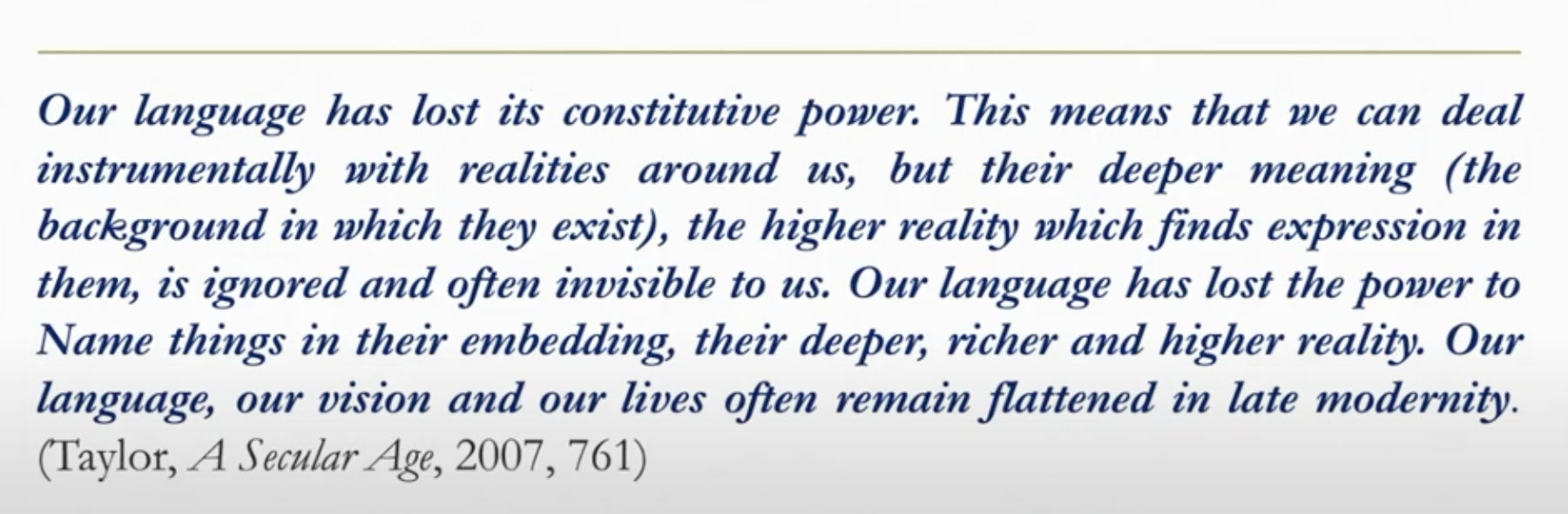
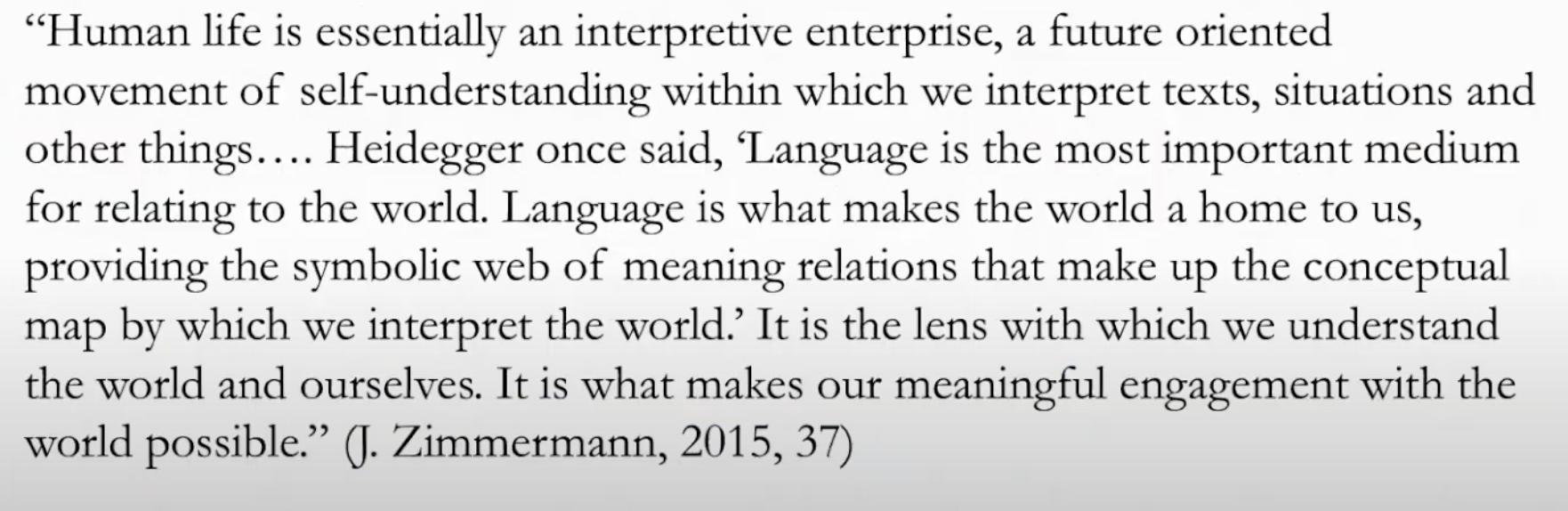
As in the previous post, shared language is key to moral realism. Sometimes our language can be quite restrictive. It is often hard to see beyond the picture of the world that has taken us captive. But fresh language and new interlocutors can free us from the grip of too narrow a perspective on life and reality–too small a social imaginary (worldview). Perhaps academics need to collaborate more on language, to expand their imagination whatever the discipline. I have been impressed over the years with engineering and science faculty who have done a second PhD in Fine Arts or Humanities. These were some of the most innovative academic program developers at University of Waterloo back in the day, pioneering communal learning in Systems Design Engineering. Can new language set us free for new levels of innovative genius and creativity? One could see language as a form of wealth to steward. It is harmful to close ourselves off, or to implode into a minimalist or reductionist language game (scientism, consumerism, materialism). Charles Taylor has a masterful coverage of two major types of language theories in his tome The Language Animal: Designative-Instrumental & Constitutive-Metabiological. The first is more scientific, the other more holistic including meaning, ritual, ethics, the arts, and religion. One longs to grasp the richness of the full human linguistic capacity. Ethics has more to do with constitutive language. Language does not merely describe; it constitutes meaning and fundamentally shapes human experience. The quote below reveals a problematic deficit of language in the West.
Morality is what tells us how to act, what our obligations are to each other, (for example, to treat each other with respect and dignity). Are you a mere means to my ends, or someone of inherent, objective value or worth? Ethics attempts to define the good life which often includes the virtues and language about character (David Brooks, The Road to Character). Together they are interwoven and they can influence the shape of a whole civilization. Humanitarianism obliges us to come to the aid of human beings in need regardless of polis, nation, race, or religion (plus other differences). One of the key sources of this outlook is Christianity in the West: “there is neither Jew nor Greek, male nor female; all are one in Christ.” Taylor puts it this way:
Our sense is that in answering this call, we are acceding to a higher, fuller, truer form of human life, as individuals, as societies, as humanity in general. But then the highest principles of morality define also an ethical ideal, a view of the good life. (C. Taylor, 2016, 203)
Barriers to this higher life include narrowness of vision, incomprehension of the other, sliding into xenophobia, burying oneself in one’s own troubles, sinking into resentment about personal trials. Worse, it can involve projection of evil onto others, in order to feel good: the defence of identity by rejecting/excluding nonconformers, or lashing out at those who trigger our inner conflicts.
On the positive side, we are moved towards the good by Christian agape, the transcendent encouragement to love one’s neighbour and even one’s enemy. This is often seen as inspired by the love of God. There are such sources of the good in other religions as well. All of this relates to Constitutive language.
Three Key Aspects of Constitutive Language Semantics: Habitus; Articulation; Hermeneutics
Habitus (enactments) This involves the everyday received culture in which we are born, a culture that we did not invent, together with its regular activities, the pre-articulate, or tacit elements: enactments/ embodiment/performativity/praxis/ritual. Habitus includes existential habits, relationships and commitments within a pre-existing skein (web) of meanings. This in turn occurs within a larger overall landscape of meanings. Because the culture pre-exists us, we must perform and discover our identity within its parameters. Examples: wedding, bathing a child, funeral, family meal, baptism, fasting, planting a tree, justice/hospitality like defending the homeless, repeating The Lord’s Prayer, Christmas or Easter celebrations. Ritual can provide healing for the individual with respect to their larger social and cosmic whole. James K. A. Smith calls these religious and secular phenomena the liturgies of life (The Nicene Option). Ritual encourages us to slow down and reflect. It helps us to process life events that impact us— especially new commitments/covenants, suffering, and tragedy. To take on a habit is to embody certain social meanings. It does, however, allow for structured improvisation. All of this is included in Taylor’s concept social imaginary of a given society. Another word he uses is doxa: the taken-for-granted preconscious understandings of the world and our place in it that shape our more conscious awareness (C.Taylor, 2016, 272, 73).
Verbal Articulation (explanation and justification) This includes naming a norm together with its crucial features (a code, principles and precepts, rights, virtues to emulate, a family of values). This can also be captured by a great work of art, an exemplary life (Martin Luther King, Nelson Mandela), a poem or musical performance. This is the symbolic-expressive. It can involve a metaphor or a meaningful story such as a novel: Les Misérables, or The Brothers Karamazov. Robust scholarship on this topic can be found in: George Lakoff and Mark Johnson, Metaphors we Live By. Articulation helps us grasp the meaning of our experience, gives us a handle on it. It is articulate meanings which animate our lives, give life to our longings and intimations. We need words to grapple with lived experience, to name things in their embedding. Language is the very house of our being in this case. It is important to know that these articulations are correct and that the norms we describe are valid. He also uses the term footings (meanings). (C. Taylor, 2016, 224)
Hermeneutics (interpretation) helps us make sense of human actions and reactions, responses and attitudes, behavioural causes and effects. This kind of reflection makes these humanly understandable, graspable and palpable or real for us. Such interpretation of self happens against the backdrop of a whole “landscape of meaning” within which an agent operates. This includes a whole constellation of motives, norms and virtues. Such packages of interpretation are rooted in an overall philosophical anthropology. This process of searching for coherence within ourselves, within our moral framework, is essential to a healthy, robust identity and essential to our own integrity. Whatever meaning we attribute to the part has to make sense within the whole, whose meaning it also helps to determine. (C. Taylor, 2016,, 218, 286)
In the CBC Series The Myth of the Secular, David Cayley and his guests open up for re-examination the language of the secular. It is an excellent series. They don’t buy the traditional thesis of secularization (flattened, one-dimensional secularism) that involves the subtraction of religion as science enters the picture in a bigger way. Today, religion is flourishing throughout the world. Charles Taylor, the featured philosopher in the series, suggests reflection on the transcendent condition of our having a grasp on our own language, especially as we explore the expressive-poetic tradition of language. We often discover this in dialogue (C. Taylor, 1989, 37) when pushed to the wall by colleagues who disagree with our personal convictions. It can be irritating but at the same time freeing and life-giving. Language is so embedded in our identity that we have a hard time transcending it without dialogue with others of a different worldview or academic field. Let’s celebrate what other language games and metaphors, figures of speech, can illuminate.
A return to transcendence is central to the recovery of one’s identity as George Steiner (Real Presences) notes. Unlike Nietzsche and Foucault, who produce a literature of escape from the self, transcending the self in Charles Taylor’s relationship to the good offers a different model. It helps us escape identification with any one particular voice in the conversation. We escape the trap of language games that are confining such as utilitarianism or tribalism. It means that we are able to step beyond our own place, to understand ourselves and others as playing a part in the whole, to see ourselves from the perspective of the larger whole, and even the common good. It is truly humbling in a good sense. This allows for the development of ‘common space’. As Taylor puts it, “Some of the most crucial human fulfillments are not possible even in principle for a sole human being…. Our sense of good and sense of self are deeply interwoven and they connect with the way we are agents who share a language with other agents” (C. Taylor, 1989, 40, 41; see also Robert Bellah, Habits of the Heart). We know how good this feels when we genuinely communicate well with others, learn from each other through genuine, creative dialogue. Charles Taylor notes that: “Because language is never private, it serves to place some matter out in the open between interlocutors… to put things in public space. The constitutive dimension of language provides the medium through which some of our most important concerns, the characteristically human concerns, can impinge on us all. This makes possible judgments and standards.” He opens up these issues in more profound detail in The Language Animal.
Taylor notes that the contemporary quest for meaning or fullness can be met by building something into one’s life, some pattern of higher action or excellence, a good; or it can be met by connecting one’s life with some greater reality or redemptive story, or both (C. Taylor, 1989, 46). Ultimately, for the believer, conversation with God brings one into play with a transcendence of identity. We can make a transcendent turn into shalom or wholeness, or agape love (Romans 5: 1-5). Here, I am using language in a very fruitful, positive, and healing way, tapping into a richer heritage. We need more words today, more concepts, not less. Science is only part of the language on offer (Designative), one room in the large household of language.
Walking in the Clouds: Highest accessible point in Canada (7,100 feet above sea level)
I want to suggest that the liberated self together with other selves, operating under the grace of God, discovers such transcendence, and captures this sub-regent responsibility to constitute language (up to a point)—to name things and make culture, a creative task. There exists more of a dialectic, two-way phenomenon between self and language. Self is neither totally transcendent of language (modern tendency) nor a mere product or effect of language (late modern tendency). Things are much richer in real life, more complex and imaginative.
We become full human agents, capable of understanding ourselves, and hence of defining our identity, through our acquisition of rich human languages of expression…. Language changes our world, introducing new meaning into our lives, open to the domain it encodes. Language doesn’t simply map our world but creates it. (C. Taylor, 2016)
As sociologist Peter Berger points out, there is a sense in which humans make the world (culture) and the world (culture), in turn, shapes them and their descendants (Berger and Luckmann, The Social Construction of Reality). Language is a crucial factor in this shaping process, but so is the strong agency of a healthy individual. Just recently I was talking with a PhD student nearing graduation who remarked that it feels really good when you eventually hammer out the language into the robust and proper shape—representing years of research, reflection, and struggle. She has experienced this process of culture- and knowledge-making firsthand. You are literally a new person when you get through all those hoops and have that all-important final conversation with your examining interlocutors (the thesis defence), including mentors who have believed in you for five and six years sometimes. I will develop this more over the coming week.
Can language help us in our question for high quality freedom, a higher way of life, higher human aspirations? Eugene Peterson is a master word craftsman, a scholar-poet-theologian. Here’s what he says about language that can engage you and set you free, enhance your existence:
Christian followers of Jesus have an urgent mandate to care for language—spoken, heard, written—as a means by which God reveals himself to us, by which we express the truth and allegiance of our lives, and by which we give witness to the Word made flesh…. Contemporary language has been dessicated by the fashions of the academic world (reductive rationalism) and the frenzy of industrial and economic greed (reductive pragmatism and consumerism). The consequence is that much of the talk in our time has become, well, just talk—not much theological content to it, not much personal relationship involved, no spirit, no Holy Spirit…. We need a feel for vocabulary and syntax that is able to detect and delete disembodied ideas, language that fails to engage personal participation. We need a thorough grounding in the robustness of biblical story and grammar that insists on vital articulated speech (not just the employment of words) for the health of the body and mind and soul…. Words don’t just sit there, like bumps on a log. They have agency. Scott Cairns, reflecting on his work as a poet working with words in the context of a believing community reading the Scriptures, says that we “are attending not only to a past (an event to which the words refer), but are attending to a present and a presence (which the words articulate into proximity for their apprehension)… leaning into that articulate presence, participating in its energies, and thereby participating in the creation of meaning, with which we help to shape the future.”
In a future post, I will open an investigation into the sources of the good. Where do we discover the good and how does it feed into our lives?
Application of Moral Language Skill Set & Wisdom for Moral-Ethical Dialogue
Able to pursue ideas amidst diversity and think for yourself.
Champion a continual search for the truth, and disagreement with lies and deception, propaganda, poor scholarship.
Too much choice can be harmful to one’s psychological and sociological wellbeing.
Don’t buy into relativism or subjectivism/solipsism (unfortunately, 70% of Canadians do just that). It cannot be lived well, and is definitely not good for human flourishing.
Remember that your personal opinion on moral issues might be poorly examined and ill-informed, weak empirically, bigoted or seriously biased.
Celebrate high values/virtues/ideals: honesty, trustworthiness, humility, compassion, decency, respect for life, good environmental stewardship, taking responsibility for your behaviour and for others (inclusive humanism).
Shun dishonesty, cheating, abuse, exploitation, theft, fraud, plagiarism, things causing emotional pain and suffering to others, the dark side of human character.
Ask yourself what leads to a truly good life and how do I get there? Hang out with good, noble people.
Embody the principles you say you believe in.
Learn to distinguish between good, better, best decisions. Not all theories or worldviews are of equal value. Remember, there is a hierarchy among the moral goods.
Think hard about the consequences of your actions and decisions before you leap, including the unintended ones.
~Dr. Gordon E. Carkner, PhD Philosophical Theology, Meta-Educator with UBC graduate students and faculty, Author of Towards an Incarnational Spiritual Culture. GFCF Past Lectures: https://www.youtube.com/channel/UCl4NgIg_ht8IZCRIhho4nxA
Peter Berger and Thomas Luckmann, The Social Construction of Reality: A Treatise in the Sociology of Knowledge. Penguin, 1967.
Charles Taylor, Sources of the Self: The Making of the Modern Identity, Harvard University Press, 1989.
Charles Taylor, A Secular Age, Harvard University Press, 2007.
Charles Taylor, The Language Animal, Harvard University Press, 2016. Jens Zimmermann, Hermeneutics: A Very Short Introduction. Oxford: Oxford University Press, 2015.



 ubcgcu
Leave a comment