Rethinking the Immanent Framewith Implications for the Moral Good
What is the nurturing river that runs through the human quest for moral health, wisdom, & sanity?
Many people seem to be hungry for fresh perspectives on the current Western cultural ethos. I argue that we urgently need to rethink our view of the ‘secular’. In this post, I reveal something quite astonishing in the work of eminent Canadian philosopher Charles Taylor that helps us see why robust morality is suppressed in our day. At stake is a more complex and creative discussion of the secular that opens the imagination to dialogue and discovery–even to new language and perspective. Taylor points out that many of our common assumptions about the relationship between science and secularity are shown to be quite naive and faulty–including bad leaps of faith. His critical analysis of the Immanent Frame, which heavily influences the social imaginary of contemporary Western thought, is nothing short of a brilliant contribution of insight. I offer a pertinent comparison between Taylor’s idea of a Closed versus an Open Immanent Frames. This blog post gives insights that could well alter your outlook on the world in which we seek our freedom, identity, purpose, and meaning. The articulate grasp of some of these concepts makes a world of difference.
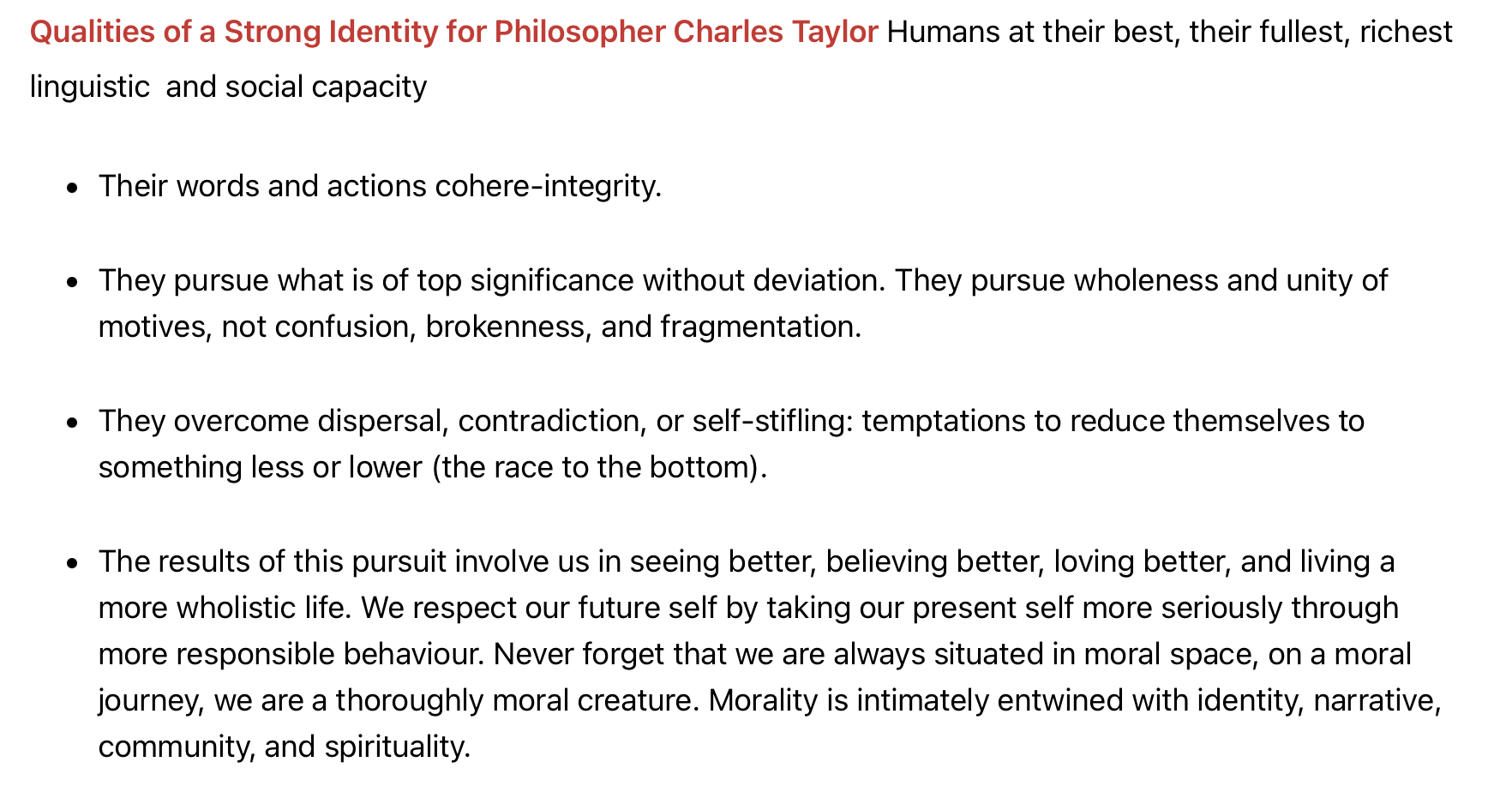
Aside: Throughout this series of posts, The Qualities of Freedom of the Will, we remember that moral frameworks offer cultural escape from devastating, confusing relativism and isolating moral subjectivism, or even dangerous amorality/nihilism/malignant narcissism–>death is the conclusion. Such moral frameworks (including many moral goods) are taken as essential to human wellbeing; their loss entails a personal crisis and possible pathology and breakdown. Language is key to creative, life-giving moral sources; the right words create new worlds. Aristotle wrote: “Humans are animals with logos.” There are three key axes of such moral frameworks: a. The value of human life itself, and the cost or demand that this realization places upon us; b. The quest for a life that is worth living (the Good Life) which permeates our choices and actions; c. The dignity we afford ourselves and others as to our place within the human drama, and our overall contribution to life and culture (our calling). Such constitutive (meta-biological) language speaks of purpose, identity, moral understanding or wisdom. This is the high road of unselfishness (other-orientation) in life of which many heroic individuals speak. We are called to make sense of (interpret) various goods at play in our life story as we move on a trajectory of moral growth (David Brooks), growth in virtue (Mark McMinn). Moral sources contribute strongly to our identity and personal vision: they offer inspiration, imagination, reorientation, even reconfiguration of life. Indeed, what are we humans like at our highest, fullest moral/linguistic capacity? What resonates with our higher self, our house of meaning, the space with less inner conflict?
We are offered a particularly insightful analysis of our current cultural ethos by Emeritus Philosophy Professor Charles Taylor. It arises in his most recent Templeton Prize tome, A Secular Age. (2007).
Late modern philosopher Richard Rorty spoke of Taylor as one the top twelve living philosophers of our day. He captures the way in which we have located ourselves in the late modern world and the picture that has taken our minds captive: he calls it theimmanent frame. This house of the mind and imagination constitutes a unique social imaginary (implicit understanding of the space in which we live) in human history. My focus here will be to exposit the key insights of chapter 15 in A Secular Age. In this critical analysis, he shows how religion along with its high ethics has been philosophically and culturally marginalized in Western culture, even while it is in resurgence. Taylor gives us tough insights and important tools to grapple with these issues. He leads us to think circumspectly about how we have arrived in this cultural space/moment.
The core theme of this landmark book is to study the fate of religious faith in the strong sense in the West, meaning: a. belief in a transcendent reality, and b. the connected aspiration of personal transformation, which goes beyond ordinary human flourishing. He is deconstructing or calling into question the subtraction story within the Western Master Narrative (one deeply embedded in our late modern consciousness), where science replaces religion after Christendom. Within this perspective, the growth of science entails the death of God and the recession of religion. Religion is taken to be replaced by science. But is this a fair claim, is it hermeneutically valid?, Taylor asks. When did science become equivalent to secularism in our minds and why? This is the crux of the investigation.
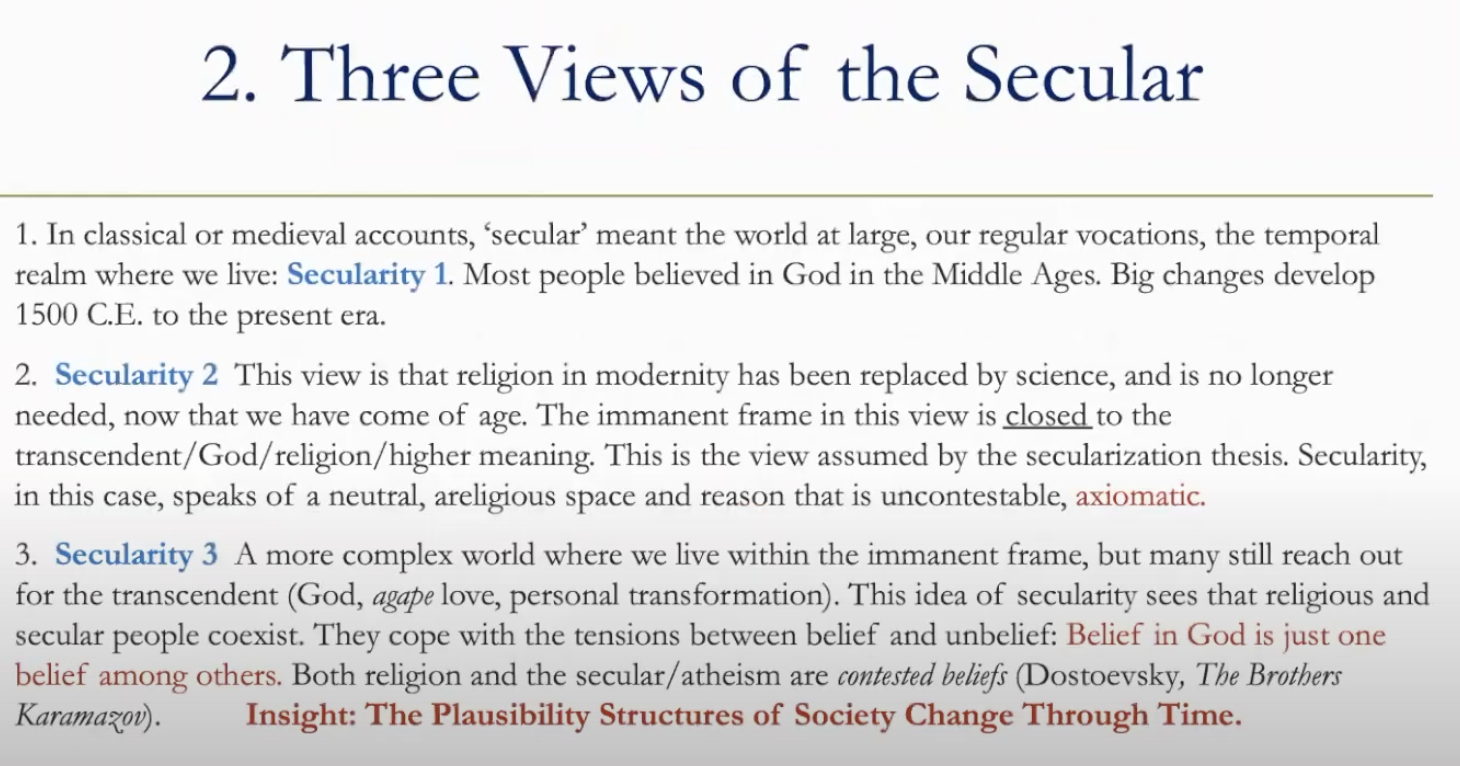
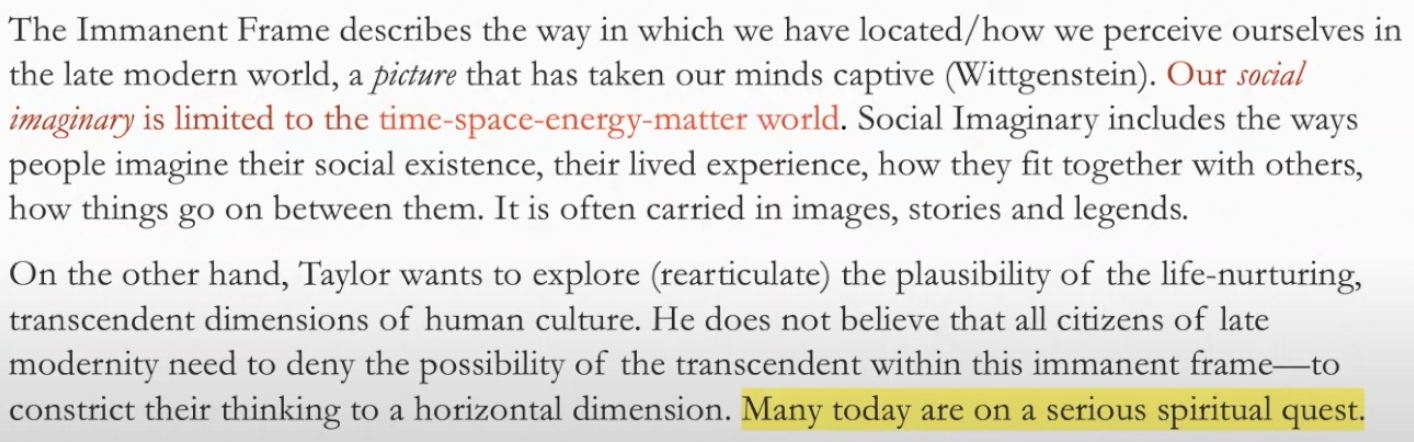
Ultimately, Taylor wants to explore with us the plausibility of the thick, life-nurturing, transcendent dimensions of human culture. He does not believe that all citizens of late modernity need to deny the possibility of the transcendent within this immanent frame, to live within a horizontal/flat dimension only. From his perspective, the story of the rise of modern social spaces doesn’t need to be given an anti-religious spin. The actual reality of Western culture is closer to the truth that “a whole gamut of positions, from the most militant atheism to the most orthodox traditional theisms, passing through every possible position on the way, are represented and defended somewhere in our society” (C. Taylor, 2007, 556). They are defended in various non-neutral contexts, institutions, and communities. This creates for citizens of late modernity the sense of being cross-pressured by the plurality of positions that they encounter in their daily lives. The dialogue and debate of these perceptions is still very robust, with endless potential options to find meaning (the so-called Nova Effect). Actually, he shows that both belief and unbelief in God co-exist within society (secularity 3). Taylor sees three views of the secular to help our discernment.
So, what does Taylor mean by the immanent frame? The bufferedidentity (as opposed to the porous pre-modern self) is a key part of such a mental frame. It operates within a disenchanted world where supernatural beings or forces with teleological goals or intentions are deemed close to impossible (C. Taylor, 2007, 539). Final causes are eliminated from the picture. With this immanent frame, there is a loss of a cosmic order; everything important is this-worldly, explicable on its own terms; it fits within the time-space-energy-matter dimensions. Social and political orders are constructed by humans solely for mutual benefit, not to please a divine entity, or follow a higher good. Society is made up of expressive individuals (the normative element). Each human is charged with finding her or his own way of being human (Nova Effect), their own individual spiritual path. Everyone has also become an individual measure of the good (auto-nomos).
But the immanent frame is by no means ethically neutral or strictly objective. It includes some things (values such as secular time) and excludes others. It renders ‘vertical’ or ‘transcendent’ worlds as either inaccessible or unthinkable. Indeed, it takes a hard moral position, and it operates as a philosophically reductionistic stance (Jeremy Begbie, Abundantly More, 2023). These are strong claims of faith. Taylor refers to this moral position as exclusive humanism (naturalistic materialism). Here’s how he puts the narrative/plausibility structure in a nutshell:
So the buffered identity of the disciplined individual moves in a constructed social space, where instrumental rationality is a key value, and time is pervasively secular. All of this makes up what I want to call “the immanent frame”. There remains to add just one background idea: that this frame constitutes a “natural” order, to be contrasted with a supernatural one, an “immanent” world over against a possible “transcendent” one. (C. Taylor, 2007, 542)
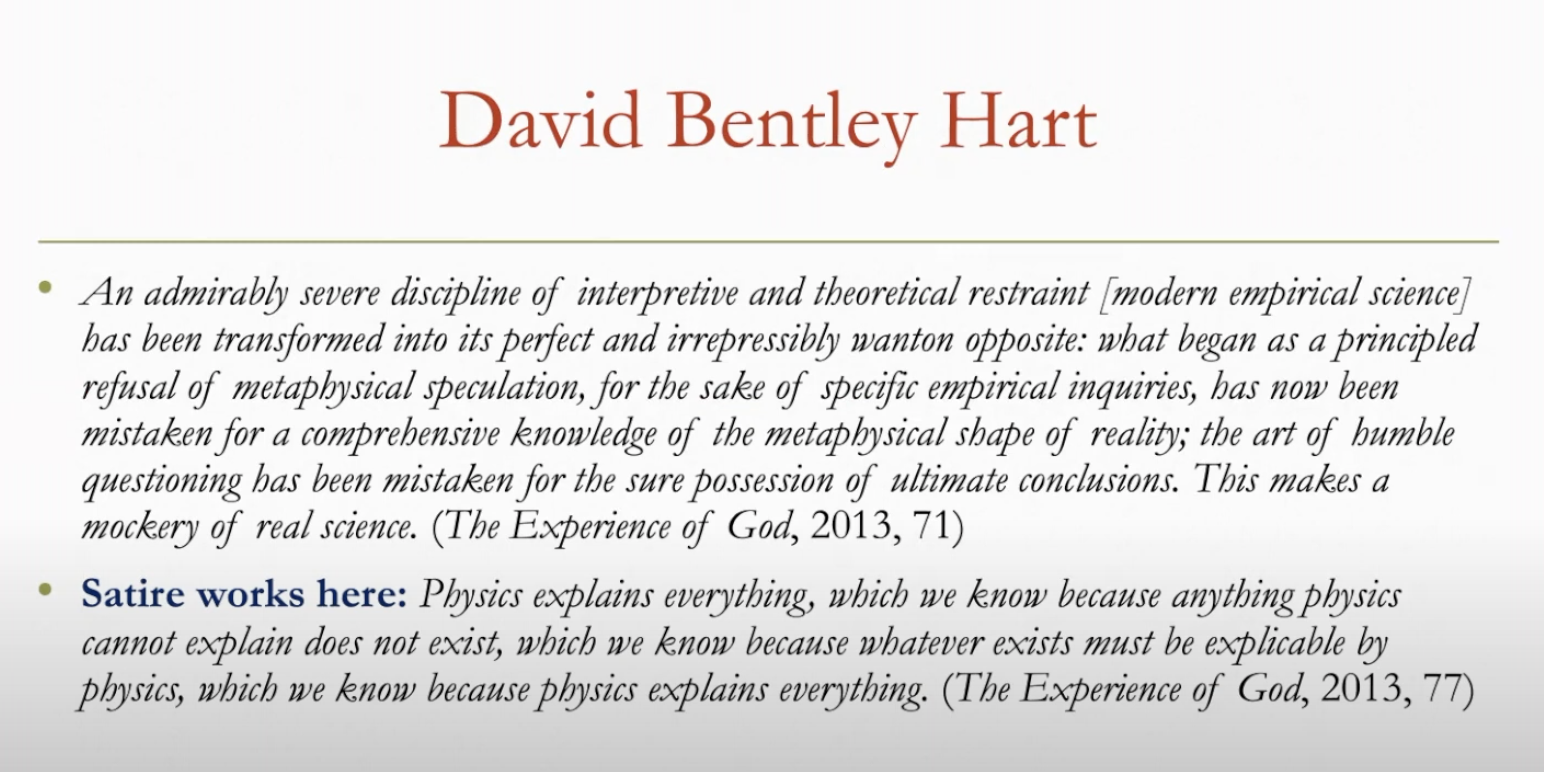
Taylor points out two different ways of seeing the world within this immanent frame, one closed (Closed World System/CWS), and one Open. The individual still does have the choice in late modernity to open themselves to the beyond or the transcendent, that something more (Jeremy Begbie, Abundantly More, 2023). As per Wittgenstein, each is a picture that holds us captive (seems both natural and logically unavoidable). It constitutes the horizon within which we observe, think and reason. But of course, it can black out (make us blind to) certain aspects of reality by the very nature of how it shapes our way of analyzing the world. It restricts our imagination. It involves an unquestioned background, something whose shape is not perceived, but which conditions, largely unnoticed, the way we think, infer, experience, process claims and arguments. For example, a major thesis in modernity is that science must bring secularity in its train, which for Taylor is a non-obvious, unproven, and biased claim (blik). But many of us do believe in the transcendent as a cultural assumption (David Bentley Hart, The Experience of God, 2013). Part One of this book is the most important. More on this later.
From within this mental and emotional picture, it just seems obvious to many who hold it that the order of “the argument proceeds from science to atheism” (C. Taylor, 2007, 565), that modernization brings secularization. The viewpoint is held passionately and defended fiercely. In the nineteenth century, Durkheim and others assumed that science would develop to the point where people no longer need to believe in God or religion. They would graduate from such superstition. This is parallel to the angry rhetoric of the New Atheists today, featured by Richard Dawkins of Oxford. But there is actually a hidden leap of faith in this stance, notes Taylor. It carries with it a false aura that it is obvious, or a logical conclusion. It involves, however, a moral attraction to a materialistic spin on reality, a moral outlook (where God and religion is at the bottom of important things to consider). An alternative viewpoint is expressed in the stories contained within the twelve scintillating stories within Coming to Faith Through Dawkins, edited by Denis Alexander and Alister McGrath (2023). These travellers were once steeped in the discourse of New Atheism, but eventually saw through the contradictions and shallowness in its rhetoric to become sincere believers in Christianity. https://ubcgfcf.com/2024/10/01/denis-alexander-engages-new-atheism/
Moral truths are fully rational, but not proven by science. Science is descriptive but not prescriptive on what one ought to do with respect to another person.
This materialistic bias is not based on scientific facts as such (despite the fact that it takes some of its inspiration from the epistemological success of science). There is a heavy focus on human goods, on human flourishing: rights, welfare, equality, and democracy. Taylor writes:
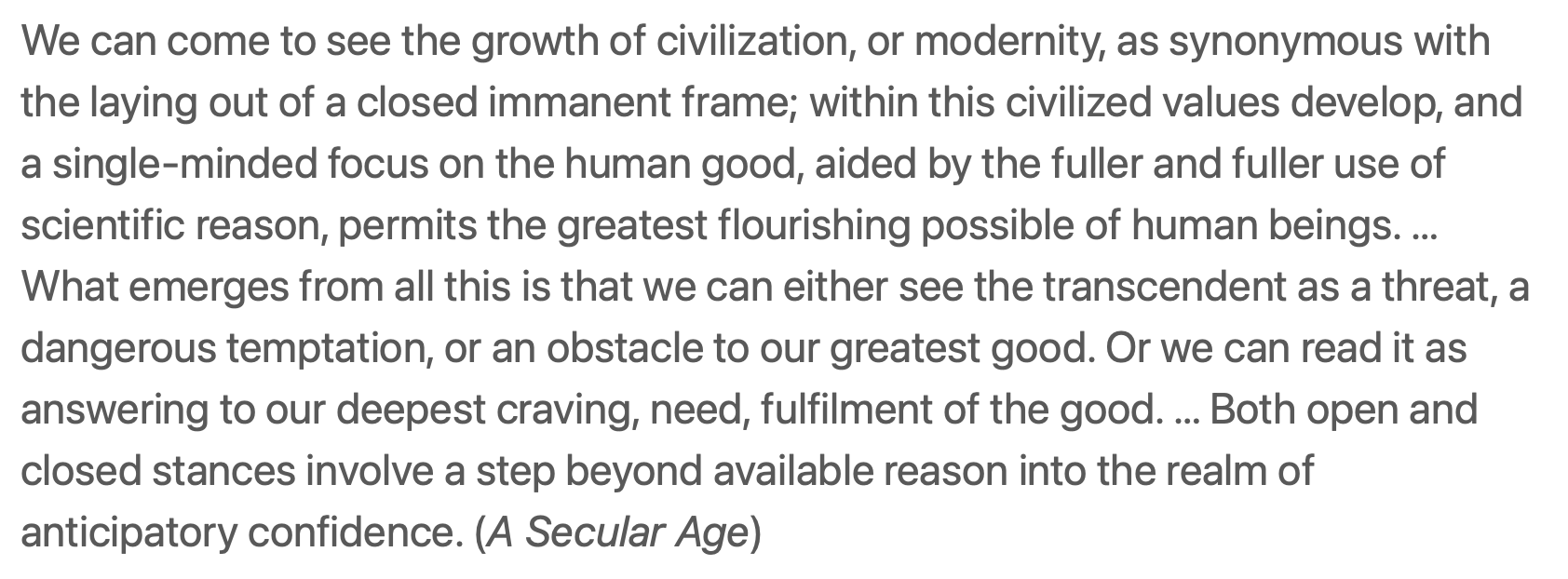
We can come to see the growth of civilization, or modernity, as synonymous with laying out of a closed immanent frame; within this civilized values develop, and a single-minded focus on the human good aided by a fuller and fuller use of scientific reason, permits the greatest flourishing possible of human beings. Religion not only menaces these goals with its fanaticism, but it also undercuts reason, which comes to be seen as rigorously requiring scientific materialism. (C. Taylor, 2007, 548)
As already stated, we currently live in this cross-pressured space of belief and unbelief. Our culture pulls us in both directions: secular and religious. This tension is found in famous writers such as Blake, Goethe, Dostoyevski, or the Polish poet Milosz. The struggle for belief is ongoing, never definitively won or lost today. This is the major theme of the insightful CBC Ideas Series produced by David Cayley called After Atheism. We know of both:
Those who opt for the ordered, impersonal universe, whether in the scientistic-materialistic form, or in a more spiritualized variant, feel the imminent loss of a world of beauty, meaning, warmth, as well as of the perspective of self-transformation beyond the everyday (along with regrets about loss of its positive impact on society and nostalgia for a distant yesterday).
Those whose strongest leanings move them towards at least some search for spiritual meaning, and often towards God. (C. Taylor, 2007, 592-3)
Two Influential Approaches to How We Perceive Reality
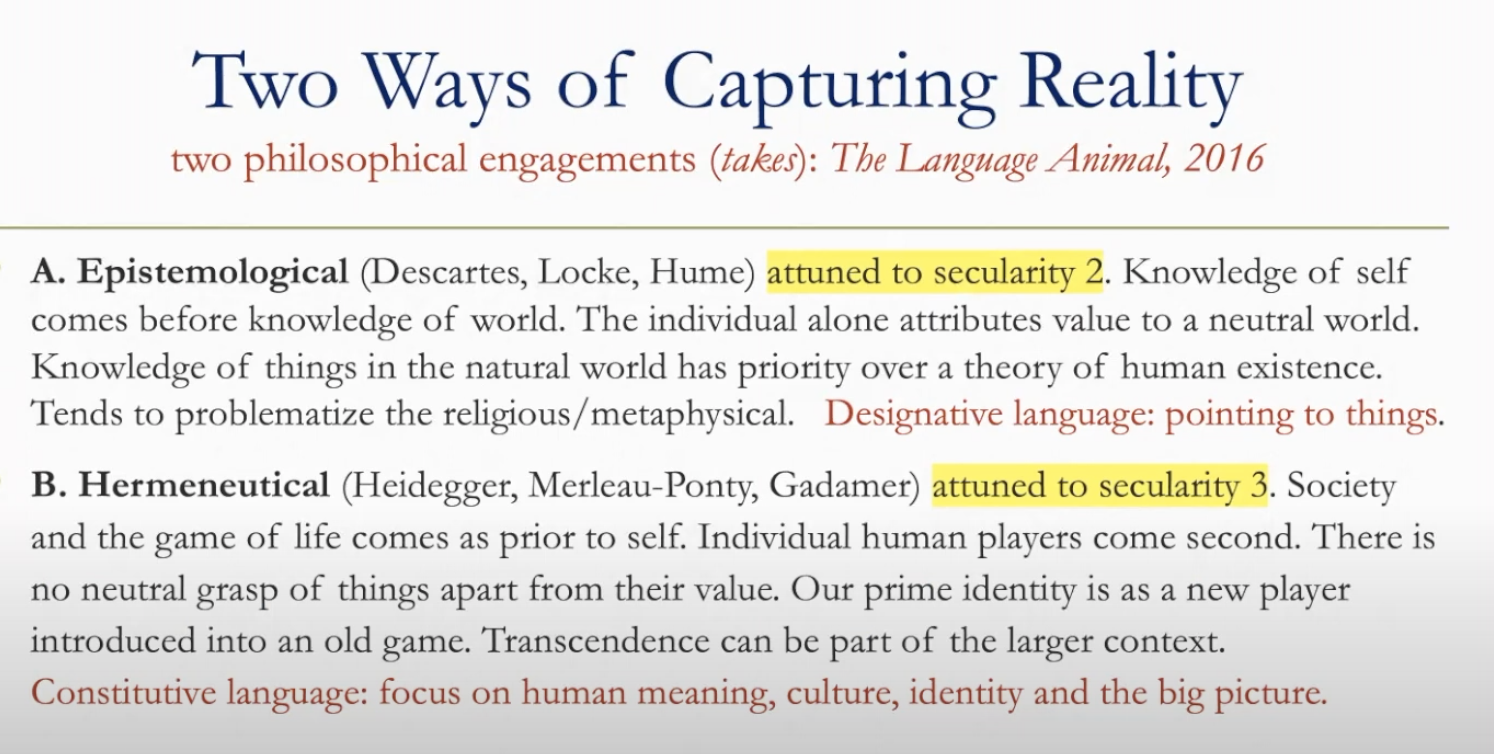
In this light, it is helpful to understand the impact of two distinct ways of engaging the world intellectually and philosophically: aka, epistemological and hermeneutical. I also lay this out in more detail in my earlier 2016 book, The Great Escape from Nihilism: Rediscovering Our Passion in Late Modernity.
1. The Epistemological Approach (tradition of Descartes, Locke, Hume). The set of priority relations within this picture often tends towards a closed world position (CWS). Its assumptions include the following:
Knowledge of self and its status come before knowledge of the world of things and others.
Knowledge of reality is a neutral fact before we (the individual self) attribute value to it.
Knowledge of things of the natural order comes before any theoretical invocations or any transcendence (which is thereby problematized, doubted or repressed). This approach tends to write transcendence out of the equation.
Within this view, the individual and their freedom of choice is primary and certainty is within the mind. The self is an independent, disengaged subject, reflexively controlling its own thought processes self-responsibly. The oft-presumed neutrality of this view is actually false; it is in fact a heavily value-laiden approach. It offers a whole construction of identity and society with distinctive priorities and values.
Materialism/Naturalism as a belief system, in point of fact, is a construction(not arising from science), a story we tell ourselves as late moderns, over and over again, about the entire cosmos and our place within it, our value, identity, trajectory and purpose. Humans have always had a way of placing themselves in the context of the cosmos and time. They have always had a creation narrative. It depends on a certain naturalistic metaphysics or worldview, which was not always as common as it is today. But how plausible is it? Taylor’s contention is that the power of materialism today comes not from scientific “facts”, but has rather to be explained in terms of the power of a certain package uniting materialism with a moral outlook, the package we call “atheistic humanism” or “exclusive humanism” (C.Taylor, 2007, 569). It works off an ontological thesis of materialism: everything which is, is based on “matter”, without explaining why this is taken as true.
Taylor rightly questions whether we are to logically conclude that everything is nothing butmatter (reductionism) and that we should try to define our entire human and natural situation in terms of matter alone. Enlightenment of this sort is a kind of excarnation or out-of-body thinking. The self is radically abstracted from its socio-cultural embodiment and this in turn causes great harm, including an identity crisis. Cambridge theologian and advocate for the arts Jeremy Begbie lays out its reductive pressures clearly and beautifully in Abundantly More.
This approach employs a designative use of language which traps the pursuit of wisdom within language and confines it to immanence, where language and its relationship to truth are reduced to pointing. Language here primarily designates objects in the world. The object is observed, held at arms length, but not participated in. It is impersonal. One assumes a use of language based on quantitative judgments that are non-subject dependant. This tradition also contributes to a mechanistic outlook on the universe, focusing on efficiency. It is committed to the primacy of epistemology (evidence and justified belief). It is not oriented to universals, transcendentals or essences. Taylor unpacks this in a more elaborate fashion in his 2016 tome, The Language Animal, chapters 4 and 5. There is a reduction of language capacity in this philosophical stance.
Ethics from this perspective goes something like this: Once upon a time, human beings took their norms, their goods, their standards of ultimate value from an authority outside themselves; from God, or the gods, or the nature of Being or the cosmos. But then they came to see that these higher authorities were their own fictions, and they realized they had to establish their norms and values for themselves, on their own authority. This is a radicalization of the coming to adulthood story as it figures in the science-driven argument for materialism (aka Scientism). The dramatic claim to establish our own standards comes down to the thought that we no longer receive those norms from an authority outside us, but rather from our own scientific investigations (C. Taylor, 2007, 580). We are, so to speak, morally self-authorized.
Part of this immanent frame Master Narrative is that for proponents of the death of God, they want to see God-absence as a property of the universe which science lays bare. Taylor notes: “It is only within some understanding of agency, in which disengaged scientific inquiry is woven into a story of courageous adulthood, to be attained through a renunciation of the more ‘childish’ comforts in meaning and beatitude, that the death of God story appears obvious” (C. Taylor, 2007, 565). He questions this narrative, this particular secularization thesis, and holds it up for serious scrutiny.
The claim is that religious belief is a childish temptation and a beautiful world, lacking courage to face reality and grow up into a more complex, harsh world. Maturing into adulthood implies leaving faith in God behind. But loss of faith in adulthood is not an obvious fact of observable reality, but a construction of human identity and our place in the world. Taylor questions whether it has a fulsome hermeneutical adequacy. (C. Taylor, 2007, 567). He is not at all convinced that the arguments from natural science to atheism are strong; they seem to include bad reason, inconclusive arguments, and are based on faulty assumptions. David Bentley Hart agrees (The Experience of God). A fair critique of the epistemological approach allows for the emergence of a more robust ethical discourse.
2. The Second Way of Perceiving Reality: the Hermeneutical Approach (tradition of Heidegger, Merleau-Ponty, Gadamer). Taylor relays that it was a revelation for him to pick up on phenomenology philosophers like Merleau-Ponty. Note also Jens Zimmermann’s hermeneutical analysis in his Hermeneutics: A Very Short Introduction (OUP 2015). One could also draw on the brilliant Anthony Thiselton, a specialist on Gadamer. The language game is Constitutive (C. Taylor, The Language Animal, 2016, chapters 6 & 7). The presuppositions of the hermeneutical approach are:
a. Self is not the first priority; the world, society and the game of life come first. We only have knowledge as agents coping with the world, and it makes no sense to doubt that world.
b. There is no priority of a neutral grasp of things over and above their value.
c. Our primordial identity is as a new player inducted into an old game.
d. Transcendence or the divine horizon is a possible larger context of this game (radical skepticism is not as strong). There is a smaller likelihood of a closed world system (CWS) view in the hermeneutical approach to the world. In a sense, it is a more humble and nuanced view. It is open to larger horizons.
Within this view, therefore, one is not so boxed in regarding the parameters of thinking. Within this Open Immanent Frame, certain hard features of the first approach to reality can be deconstructed and the weakness of such features exposed. Enlightenment could and does mean an engaging belief in God for millions if not billions around the world in late modernity. The first view is definitely a more restrictive possibility for making sense of the world. Thomas Nagel questions its reductionism in making sense of consciousness, purpose or teleology and moral value (Mind & Cosmos). We may well ask: Is it actually a progressive environment for thought, or is it intellectually stifling? I propose that one gets more purchase from the hermeneutical approach, especially as one moves beyond the very restrictive purview of science itself. At the end of the day, science the methodology was never meant to be turned into an ontology (reductive materialism). David Bentley Hart offers an amazing follow through from this discussion and helps late modern culture avoid implosion into nihilsim through circular reasoning (see above quote). John Milbank also suggests this point in his Theology and Social Theory.
Some Reflective Conclusions
This discussion on secularity and the immanent frame has been quite revealing regarding the background of our thinking, how we infer, experience, and process claims and arguments–including our biases. Despite the existence of closed versions of the immanent frame, Taylor claims that we are in pursuit of more spirituality today than ever (Nova Effect). We are all quite religious in our own way. This is partly a reaction to the reductionism and stifling nature of contemporary nihilisms and posthumanism, the dangers of lost dignity to being human, even dire threats to human rights. He believes, as does William T. Cavanaugh in The Uses of Idolatry (2024), that human beings are religious animals all the way down. Taylor brings an indictment to the Closed Immanent Frame which harmfully eclipses dialogue about other significant dimensions of reality. It renders us inarticulate, or autistic, concerning very pertinent matters, robbing us of our fullest language capacity (C. Taylor, The Language Animal, 2016). Religion and belief in God have a very significant role to play in ethics, culture, and in late modern society. This is recognized by many intellectuals and regular people, even though contested by others. But in fact, secularity 2 is also a contested stance, involving much faith; it cannot be proven. Taylor has exposed the myth of secularity 2, and deconstructed the subtraction story that science has replaced religion in the contemporary world. Science is a good and fruitful, but limited, epistemological approach to reality. But it is pathetic and weak as a worldview. This makes room for the recovery of ethics that is connected to strong transcendence. At the end of Sources of the Self, Taylor suggests that there is a possibility of a transcendent turn towards the very profound, identity-enriching agape love.
A Critical Point of Application: In our globalized world, given the huge military, technological, and environmental challenges of our day, massive kleptocracy, leader idolatry and corruption, the very survival of our species depends on the imperative of a fresh vision of how we can live together wisely, honestly, fairly, and peacefully. We need deep solutions to contemporary problems and threats to human wellbeing. We need to find ways of coming together in mutual benevolence.
Roger Scrutin Muses on Virtue, Freedom, and Accountability
Virtue consists in the ability take full responsibility for one’s acts, intentions, and avowals, in the face of all the motives for renouncing or denouncing them. It is the ability to retain and sustain the first-personal centre of one’s life and emotions, in the face of decentering temptations with which we are surrounded and which reflect the fact that we are human beings, with animal fears and appetites, and not transcendental subjects, motivated by reason alone….. Virtues are dispositions that we praise, and their absence is the object of shame…. It is through virtue that our actions and emotions remain centred in the self, and vice means the decentering of action and emotion…. Vice is literally a loss of self-control, and the vicious person is the one on whom we cannot rely in matters of obligation and commitment…. Freedom and accountability are co-extensive in the human agent…. Freedom and community are linked by their very nature, and the truly free being is always taking account of others in order to coordinate his or her presence with theirs…. We need the virtues that transfer our motives from the animal to the personal centre of our being–the virtues that put us in charge of our passions [because] we exist within a tightly woven social context. Human beings find their fulfilment in mutual love and self-giving, but they get to this point via a long path of self-development, in which imitation, obedience and self-control are necessary moments….. Let’s put virtue and good habits back at the centre of personal life.” (R. Scrutin, On Human Nature, 100, 103, 104, 111, 112)
Sittlichkeit is the German word (Hegel) for the concept of the ethical life or ethical order. There is family life, civic society, state laws, community laws, strata laws. Ethical behaviour is grounded in customs and traditions; it is developed through habit and imitation in accord with the objective laws of the community. This is what we call healthy normativity. The question today is whether we are losing this sense of normativity, groundedness, and balance in an age of deconstruction and revolution–late modernity. I recently heard a Harvard professor of European Law intensely focused on deconstruction, but with no alternative to replace it. Our response to the ethos of our age is of highest importance if we want to preserve what is good, wise, true, and beautiful. Listen to Justin Brierly on The Surprising Rebirth of Belief in God: https://open.spotify.com/show/7lovL2tXCyAGkbWZM9F9hg?si=PGZddmZZSLyv5REMaLIZ7g
~Dr. Gordon E. Carkner PhD, Author, Blogger, YouTube Webinar Producer, Meta-Educator with UBC Postgraduate Students




 ubcgcu
Leave a comment