Posted by: gcarkner | February 22, 2020

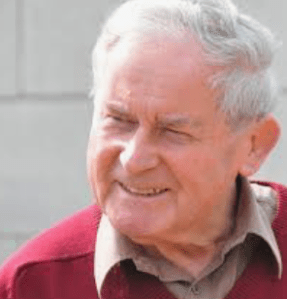
Dr. Raymond Aldred on Truth and Reconciliation

Meeting Postponed Until Further Notice due to Covid-19 Safety Concerns

Samples of Ray’s Perspective from YouTube

Abstract

In the wake of the Truth and Reconciliation Commission report on residential schools, Canadians have often viewed Christianity as the enemy of Indigenous people. But there is another side to the story, claims Professor Raymond Aldred. Almost two-thirds of Indigenous people in Canada actually call themselves Christian and appreciate what they have learned from Christian leadership over the years. Aldred notes that there is currently real hope for a better day, a way forward for our Indigenous people. This hope begins in community, in rethinking our identity, who we are and where we have come from. In this address, he will show the need to tell the truth and use human imagination to heal relationships with the land/creation, with family, clan and community, and with the Creator. At the heart of Indigenous peoples’ quest for healing is a shift in identity from shame to dignity of heritage. Mohawk writer Patricia Monture notes that key to this shift is a decision to take responsibility for all relationships, “Responsibility is at the heart of Indigenous freedom and self-determination.” We must strive to live in harmony with all things and all peoples, including the new visitors. We also wish to heal our treaty covenant relationships: through the threefold strategy of telling the truth, listening to one another, and seeking a common plan to repair the damage of abuse. Employing the principles of restorative justice, the difficult task of retelling our stories offers an important, creative way forward. These stories help us revisit the pain, face reality, and rediscover the good roots of our heritage. These vital steps constitute the effective direction of hope, as Ray has discovered through much experience.


Biography

Reverend Dr. Raymond C. Aldred holds a Master of Divinity from Canadian Theological Seminary,  and a Doctor of Theology from Wycliffe College, Toronto School of Theology. Currently, he is the Director of the Indigenous Studies Program, whose mission is to partner with the Indigenous Church around theological education. He is professor of Theology: Narrative, Systematic, Indigenous at the Vancouver School of Theology on the UBC campus. A status Cree, he is ordained with the Christian and Missionary Alliance Church in Canada. Born in Northern Alberta, he now resides with his wife in Richmond. Formerly Ray served as the Assistant Professor of Theology at Ambrose Seminary in Calgary, Alberta. He is former Director for the First Nations Alliance Churches of Canada, now a committee member, where he works to encourage Indigenous churches. Ray also has had the privilege of addressing several college conferences and meetings to raise awareness of these issues. He and his wife, Elaine, are involved in ministry to help train people to facilitate support groups for people who have suffered abuse.

Posted by: gcarkner | February 5, 2020

Sources of Identity: Thomas Merton

From: Seeds of Contemplation by Thomas Merton

Screen Shot 2020-02-05 at 9.43.00 AM

In all the situations of life, the “will of God” comes to us not merely as an external dictate of impersonal law but above all as an interior invitation of personal love. (15)

We must learn to realize that the love of God seeks us in every situation, and seeks our good. His inscrutable love seeks our awakening. (15)

Our vocation is not simply to be, but to work together with God in the creation of our own life, our own identity, our own destiny…. We are even called to share with God’s work of creating the truth of our identity….. To work out our own identity in God, which the Bible calls “working out our salvation,” is a labor that requires sacrifice and anguish, risk and many tears. It demands close attention to reality at every moment, and great fidelity to God as he reveals himself, obscurely, in the mystery of each new situation. (32)

The secret of my full identity is hidden in Him. He alone can make me who I am, or rather who I will be when at last I fully begin to be. But unless I desire this identity and work to find it with Him and in Him, the work will never be done…. Not to accept and love and do God’s will is to refuse the fullness of my existence. (33)

To say I was born in sin is to say I came into the world with a false self…. My false and private self is the one who wants to exist outside God’s will and God’s love—outside of reality  and outside of life. And such a self cannot help be but an illusion…. The secret of my identity is hidden in the love and mercy of God…. Ultimately, the only way I can be myself is to become identified with him in whom is hidden the reason and fulfilment of my existence. (33-35)

The true inner self must be drawn up like a jewel from the bottom of the sea, rescued from confusion, from indistinction, from immersion in the common, the nondescript, the trivial, the sordid, the evanescent. (38)

People who know nothing of God and whose lives are centered on themselves, imagine that they can only find themselves by asserting their own desires and ambitions and appetites in a struggle with the rest of the world. (47)

To say that I am made in the image of God is to say that love is the reason for my existence, for God is love. Love is my true identity. Selflessness is my true self. Love is my true character. Love is my name. If, therefore, I do anything or think anything or say anything or know anything that is not purely for the love of God, it cannot give me peace, or rest, or fulfilment, or joy. To find love I must enter into the sanctuary where it is hidden, which is the mystery of God. And to enter into his sanctity I must become holy as he is holy, perfect as he is perfect. (60, 61)

I who am without love cannot become love unless Love identifies me with himself. But if he sends his own love, himself, to act and love in me and in all that I do, then I shall be transformed, I shall discover who I am and shall possess my true identity by losing myself in Him. (63)

Posted by: gcarkner | January 31, 2020

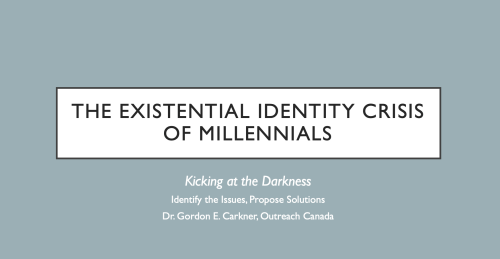
Existential Identity Crisis of Millennials

__________________

Millennials are claiming that life is hard and often exhausting. Life today is like climbing a bare rock face, without instruction or ropes, as per this young man at Joshua Tree National Park in California. The feel vexed by self-worth issues and deeply lonely, even though they are heavily networked on social media. They are overwhelmed with diversity and pluralism and are crying out for mentorship and guidance (discernment) as to how to do life in a high tech age, one which overwhelms them with far too much information to process.  They also long for orientation, inspiration and transformation, personal growth and meaning. This talk attempts to map some of the Millennial burdens/struggles (the clouds or vexing problems and addictions that hover over them) and offers a trajectory for solutions, actions and engagement towards a more resilient, healthy identity growth, a more mature diversity. It shows an exit from our contemporary existential despair or dread that Kierkegaard opined about, and helps point the way to recovery.

~Dr. Gordon E. Carkner, Meta-Educator with UBC Postgrad students. Author; Blogger; YouTube Webinar Producer.

See also on topic of identity James K.A. Smith, You Are What You Love.

Faithful Presence: I have argued that there is a different foundation for reality and thus a different kind of binding commitment symbolized most powerfully in the incarnation. The incarnation represents an alternative way by which word and world come together. It is in the incarnation and the particular way the Word became incarnate in Jesus Christ that we find the only adequate reply to the challenges of dissolution and difference. If, indeed, there is a hope or an imaginable prospect for human flourishing in the contemporary world, it begins when the Word of shalom becomes flesh in us and is enacted through us toward those with  whom  we live, in the tasks we are given, and in the spheres of influence in which we operate. When the Word of all flourishing—defined by the love of Christ—becomes flesh in us, in our relations with others, within the tasks we are given, and within our spheres of influence—absence gives way to presence, and the word we speak to each other and to the world becomes authentic and trustworthy. This is the heart of the theology of faithful presence.

~from James Davison Hunter, To Change the World: the irony, tragedy and possibility of Christianity in the late modern world. OUP, 2010.

Posted by: gcarkner | January 20, 2020

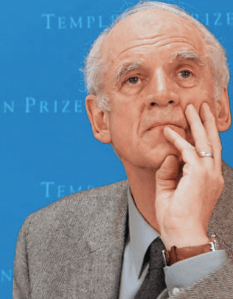
Charles Taylor and the Modern Quest for Identity

Charles Taylor and the Modern Quest for Identity: Dialogue on a Great Mind

Dr. Gordon E. Carkner &  Dr. Marvin McDonald

4:00 pm, Wednesday, January 22, 2020

______________________

Dr. Carkner

 https://www.youtube.com/watch?v=DfMHXFjEXys 

____________________


Question Period

Abstract 

Pre-eminent McGill University Emeritus Philosopher Charles Taylor is an iconic international scholar in the field of the late modern self. His critical thinking bridges Continental and Anglo-American thought. Millennials are currently facing a significant existential identity struggle and Taylor’s work can help.

Dr. Carkner will trace the contribution of Charles Taylor on the question of identity, drawing on his three major tomes: Sources of the Self(1989); A Secular Age (2007); The Language Animal (2016). Throughout his work, Taylor offers a highly sophisticated approach; he helps the individual to develop a strong consciousness that avoids identity crisis and collapse of meaning, with its accompanying anxiety (angst). For the reflective person, he believes that identity, morality and spirituality are inescapably interwoven. But the quest for identity also involves a quest to recover lost or repressed human language capacity—in particular, constitutive language. This recovery can open whole new worlds for Millennials and others as they wrestle with identity and purpose. In The Language Animal, Taylor reveals the various contours of language necessary for this recovery of a robust identity. Significant to this perspective are the moral sources within one’s moral framework that are discovered through building a relationship to the good.  The best account of life makes sense of these moral sources of metabiological (human) meaning. Taylor notes that as we grow morally, our maturing meanings involve us in “seeing better, believing better and ultimately living better”. Dr. Carkner will apply these insights to one current existential dilemma in the West, the crisis of affirmation.

Dr. McDonald will focus on the application of Taylor’s idea of moral footing and its implications for dialogue across difference within the celebrated Canadian cultural mosaic. He will show how this insight applies, with special reference to the Gerard Bouchard-Charles Taylor Commission Report of 2008 called “Building the Future: a Time for Reconciliation.” https://www.cpac.ca/en/programs/public-record/episodes/14595692/ Taylor gives us deep insight into this dynamic identity question. It is critical for fruitful dialogue and bridging between groups who represent diversity to each other. Discernment is required for mature integration. What is the respect and dignity that is due others? What will it cost us and how will it benefit all concerned? Taylor’s astute understanding increases our ability to reframe this important discussion.

Biographies

Gordon E. Carkner holds a PhD in philosophy of late modern culture from University of Wales, UK (2006). His dissertation is entitled “A Critical Examination of Michel Foucault’s Concept of Moral Self-Constitution in Dialogue with Charles Taylor.” He has been invested in the work of Charles Taylor for over two decades. His own writing and research interacts regularly with the Taylor’s thought including the 2016 publication, The Great Escape from Nihilism: Rediscovering Our Passion in Late Modernity, a critique of Western culture which analyses the quest for identity. In the context of the UBC’s Graduate Christian Union and The Forum, Gordon  is passionate about questions of meaning and identity, faith and culture, science and religion. His work as a chaplain and meta-educator helps to shape young leaders for a strong future contribution. He offers graduate students extracurricular space to reflect on their work and their lives at UBC, feeding them targeted resources and faculty support. His research interests are in the area of freedom, identity and the moral good, secularity and philosophical anthropology.

Marvin McDonald is a professional psychologist, Associate Professor of Counselling Psychology and he also teaches in the Gender Studies Program at Trinity Western University. He directed the MA in Counselling Psychology during 2001-2017. He is a writer whose work engages theoretical psychology and positive psychology. A gracious interlocutor, Marvin loves dialogue across worldview perspectives. He believes in a creative interface between philosophy and psychology, and articulates responses to his graduate student inquiries from a vast landscape of knowledge and insight. https://www.twu.ca/profile/marvin-mcdonald

__________________________
Posted by: gcarkner | January 9, 2020

Provocative Quotes on Identity from Charles Taylor

Provocative Quotes from Charles Taylor on Language, Morality and Identity

A society of self-fulfillers, whose affiliations are more tentative, revocable (without covenant) and mobile, cannot sustain a strong identification with community.

[M]y discovering my own identity doesn’t mean that I work it out in isolation, but that I negotiate it through dialogue, partly overt, partly internal, with others. We define our identity always in dialogue with, sometimes in struggle against, the things our significant others want to see in us. Even after we outgrow some of these others—our parents, for instance—and they disappear from our lives, the conversation with them continues within us as long as we live.

To know who I am is a species of knowing where I stand. My identity is defined by the commitments and identifications which provide the frame or horizon within which I can try to determine from case to case what is good, or valuable, or what ought to be done, or what I endorse or oppose. In other words, it is the horizon within which I am capable of taking a stand. (Sources of the Self)

I want to defend the strong thesis that doing without moral frameworks is utterly impossible for us; otherwise put, that the horizons within which we live our lives and which make sense of them have to include these strong qualitative discriminations. Moreover, this is not meant just as a contingently true psychological fact about human beings … Rather the claim is that living within such strongly qualified horizons is constitutive of human agency, that stepping outside these limits would be tantamount to stepping outside what we would recognize as integral, that is, undamaged human personhood. (Sources of the Self)

Our language has lost its constitutive power. This means that we can deal instrumentally with realities around us, but their deeper meaning (the background in which they exist), the higher reality which finds expression in them, is ignored and often invisible to us. Our language has lost the power to Name things in their embedding, their deeper, richer and higher reality. The current incapacity of language is a crucial factor in our incapacity of seeing well and impacts our flourishing. Our language, our vision and our lives often remain flattened in late modernity. (A Secular Age)

We become full human agents, capable of understanding ourselves, and hence of defining our identity, through our acquisition of rich human languages of expression. (The Language Animal)

Language changes our world, introducing new meaning into our lives, open to the domain it encodes. Language doesn’t simply map our world but creates it. (The Language Animal)

We can come to see the growth of civilization, or modernity, as synonymous with the laying out of a closed immanent frame; within this civilized values develop, and a single-minded focus on the human good, aided by the fuller and fuller use of scientific reason, permits the greatest flourishing possible of human beings. … What emerges from all this is that we can either see the transcendent as a threat, a dangerous temptation, or an obstacle to our greatest good. Or we can read it as answering to our deepest craving, need, fulfilment of the good. … Both open and closed stances involve a step beyond available reason into the realm of anticipatory confidence. (A Secular Age)

Constitutive language can open new spaces for human meanings and identity: new terms, new expressions, enactments, new fields of articulacy and how to recognize and bring to expression new domains of meaning. The disciplined languages of objective description suitable for science are comparatively late achievements of human culture.  In light of all this, it is clear that the regimented, scientific zone can only be a suburb of the vast, sprawling city of language, and could never be the metropolis itself.  (The Language Animal)

Language can only be understood if we understand its constitutive role in human life…. Language is the domain of right and wrong motives. (The Language Animal)

We make these meanings exist for us by enacting them, then expressing them, naming them, critically examining them, arguing about them, fighting (sometimes) about them.  (The Language Animal)

Hermeneutics (interpretation) helps us make sense of human actions and reactions, responses and attitudes, behavioural causes and effects. This kind of reflection makes these humanly understandable, graspable and palpable or real for us. Such interpretation of self happens against the backdrop of a whole “landscape of meaning” within which an agent operates. This includes a whole constellation of motives, norms and virtues. Such packages of interpretation are rooted in an overall philosophical anthropology. This process of searching for coherence within ourselves, within our moral framework, is essential to a healthy, robust identity and essential to our own integrity. Whatever meaning we attribute to the part has to make sense within the whole, whose meaning it also helps to determine. (The Language Animal)

Our moral reactions have two facets … On the one side, they are almost like instincts, comparable to our love of sweet things, or our aversion to nauseous substances … on the other, they seem to involve claims, implicit or explicit, about the nature and status of human beings. From the second side, a moral reaction is an assent to, an affirmation of a given ontology of the human … The whole way in which we think, reason, argue, and question ourselves about morality supposes that our moral reactions have these two sides: that they are not only “gut” feelings but also implicit acknowledgments of claims concerning the objects. (Sources of the Self)

The best account of morality must be one that incorporates the fact that individuals experience goods as being worthy of their admiration and respect for reasons that do not depend on their choice of them. Beginning with humans and the way they experience morality, Taylor claims that the most plausible explanation of morality is one that takes seriously humans’ perception of the independence of the goods. (Sources of the Self)

We generally reproduce the society in which we are brought up because we have been trained in certain “habituses”, which are not at all stereotyped reactions, but flexible modes of improvisation. A habitus is basically the reembodied sensibility which makes possible structured improvisation. To take on a habitus  is to embody certain social meanings. (The Language Animal)

I want to claim that a complex of key human phenomena, norms, footings, institutions, social orders, political structures and the offices that figure in them are constituted and transformed in discourse, often in rhetorical speech acts which purport to refer to established values, or invoke existing structures, but which in fact bootstrap [such values]…. The animals were indeed there before their names were ever uttered, but the language we have to describe the political life of Athens is the precipitate of  the constitutive discourse in which this life came to be. (The Language Animal)

Stories give us an understanding of life, people, and what happens to them which is peculiar (i.e., distinct from what other forms, like works of science and philosophy, can give us), and also unsubstitutable…. It is through story that we find or devise ways of living bearably in time…. We must have a take on reality and what constitutes progress, or we entertain an identity crisis…. How I tell my story defines my identity, which is central to being a self.  Each of us has an inner biographer—linking past, present and future mental states. This kind of temporal (diachronic) mapping is essential to a healthy identity…. It is imperative that I care about my future self as much as my present self…. As we grow morally, our maturing meanings involve us in seeing better, believing better and ultimately living better. (The Language Animal)
______________________
God’s love is one active contemporary source of the good, the love of which has empowered people to do the good and exemplify the good in their character, social life and politics. Taylor suggests that to avoid nihilism, we need a transcendent turn to avoid the extremes of self-hatred, guilt and shame; or alternatively the extremity of hating morality itself—spiritual lobotomy. The transcendent turn to agape becomes vital: “The only way to escape fully the draw toward violence”, he writes, “lies somewhere in the turn to transcendence—that is, through the full-hearted love of some good beyond life” (Taylor, A Catholic Modernity?, 1999, 28).
Diversity Skill Set & Wisdom for Dialogue
  • Able to pursue ideas amidst diversity and think for yourself.
  • Champion a continual search for the truth, and disagreement with lies and deception, propaganda, poor scholarship.
  • Beware: too much choice can be harmful to one’s psychological and sociological wellbeing.
  • Don’t buy into relativism or subjectivism/solipsism (unfortunately, 70% of Canadians do just that). It cannot be lived well, is definitely not good for human flourishing.
  • Remember that your personal opinion might be poorly examined and ill-informed, weak empirically, bigoted or seriously biased.
  • Celebrate high values/virtues/ideals: honesty, trustworthiness, humility, compassion, decency, respect for life, good environmental stewardship, taking responsibility for your behaviour and for others (inclusive humanism).
  • Shun dishonesty, cheating, abuse, exploitation, theft, fraud, plagiarism, things causing emotional pain and suffering to others, the not-so-good or dark side of human character.
  • Ask yourself what leads to a truly good life?
  • Learn to distinguish between good, better, best decisions. Not all theories or worldviews are of equal value. There is a hierarchy among the moral goods.
  • Think about the consequences of your actions and decisions, including the unintended ones.
___________________________

Charles Taylor’s Moral Ontology of Frameworks:  Taylor’s Moral Ontology.current

Posted by: gcarkner | December 16, 2019

Advent Reflections 2019

 Everything is New in 2020 in Light of the Incarnation

He Comes, God is Coming, Can’t You Feel It?

God’s word of love becomes flesh in us, is embodied in us, is enacted through us and in doing so, trust is forged between word spoken and the reality of which it speaks, between the words we speak and transcendent realities to which we point. The Word became flesh … a human life … a work of art … shaping a new humanism … a new community … a new social imaginary. Integrity is his name. God with us is the hope of a new creation, a new covenant, new purpose, abundant new life.

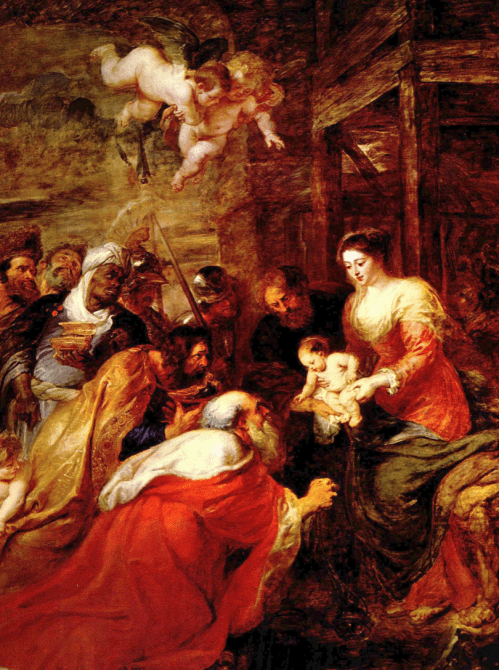
Peter Paul Rubens, Adoration of the Magi (1609-1629) Photo: Wikimedia Commons


At just the right time, it was kairos time, richer, deeper, more meaningful than any chronological time. He comes to dwell among us in incarnate human flesh: pulsating corpuscles, arms and legs running to greet us, face filled with compassion, hands breaking bread to feed the masses, words that give life and vision, fuel the imagination about justice, righteousness and passion. Here lies the great invitation to counter nihilism, violence, lies, will to power.

The season of Advent means there is something on the horizon the likes of which we have never seen before…. What is possible is to not see it, to miss it, to turn just as it brushes past you. And you begin to grasp what it was you missed, like Moses in the cleft of the rock, watching God’s [back] fade in the distance. So stay. Sit. Linger. Tarry. Ponder. Wait. Behold. Wonder. There will be time enough for running. For rushing. For worrying. For pushing. For now, stay. Wait. Something is on the horizon. (Jan L. Richardson, Night Visions: Searching the Shadows of Advent and Christmas)

It is high time to slow down and search the deeper things of life, reach higher than ever before for a transcendent I-Thou encounter with divine Otherness. It is time to ponder the big questions of meaning, purpose and identity as the profound light from heaven dispels darkness and confronts evil. Indeed, there is more here than meets the eye, and there is plenty of wonder that captivates. Where are our best philosophers, historians and scholars, poets and scientists? What say they about the dramatic Christ event? There are clues to a great turn in history: both fulfilment and promise. What kind of thunderous inbreaking is this? What’s the meaning of this virgin birth, this epiphany of grace, these angelic visitations? Advent is a sign of good things to come for Mary, for the Jewish people, for the whole world. It speaks of infinite hope.

We have touched him with our hands, rubbed shoulders, gone for long walks, felt his robust embrace, dined and broken bread together, heard wisdom from his lips that set our minds and hearts on fire. We have been embraced by his care and inclusion. We have captured a mission that drove us to reach the world. It was a compelling message of dikaiosune justice, caritas grace and agape love, one that drills down deep into human culture. Deep calls to deep. We saw him die and rise again, ascend through the heavens. He has inaugurated an economy of grace and goodness, humility and compassion.

Read More…

Posted by: gcarkner | December 5, 2019

Epiphanic Encounters


Mary Encounters the Wholly Other

Luke 1: 26-56

Epiphanies are suggestive of transcendence. Michael Morgan (1994, pp. 56f)) points out that Charles Taylor sees a parallel between the epiphanies of art and poetry in the nineteenth and twentieth centuries and the I-Thou epiphany of religious encounter with the divine. Taylor elaborates the idea of epiphanies (1989, pp. 419f, especially 490-93). He sees Post-Romantic and modernist art as oriented to epiphanies, episodes of realization, revelation, or disclosure. Epiphanies and epiphanic art are about a kind of transcendence, about the self coming in touch with that which lies beyond it, a ground or qualitative pre-eminence. One might call it a gift of the imagination or a re-enchantment of reality.

Taylor reviews various ways of articulating epiphany in Sources of the Self (1989, pp. 419-93). He articulates how God, inserted into this idea of epiphany, fits as a moral source (Sources of the Self, pp. 449-52). Epiphanies can be a way of connecting with spiritual and moral sources through the exercise of the creative imagination: sources may be divine (Taylor), or in the world or nature (Romantics like Thoreau), or in the powers of the imaginative, expressive self (Michel Foucault).

These epiphanies are a paradigm case of what Taylor calls recovering contact with moral sources. A special case of this renewal of relationship between the self and the moral source is religion and the relation to God, which he sees in the work of Dostoyevski. The relationship to art parallels the relationship to religion. The self is oriented in the presence of the inaccessible or sublime, that which captures one’s amazement or awe, for example, when one’s eyes are riveted to a certain painting like Monet’s Lillies, and one’s inner emotions are deeply moved by a poem. One is taken beyond oneself, in an experience of transcendence; the experience involves both elements of encounter and revelation. It can come in a discovery such as finding out the chemicals in our bodies were once part of the death of a star; we are stardust, embedded in creation itself; we owe the stars our very life.

When Mary hears from an angel that she is to become the vessel of a most profound turn of events in history, she is in awe, overwhelmed. It is truly an epiphany, an I-Thou encounter with radical alterity. Heaven and earth reach out to each other at this juncture and something dramatic occurs. This news changes everything. Time stands still in this kairos moment. She allows transcendence and immanence to intermingle within her body, her life. Mary’s story is punctuated by the incursion of the eternal into the temporal, informed by the descent of transcendence into a historical teenager’s life. We know it as the incarnation. D. Steven Long writes in Speaking of God (309): “The purpose of the church is to recognize and acknowledge those conditions by which we can, like Mary, say yes to God and in so doing make Jesus present to the world. Those conditions are the way of holiness and that assumes the transcendentals—truth, goodness and beauty.”

Read More…

Posted by: gcarkner | November 28, 2019

Christmas Reading Suggestions


The God Who Plays by Brian Edgar

The True Story of Canadian Human Trafficking by Paul Boge

Postcards from the Middle East by Chris Naylor

All the Light We Do Not See by Anthony Doerr

Christ the Heart of Creation by Rowan Williams

On the Road With Saint Augustine by James K.A. Smith

The Runes of Evolution: How the Universe Became Self-Aware by Simon Conway Morris

The Psalms as Christmas Praise by Bruce Waltke & James Houston

The New Testament in its World by N.T. Wight and Michael Bird

This Day: Sabbath Poems 1979-2013 by Wendell Berry

The Gospel in Gerard Manley Hopkins: Selections from His Poems, Letters, Journals, and Spiritual Writings (Margaret R. Ellsberg editor)

Czeslow Milosz: Selected and Last Poems 1931-2004.

Dominion: How the Christian Revolution Remade the World  by Tom Holland 

On the Future Prospects for Humanity by Martin Rees

The Second Mountain: The Quest for the Moral by David Brooks

The Works of His Hands: A Scientist’s Journey from Atheism to Faith by Sy Garte, Alister McGrath

Ernan McMullin and Critical Realism in the Science-Theology Dialogue by Paul Allen

Blowout by Rachel Maddow

The Road to Unfreedom: Russia, Europe, America by Timothy Snyder

Science and the Good: the Tragic Quest for Foundations of Morality by James Davison Hunter and Paul Nedelisky

Dietrich Bonhoeffer’s Christian Humanism by Jens Zimmermann

https://www.youtube.com/watch?v=BBdqt8OaCt0&app=desktop  Dr. Anders Kraal, UBC Lecturer in Philosophy on “Philosophy’s Struggle with God”


Christmas on the Edge by Malcolm Guite

Christmas sets the centre on the edge;
The edge of town, the outhouse of the inn,
The fringe of empire, far from privilege
And power, on the edge and outer spin
Of  turning worlds, a margin of small stars
That edge a galaxy itself light years
From some unguessed at cosmic origin.
Christmas sets the centre at the edge.

And from this day our  world is re-aligned
A tiny seed unfolding in the womb
Becomes the source from which we all unfold
And flower into being. We are healed,
The end begins, the tomb becomes a womb,
For now in him all things are re-aligned.

Posted by: gcarkner | November 16, 2019

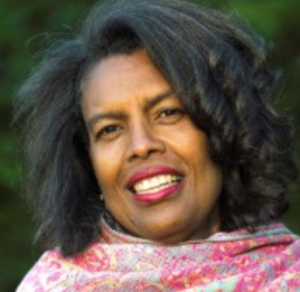
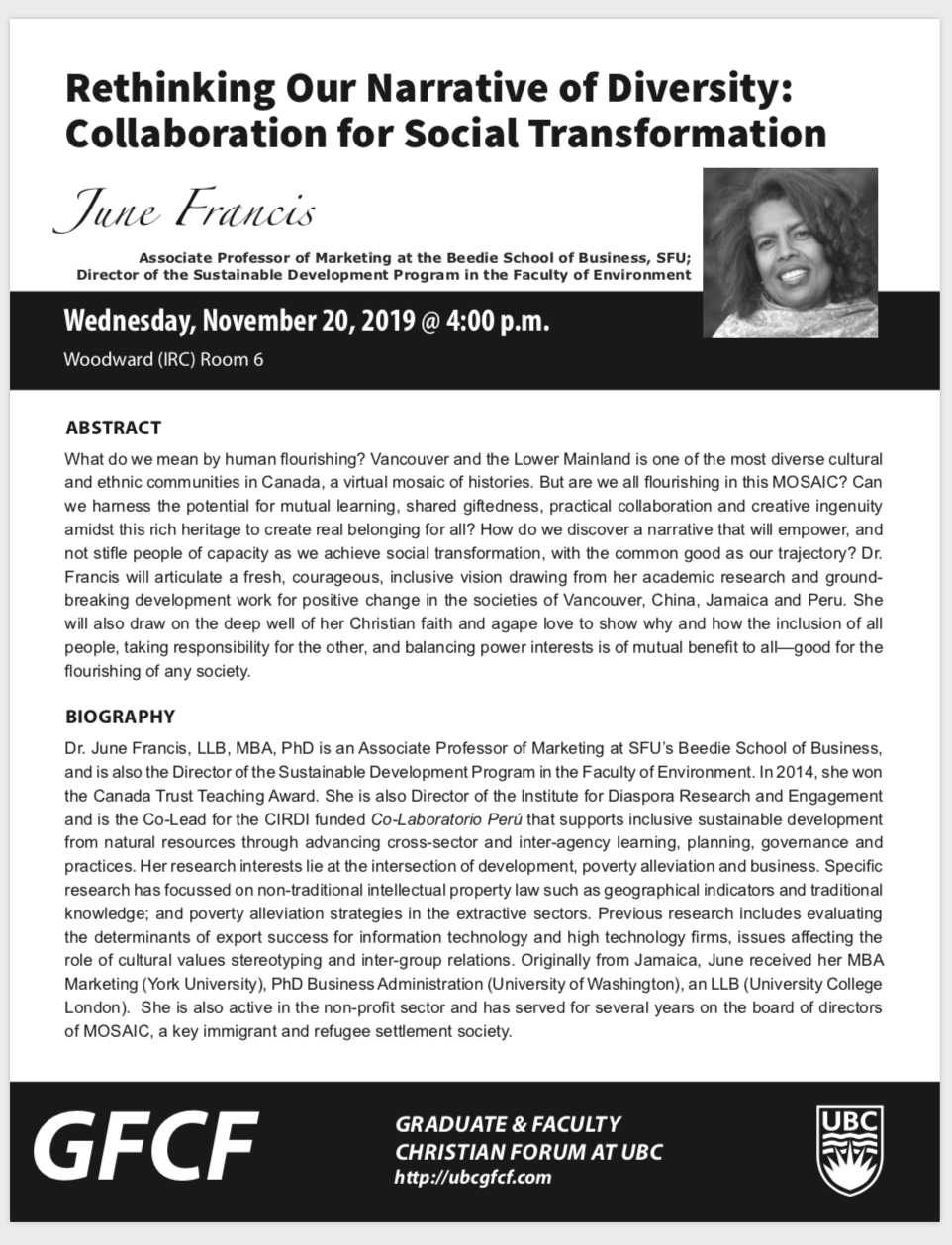
June Francis Speaks on Our Narrative of Diversity

https://beedie.sfu.ca/profiles/JuneFrancis

Recording of June Francis Talk on Diversity November 20 at UBC


Posted by: gcarkner | November 6, 2019

Climate Change: a Christian Response

A Christian Response to Anthropogenically Generated Climate Change

Olav Slaymaker, Professor Emeritus of Geography at the University of British Columbia

Summary statement: “the really inconvenient truth about climate change is that it’s not about carbon–it’s about greed”.

Since 1990 the Inter-Governmental Panel on Climate Change process has demonstrated with ever increasing precision the correlation between carbon dioxide concentration in the atmosphere at Hawaii’s Geophysical Observatory and the average temperature in the northern hemisphere. And the focus of the discussion has been the rising temperature, hence the expression “global warming”. But climate is about much more than temperature: it includes incidence of flooding, aridity, glacier melt, permafrost thawing and much else. And the driving force is much more than just carbon dioxide concentration in the atmosphere. It is no less than the cumulative behavior of society, especially our neo-liberal consumer society. The driving force behind our society is quite simply greed and the irresponsible, unsustainable way in which we use our resources.

One of the most helpful books on climate change is by Mike Hulme, a Professor of Environmental Science at the University of East Anglia in the UK. The book is called “Why We Disagree about Climate Change: Understanding Controversy, Inaction and Opportunity” (Cambridge University Press). He uses biblical imagery to enlighten the discussion. He points out that climate change is not a physical problem looking for a solution (although in 1990 this was the way in which the problem was couched by the IPCC) but to use his phraseology, climate change has become a kind of Christmas tree onto which we all hang our favourite baubles. He highlights the way in which the issue has been appropriated by so many different groups to promote their own causes. Four ways of thinking about climate change, Hulme suggests, can be labelled: (1) Lamenting Eden; (2) Presaging Apocalypse; (3) Constructing Babel; and (4) Celebrating Jubilee. These are all biblical metaphors which imply that climate change is not a problem to be solved but an idea of the imagination that requires deep reflection.

Lamenting Eden: This perspective views climate as a symbol of a pure and pristine Nature. Climate becomes something fragile that needs to be protected or saved. This is an idea which is associated with Western Enlightenment and treats Nature as a category that is distinct from Culture (the so-called Nature/Culture binary). A suggested Christian response would be to recognize the profound interdependence of Nature and Culture and to reject the ecotheology of the deep ecology movement.

Presaging Apocalypse: This view appeals to our instinctive fear of the future. Wildly exaggerated predictions of environmental collapse is an ineffective, counterproductive way of inducing behavioural change. A suggested Christian response is to examine very closely the extent to which such disaster scenarios are consistent with the available data.

Constructing Babel:  A confident belief in the human ability to control Nature is a dominant attribute of the international diplomacy that engages climate change and geo-engineering is a dangerous instance of humanitiy’s hubris. A Christian response would be to be highly suspicious of the claims of geoengineers. The Enlightenment project objectivizes climate through standardized measurement and quantification: hence prediction, management and mastery are the foci.

Celebrating Jubilee: This critique uses the idea of justice, freedom and celebration. This way of thinking about climate change uses the language of morality and ethics. For those in social and environmental justice movements climate change is not merely a substantive material problem nor simply (as in lamenting Eden) a symbolic one. Climate change is an idea around which their concerns for social and environmental justice can be mobilized. Climate change offers humanity the chance to do the right thing.

Climate change cannot be understood by focusing only on its physicality. We need to understand the ways in which we talk about climate change. What climate change means to us lies beyond the reach of science, economics and political science. “When we have found all the mysteries and lost all the meanings, we will be alone, on an empty shore”. (Stoppard, 1993, Arcadia). Christians can safely change the conversation and introduce the language of faith in a loving God.

The four ways of thinking about climate change above are mirrors that reveal important truths about the human condition. Lamenting Eden tells us of our desire or even yearning for a simpler time. Presaging Apocalypse tells us of our worries about the future. Constructing Babel tells of our desire for mastery and control. Celebrating Jubilee tells us of our human urge to respond to injustice. Climate change opens up new ways of understanding the greed, willfulness and structural causes of inequality and injustice in the world, but also reveals the limits of individual moral agency.

Other Material on Creation/Environment Care

Earth-Wise by Calvin B. DeWitt (Faith Alive Christian Resources 2007, 2nd ed.)

The Care of Creation ed. RJ Berry (InterVarsity Press, 2000)

For the Beauty of the Earth: a Christian Vision for Creation Care by Steven Bouma-Prediger (Baker Academic, 2001)

Serve God Save the Planet by Mathew Sleeth, MD (Zondervan, 2006)

Sex, Economy, Freedom and Community   by Wendell Berry

Blowout by Rachel Maddow

This Changes Everything by Naomi Klein

An Inconvenient Truth by Al Gore

Christ the Heart of Creation by Rowan Williams

« Newer Posts - Older Posts »

Categories