Posted by: gcarkner | May 1, 2017

Ghost in a Machine? Identity Crisis?

The Ongoing Debate about the Relationship between Mind & Brain

(Self, Soul, Mind, Consciousness)

Professor William Newsome, distinguished neurobiologist from Stanford, will visit UBC and Lower Mainland January 29-31, 2018 to open up some of these questions.
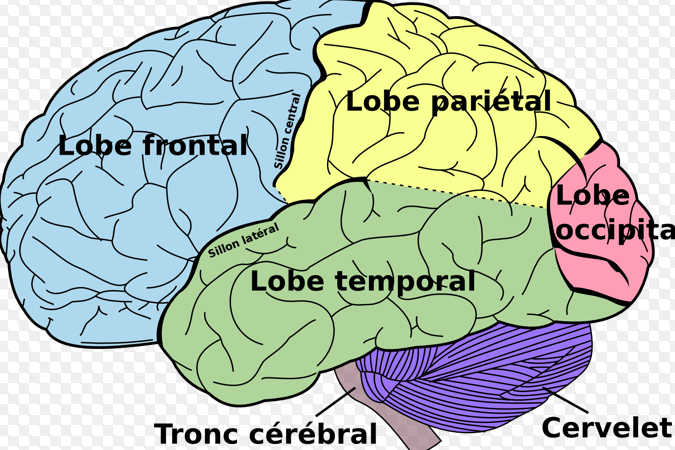
Brain

http://www.youtube.com/watch?v=PniAu9XTW3Y

Is there a ghost in the machine? Mind-Brain Debate

Richard Swinburne (Oxford), Raymond Tallis (Manchester),

Martha Robinson (University College London) & Dr Stuart Derbyshire (Birmingham)

___________________

http://www.youtube.com/watch?v=YfWGV9sZ3J4

William Lane Craig, The Materialist and the Mind

____________________

http://www.youtube.com/watch?v=ku-GmndXDXo

Professor Raymond Tallis debates RSA chief executive Matthew Taylor

Neuromania: can neuroscience explain human behaviour and culture?

See also the volume Carl Cramer, Explaining the Brain.

___________________

Four Principles of Self-transcendence from Philosopher Bernard Lonergan

Be Attentive

Be Intelligent

Be Reasonable

Be Responsible

Thomas Nagel’s Big Question in Mind & Cosmos.

1. He discusses the conflict between reductionist and antireductionist views of reality: he is convinced as a philosopher that physicalistic and naturalistic view of the human brain (and the universe) is fundamentally flawed.

“My aim is not so much to argue against reductionism as to investigate the consequences of rejecting it— to present the problem rather than to propose a solution. Materialist naturalism leads to reductionist ambitions because it seems unacceptable to deny the reality of all those familiar things that are not at first glance physical. But if no plausible reduction is available, and if denying reality to the mental continues to be unacceptable, that suggests that the original premise, materialist naturalism, is false, and not just around the edges.” (p. 15)

2. Nagel focuses on three different aspects of the the amazing world of mind: consciousness, cognition (mental functions such as thought, reasoning, and evaluation) and value. In each case, he explains why a reductionist explanation is inadequate. In the chapter on consciousness he writes:

“What kind of explanation of the development of these organisms, even one that includes evolutionary theory, could account for the appearance of organisms that are not only physically adapted to the environment but also conscious subjects? In brief, I believe it cannot be a purely physical explanation. What has to be explained is not just the lacing of organic life with a tincture of qualia but the coming into existence of subjective individual points of view— a type of existence logically distinct from anything describable by the physical sciences alone.” (p. 44)

“The existence of consciousness is both one of the most familiar and one of the most astounding things about the world. No conception of the natural order that does not reveal it as something to be expected can aspire even to the outline of completeness. And if physical science, whatever it may have to say about the origin of life, leaves us necessarily in the dark about consciousness, that shows that it cannot provide the basic form of intelligibility for this world.” (p. 53)

According to the reductionist point of view, every aspect of reality can be explained in terms of physics, chemistry and the initial conditions of the universe. The origin and development of life, consciousness, and the capacity of human beings to understand the universe via science can all be explained in terms of biochemical processes that are governed by the laws of physics and chemistry. For an alternative well-informed perspective, see Alister McGrath’s excellent work A Fine-Tuned Universe. Philosophy of mind and Christian theism (to name just two domains of human knowledge) has long held there are problems with this view of reality. From these disciplines the explanation is offered that nearly every aspect of the life of the mind is best explained by appealing to a comparable cause, another mind.

Other Scholarly Reading on Neuroscience, Philosophy of Mind & Religion

(in consultation with Dr. Judith Toronchuk, Biopsychology, Trinity Western University)

Barrett, Justin. Why would anyone believe in God? AltaMira Press, 2004.

Barrett, Justin. Cognitive Science, Religion, and Theology: From Human Minds to Divine Minds. Radnor, PA: Templeton Foundation Press, 2011; Born Believers.

Beauregard, Mario. Brain Wars: The Scientific Battle Over the Existence of the Mind and the Proof That Will Change the Way We Live Our Lives, Harper One 2012.; The Spiritual Brain: a neuroscientist’s case for the existence of the soul. (with Denyse O’Leary)

Brown, Warren S. and Brad D. Strawn. The Physical Nature of Christian Life: Neuroscience, Psychology, and the Church. NY: Cambridge University Press, 2012.

Corcoran, Kevin. Rethinking Human Nature. Grand Rapids, MI: Baker, 2006.

Green, Joel. Body, Soul and Human Life. Grand Rapids: Baker, 2008.

Green, Joel, ed. What About the Soul? Neuroscience and Christian Anthropology. Nashville, TN: Abingdon, 2004.

Green, Joel and Palmer, Stuart. In Search of the Soul: Four Views of the Mind-Body problem. Downer’s Grove, IL: InterVarsity, 2005.

Hasker, William. The Emergent Self. Cornell University Press, 1999.

Jeeves, Malcolm, ed.  From cells to souls–and beyond: changing portraits of human nature. GrandRapids, MI: Eerdmans, 2004..

Jeeves, Malcolm. Human Nature: Reflections on the Integration of Psychology and Christianity . Radnor, PA: Templeton Foundation Press, 2006.

Jeeves, Malcom.ed., Rethinking Human Nature: A Multidisciplinary Approach.Grand Rapids: Eerdmans, 2011.

Jeeves, Malcom and Warren Brown. Neuroscience, Psychology and Religion. Conshohoken, PA: Templeton Foundation Press. 2009.

McNamara, Patrick. The Neuroscience of Religious Experience. Cambridge University Press, 2009.

Markham, Paul N. Rewired: Exploring Religious Conversion. Eugene, OR: Pickwick, 2007.

Murphy, Nancey. Bodies and Souls, or Spirited Bodies? New York, NY: Cambridge, 2006.

Murphy, Nancey and Warren Brown, Did MNeurons Make Me do it?: Philosophical and Neurobiological Perspectives on Moral Responsibility and Free Will. Oxford: Clarendon, 2007.

Newberg, Andrew and Mark Waldman, How God Changes Your Brain: Breakthrough Findings from a Leading Neuroscientist. Ballantine Books, 2010.
Russell, Robert John et al (eds.) Neuroscience and the Person: scientific perspective on divine action 4. Vatican City State: Vatican Observatory, 1999.

Schjoedt, Uffe. “The Religious Brain: A General Introduction to the Experimental Neuroscience of Religion”, Method and Theory in the Study of Religion 21 (2009): 310-339.

Schloss, Jeffrey & Michael Murray (eds.) The Believing Primate: scientific, philosophical and theological reflections on the origin of religion.

Swinburne, Richard. The Evolution of the Soul. Oxford University Press.

Posted by: gcarkner | April 16, 2017

Resurrection by Peter Paul Rubens

http://mailchi.mp/veritas/nt-wright-sean-kelly-ian-hutchinson-on-the-resurrection?e=9f1d2a36f1  An MIT Physicist, a Harvard Philosopher, and a New Testament Theologian Reflect on the Meaning of the Resurrection 

Posted by: gcarkner | March 15, 2017

Theology of Science: a Thought-Experiment

Theology of Science: the Quest for a Robust Narrative of Science’s Purpose or telos

“Science is the participative, relational, co-creative work within the kingdom of God of healing the fallen relationship of humans with nature.” ~Tom McLeish

IMG_1486

Below a summary of Tom McLeish’s insights last November in his Lower Mainland Tour.

Science (aka Natural Philosophy in medieval times) is the love of wisdom about natural things. Our relationship to nature is a key aspect of the way to wisdom that reconciles us to nature, and we should never deny or forget this. The biblical authors agree. See Book of Job or Paul’s letter to the Corinthians (Romans 8; 2 Corinthians 5:17) In this light, science has a very long human history, longer than we often think—it is a deep cultural narrative. Modern science is a new chapter in a very old book about human culture. Science makes us more human.

How do we develop and release this narrative into the culture in positive ways? The deepest imagery and iconography in his project is one of a healing narrative. We seek a healing relationship with God, fellow humans and his creation. Pain and suffering are not excluded from the purview of science. Wisdom and pain always conjoined, as we see in the wisdom literature, especially Job. Theological questions are always in the background when we are doing science. Why not make them more explicit. The power of Tom’s challenge is to build a theology of all science—a bit breathtaking. We ought to proceed with skill and optimism that we can do this, even within the current limits of our understanding.

Key Words: Relational-Creation-Wisdom

Pursuit of wisdom applies to both science and technology. We are privileged to rumble with Tom’s paradigm shift in thinking about these issues. Science is at the heart of, and part of, a Christian worldview. What would the Lordship of Christ mean for science? How do we get our philosophical categories corrected—confront Deism, grapple with Contingency, the Demi-urge, scientism, materialistic naturalism, dualism of the natural and supernatural, the dumbing down of speech. We seem to need new hermeneutical ways of seeing and interpreting reality.

As Tom points out, the roots of science are very old and part of the healing story of the biblical narrative. This insight is thoroughly profound.

Leadership is needed to promote a healthier, more positive narrative of science in church and on campus. God’s call to scientists is to come and heal the broken relationships in the world. Science can be a form of delight, of worship, not of nature, but of God and appreciation of his redemption of the whole world.

Wonder (awe) rather than doubt is the root of all knowledge. Our goal should be to live life in radical amazement … get up in the morning and look at the world in a way that takes nothing for granted. Everything is phenomenal; everything is incredible; never treat life casually. To be spiritual is to be amazed.  ~Abraham Joshua Heschel

This involves a deep level of curiosity and quest for understanding of how all knowledge holds together and is grounded. This outlook positions us within faith, not just Cartesian doubt. 

This Proposal Rests on Some Key Assumptions 

  • There is a long history of human and non-human interactions—as old as mankind.
  • It is a high view of the human ability to re-imagine nature.
  • The dual structure of wisdom and knowledge. Both are vital to human flourishing.
  • Our engagement with nature is often ambiguous and painful. Often we are in terror of nature and we fear its chaos (hurricanes, floods, volcanoes, earthquakes)
  • We must recognize the balance and serendipity between order and chaos. Randomness explores its shape within limits. Creativity is order emerging out of chaos. Chaos with limits/boundaries provides the condition for order and creativity.
  • The Creation Question is central, but must be rearticulated to meet the full textuality of Scripture: Job 30-40; Proverbs 8; Psalms 19, 33, 104; Isaiah 40, 45; Jeremiah 10; Hosea 2; John 1; Genesis 1-3.
  • Questions are more important than the right answers—Job 38-40. Look again at your world with me, your God. God invites us to creatively explore his world with tough questions. This is the spirit of science from ancient times.

How does the big Christian narrative play in this discussion of a theology of science? Creation, Fall, Redemption, Consummation.

Consequences of this Vision

  • There are no pre-determined histories or boundaries for science and technology—rather all are meant to be theo-centric, and within the aegis of the pursuit of wisdom.
  • Our thought-relationship with nature is therapeutic.
  • The church can celebrate the deep humanity of science.
  • This discourse on wisdom can help heal the relationship between two cultures on campus (science & humanities).
  • We gain new insights into the narratives (many wrongheaded) that inform public debates about science and technology.
  • There is potential for a positive relationship between science and the media.
  • We discover a mutual task for inter-faith dialogue as well.

Pagan Narratives of Despair about Nature/Science Narrative of Ignorance, Fear, and Harm. This leads to such problems as:

  • Alienation/Being kept in the dark—conspiracy theories; scientists are secretive and super-specialized.
  • Chaos—be careful of the consequences of scientific work (Fracking, nanotechnology, GMO foods, etc.)
  • Punishment—nature will punish us if we are bad.
  • Exploitation—rich get richer, poor get poorer
  • Nature as sacred, therefore untouchable
  • Evil—potential Pandora’s Box of troubles

Tom notes that the intellectual and practical framing of science through society and church is currently a problem—the church is largely alienated from science, and particularly weak on a theology of science, enmeshed in culture wars about evolution. Can we in our theology take the whole of known reality, the whole of truth, seriously? N.T Wright is a good example/model of a healthier framing of science. Liturgy for science is needed to break down dualism. Most common command ins Scripture is “Fear Not…” We must be much more proactive and positive and not give in to fear and negativity.

Key Title: Faith & Wisdom in Science. OUP 2014

Tom McLeish’s Medieval Big Bang talk at St. John’s College, UBC November 4, 2016: https://youtu.be/JFFt0kUIlWA 

Tom McLeish TWU Talk on the CSCA YouTube channel. It is very similar to the UBC talk in early November:  https://www.youtube.com/watch?v=8vkth1bnx2E

See also new collection of essays edited by two outstanding Christian scholars (Jamie Smith and William Cavanaugh) promises to take the Christian tradition forward in its engagement with the biological sciences: https://www.youtube.com/watch?v=DdlU_F6FH-o&feature=youtu.be

screen-shot-2016-01-22-at-6-48-54-am

Posted by: gcarkner | February 22, 2017

C.S. Lewis Scholar Reconsiders Love


screen-shot-2017-02-10-at-11-34-07-am


Audio File: 

Jason writes in order to capture our imagination:

“I intend to offer a definition of love itself (the genus of which the “four” loves are species), of Charity or agape in The Four Loves (it is not what we think it is), and of “Christian love” (if such a thing exists).

“Charity has undeniably been the most misunderstood of the ‘four’ loves, even or especially among his most devoted readers.”

“The word agape, too, had a more or less fixed meaning in the imagination of his contemporary Christian readership. This assumed fixed meaning, I now suspect, was actually part of the mindset Lewis wanted to correct. And it probably continues to be the default understanding of many Christians.”

“So absorbing is the description of these loves that one’s critical faculties are lulled to sleep.”

“There are not ‘four’, nor are they even ‘loves’.”

The Four Loves—a simple and memorable title, brilliant really, but at the expense of creating a false expectation.”

“One of the most peculiar facts about The Four Loves is that it never tells us what love is. If you comb its pages for a definition of love, you will leave empty-handed.”

“Lewis dissected love but never patched it back together.”

“Charity or agape in The Four Loves is not what we think it is. It is actually surprisingly practical, mundane, and even ‘secular’.”

“Strictly speaking there is no such thing as a ‘Christian love’, only a Christian praxis of love.”

screen-shot-2017-03-02-at-8-36-13-am

screen-shot-2017-02-15-at-4-24-54-am


Thursday, February 23 @ 6:30 pm

RSVP gcarkner@shaw.ca

Biography of Martin Luther, the 16th-century priest who led the Christian Reformation and opened up new possibilities in exploration of faith. The film begins with his vow to become a monk, and continues through his struggles to reconcile his desire for sanctification with his increasing abhorrence of the corruption and hypocrisy pervading the Church’s hierarchy.

He is ultimately charged with heresy and must confront the ruling cardinals and princes, urging them to make the Scriptures available to the common believer and lead the Church toward faith through justice and righteousness.

Starring Joseph Fiennes and Peter Ustinov

Posted by: gcarkner | February 3, 2017

Angela Duckworth: Psychology of Grit

screen-shot-2017-02-03-at-2-23-19-pm

See also Character Quest button on this Blog.

Angela Lee Duckworth (born 1970) is an American psychologist and popular science author. She won a 2013 MacArthur Fellowship. She is a professor at the University of Pennsylvania. She’s also the Founder and Scientific Director of an educational nonprofit called Character Lab. Her lab studies grit and self-control. What builds resilience into our lives and careers? This is a young genius who has done her homework.

Duckworth earned an A.B. in neurobiology at Harvard College in 1992. She then graduated at the University of Oxford in 1996 with an M.Sc. in neuroscience on a Marshall Scholarship, and at the University of Pennsylvania in 2006 with a Ph.D. in psychology. Her first book, Grit: The Power of Passion and Perseverance, was released in May 2016. A review of this book in the New York Times called Duckworth “the psychologist who has made ‘grit’ the reigning buzzword in education-policy circles.”

See also Brené Brown, Rising Strong: the reckoning, the rumble, the revolution. Speigel & Grau, 2015. The most transformative and resilient leaders Brown has met have the following characteristics:

a. Recognize the central role that relationships and story play in culture and strategy.

b. Stay curious about their own emotions, thoughts and behaviours.

c. Understand and stay curious about how emotions, thoughts and behaviour are connected in the people they lead and how those factors affect relationships and perceptions.

d. Have the ability to lean into discomfort and vulnerability.

e. Identify the things that kill trust and creativity in order to nurture cultures and conditions that allow good people to do what they do best.

f. Leaders with resilience live BIG: revealing a commitment to setting boundaries, standing in their integrity and expressing  continued generosity. They refuse to give in to self-righteousness, ego, self-protection, anger, blame or avoidance. Living in their integrity means choosing courage over comfort, choosing what is right over what is fun or easy, choosing to practice their values rather than just profess them. Such leaders extend generous interpretations to the intentions, words and actions of others (giving them the benefit of the doubt).

Why do we love the TV program Grey’s Anatomy? Specifically, we think, because Shonda Rhimes pays attention to all these elements as she shows the complexity of training young surgeons.


Personal Mission Statement: the Power of Focus

Words to the Wise in our Uncertain Times

Blessed are the poor in spirit, for theirs is the kingdom of heaven.

Blessed are those who mourn, for they will be comforted.

Blessed are the meek, for they will inherit the earth.

Blessed are those who hunger and thirst for righteousness, for they will be filled.

Blessed are the merciful, for they will be shown mercy.

Blessed are the pure in heart, for they will see God.

Blessed are the peacemakers, for they will be called sons of God.

Blessed are those who are persecuted because of righteousness, for theirs is the kingdom of heaven.

Blessed are you when people insult you, persecute you and falsely say all kinds of evil against you because of me.

Rejoice and be glad, because great is your reward in heaven, for in the same way they persecuted the prophets who were before you.

You are the salt of the earth.

You are the light of the world.


Posted by: gcarkner | January 29, 2017

Paul Davies on Faith and Science

Reprint from PAUL DAVIES (thought provoking article on the nature of science and the laws of physics)

The New York Times, 
November 24, 2007

Tempe, Arizona.

SCIENCE, we are repeatedly told, is the most reliable form of knowledge about the world because it is based on testable hypotheses. Religion, by contrast, is based on faith. The term “doubting Thomas” well illustrates the difference. In science, a healthy skepticism is a professional necessity, whereas in religion, having belief without evidence is regarded as a virtue. 
 
The problem with this neat separation into “non-overlapping magisteria,” as Stephen Jay Gould described science and religion, is that science has its own faith-based belief system. All science proceeds on the assumption that nature is ordered in a rational and intelligible way. You couldn’t be a scientist if you thought the universe was a meaningless jumble of odds and ends haphazardly juxtaposed. Read More…

Posted by: gcarkner | January 15, 2017

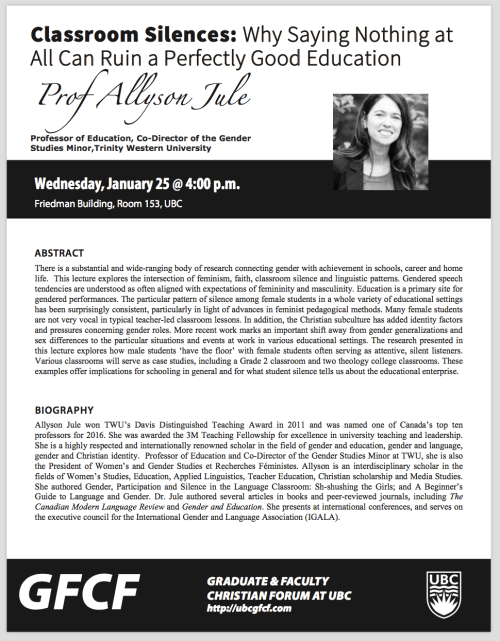
Allyson Jule at UBC January 25, 2017

Allyson Jule Classroom Silences Audio File 

screen-shot-2017-01-15-at-1-40-44-pm

Posted by: gcarkner | January 13, 2017

Wisdom of Abraham Heschel

The Wisdom of Abraham Joshua Heschel

Abraham Joshua Heschel was a Polish-born American rabbi and one of the leading Jewish theologians and philosophers of the 20th century. He was a prophetic genius, a voice deeply concerned about justice and human rights, and a strong advocate of Jewish-Christian dialogue. He had a profound insight into society and its discontents. Here are some quotes from his thought.

http://www.cbc.ca/radio/ideas/the-truth-about-post-truth-1.3939958

Join our weekly GCU study on wisdom in the Psalms (gcarkner@shaw.ca) Gord

Philosophy can be defined as the art of asking the right questions… Awareness of the problems outlives all solutions. The answers are questions in disguise, every new answer giving rise to new questions.

Wonder (awe) rather than doubt is the root of all knowledge. Our goal should be to live life in radical amazement … get up in the morning and look at the world in a way that takes nothing for granted. Everything is phenomenal; everything is incredible; never treat life casually. To be spiritual is to be amazed.

The worship of reason is arrogance and betrays a lack of intelligence. The rejection of reason is cowardice and betrays a lack of faith.

What is the meaning of my being? … My quest is not for theoretical knowledge about myself … What I look for is not how to gain a firm hold on myself and on life, but primarily how to live a life that would deserve and evoke an eternal Amen. What am I here for?

To be human is to be involved, to act and react, to wonder and respond. For humans to be is to play a part in the cosmic drama, knowingly or unknowingly. Living involves responsible understanding of one’s role in relation to all other beings.

We cannot restrain our bitter yearning to know whether life is nothing but a series of momentary physiological and mental processes, actions, and forms of behaviour, a flow of vicissitudes, desires, and sensations, running like grains through an hourglass, marking time only once and always vanishing … Is life nothing but an agglomeration of facts, unrelated to one another–chaos camouflaged by illusion?

Humans are more than what they are to themselves. In reason the human may be limited, in will perhaps wicked, yet the human stands in a relation to God which one may betray but not sever, and which constitutes the essential meaning of life. The human is the knot in which heaven and earth are interlaced. God in the universe is a spirit of concern for life … We often fail in trying to understand him not because we do not know how to extend our concepts far enough, but because we do not know how to begin close enough. To think of God is not to find him as an object in our minds, but to find ourselves in him.

A religious man is a person who holds God and man in one thought at one time, at all times, who suffers harm done to others, whose greatest passion is compassion, whose greatest strength is love and defiance of despair.

God is not a hypothesis derived from logical assumptions, but an immediate insight, self-evident as light. He is not something to be sought in the darkness with the light of reason. He is the light.

Screen Shot 2015-04-04 at 9.37.25 AM

Faith is not the clinging to a shrine but an endless pilgrimage of the heart.

People of our time are losing the power of celebration. Instead of celebrating we seek to be amused or entertained. Celebration is an active state, an act of expressing reverence or appreciation. To be entertained is a passive state–it is to receive pleasure afforded by an amusing act or a spectacle … Celebration is a confrontation, giving attention to the transcendent meaning of one’s actions.

A test of a people is how it behaves toward the old. It is easy to love children. Even tyrants and dictators make a point of being fond of children. But the affection and care for the old, the incurable, the helpless are the true gold mines of a culture.

The Search for reason ends at the known; on the immense expanse beyond it only the sense of the ineffable can glide. It alone knows the route to that which is remote from experience and understanding. Neither of them is amphibious: reason cannot go beyond the shore, and the sense of the ineffable is out of place where we measure, where we weigh. We do not leave the shore of the known in search of adventure or suspense or because of the failure of reason to answer our questions. We sail because our mind is like a fantastic seashell, and when applying our ear to its lips we hear a perpetual murmur from the waves beyond the shore. Citizens of two realms, we all must sustain a dual allegiance: we sense the ineffable in one realm, we name and exploit reality in another. Between the two we set up a system of references, but we can never fill the gap. They are as far and as close to each other as time and calendar, as violin and melody, as life and what lies beyond the last breath.

Remember that there is meaning beyond absurdity. Know that every deed counts, that every word is power … Above all, remember that you must build your life as if it were a work of art.

Morally speaking, there is no limit to the concern one must feel for the suffering of human beings, that indifference to evil is worse than evil itself, that in a free society, some are guilty, but all are responsible.

There are no two hours alike. Every hour is unique and the only one given at the moment, exclusive and endlessly precious. Judaism teaches us to be attached to holiness in time; to learn how to consecrate sanctuaries that emerge from the magnificent stream of a year.

We stand on a razor’s edge. It is so easy to hurt, to insult, to kill. Giving birth is a mystery; bringing death to millions is but a skill. It is not quite within the power of the human will to generate life; it is quite within the power of the will to destroy life.

Creation is not an act that happened once upon a time, once and forever. The act of bringing the world into existence is a continuous process. God called the world into being, and that call goes on. There is this present moment because God is present. Every instant is an act of creation. A moment is not a terminal but a flash, a signal of Beginning. Time is perpetual innovation, a synonym for continuous creation.

Posted by: gcarkner | December 29, 2016

The Road to Freedom, Democracy and the Common Good

Join the GCU Dialogue

http://www.cbc.ca/radio/ideas/the-truth-about-post-truth-1.3939958

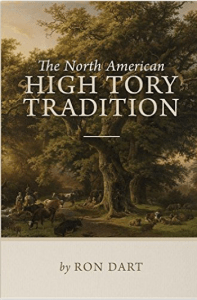
See Professor Ron Dart’s new book The North American High Tory Tradition (American Anglican Press, 2016)

screen-shot-2016-12-29-at-3-50-39-pm

A significant struggle began in the year 1776 over the fate of a continent, and there are those who believe that this struggle ended in the year 1783, with the ancient ways of the Old World being given over entirely to those of a New. Is it true, however, that the end of what has been called ‘The First American Civil War’ saw the complete victory of the republican way, and the banishment of the older Tory tradition from these shores? The North American High Tory Tradition tells another story, one in which a different vision for life in North America emerges from the cold of the True North where its flame has been kept burning until the present day. George Grant (1918-1988), the most influential High Tory intellectual of the 20th century, warned us in his Lament for a Nation of the collision course which lies ahead for these two different ‘North Americas’–that embodied in the Dominion of the North, and that in the Republic to its South. Is the disappearance of the Tory alternative an inevitable fate to our future as ‘North Americans’? In The North American High Tory Tradition Ron Dart shines light upon the classical lineage, deep wisdom and enduring nature of the High Tory tradition as it has been planted and grown in the soil of North America, and in doing so reveals how Canada may serve as a north star to lead North Americans to a different destiny than that planned for them by a certain few in 1776.

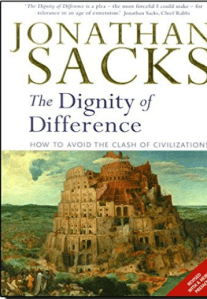
I am enjoying the insights (historical, moral, philosophical and political) of this well-written book. The reflections are rooted in some of the key shapers of the Canadian identity. We need sane, substantial voices and balance amidst today’s sometimes bizarre political theatrics, growth of populism and the ideology of image. I would also recommend highly the book by Chief UK Rabbi Jonathan Sacks called The Dignity of Difference; it is a fair treatment/critique of religion and globalization. One might also view on the same theme Yale professor Miraslov Volf’s insightful 2016 book, Flourishing: why we need religion in age of globalization. ~Gord Carkner

screen-shot-2017-01-06-at-4-54-40-pm

https://www.youtube.com/watch?v=UHejQDNwARk Rabbi Jonathan Sacks

Modern thought raises no barriers to a future nihilistic war against liberal democracy on the part of those who have been brought up in its bosom. Relativism–the doctrine that all values are merely relative and which attacks all ‘privileged perspectives’–must ultimately end up undermining democratic and tolerant values as well. Relativism is not a weapon that can be aimed selectively at the enemies one chooses. It fires indiscriminately, shooting out the legs of not only the ‘absolutisms’, dogmas, and certainties of the Western tradition, but the tradition’s emphasis on tolerance, diversity, and freedom of thought as well. If nothing can be true absolutely, if all values are culturally determined, then cherished principles like human equality have to go by the wayside as well.   Francis Fukuyama, The End of History (1992, 332)

Mankind…is not merely the maximizing animal. We are also, uniquely, the meaning-seeking animal. (J.Sacks, The Dignity of Difference, 194)

Man was not made for the service of economies; economies were made to serve mankind; and men and women were made–so I believe–to serve one another, not just themselves. We may not survive while others drown; we may not feast while others starve; we are not free when others are in servitude; we are not well when billions languish in disease and premature death. (J. Sacks, The Dignity of Difference, 196)

Economic superpowers, seemingly invincible in their time, live a relatively short life-span: Venice in the sixteenth century, the Netherlands in the seventeenth, France in the eighteenth, Britain in the nineteenth, and the United States in the twentieth. The great religions, by contrast, survive…. Why this should be so is open to debate. My own view is that the world faiths embody truths unavailable to economics and politics, and they remain salient even when everything else changes. They remind us that civilizations survive not by strength but by how they respond to the weak; not by wealth but by the care they show for the poor; not by power but by their concern for the powerless. The ironic yet utterly humane lesson of history is that what renders a culture invulnerable is the the compassion it shows to the vulnerable. The ultimate value we should be concerned to maximize is human dignity–the dignity of all human beings, equally, as children of the creative, redeeming God. (J. Sacks, The Dignity of Difference, 195)

Six C’s:

I have proposed a simple set of ideas that might guide us in the choppy waters ahead. Control means taking responsibility and refusing to see economic or political development as inevitable. Contribution means that there is a moral dimension to economics. Advertisers who mislead, producers who turn a blind eye to inhumane working conditions and starvation wages, beneficiaries of the system who do not share their time and blessings with others, are unacceptable whether or not what they do is legal. Compassion means that developing countries must take seriously their obligation to the world’s poor, protecting their independence while opening up ways of escaping from poverty. Creativity suggests that (not the only, but) the best way of doing this is through investment in education. Co-operation tells us that market do not survive on competition alone. They presuppose virtues and what I have called covenantal relationships, without which the Prisoner’s Dilemma tells us that individual self-interest will fail to generate collective good. Conservation reminds us of our duties to nature and to the future, without which the pace of economic growth will merely be a measure of the speed at which  we approach the abyss…. Freedom means restraint. (J. Sacks, The Dignity of Difference, 174)

« Newer Posts - Older Posts »

Categories