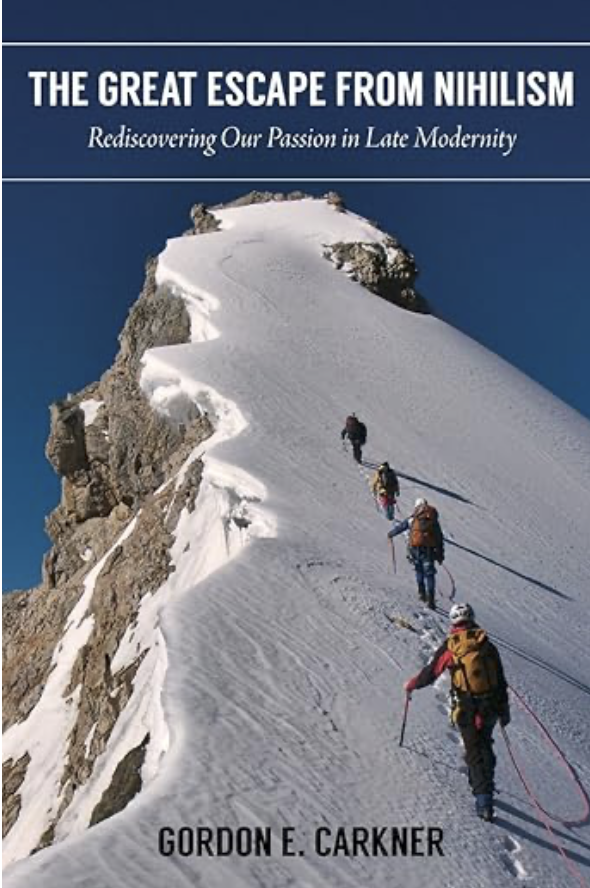
The Great Escape from Nihilism: Rediscovering Our Passion in Late Modernity (2016) by Gordon E. Carkner, PhD, is a philosophical and cultural critique that diagnoses nihilism as a pervasive “prison camp” in late modern Western society and proposes hopeful, substantive ways to escape it toward deeper meaning, moral passion, and human flourishing.
Core Thesis and Metaphor Carkner uses the metaphor of the 1963 film The Great Escape (Allied POWs digging a secret tunnel out of a Nazi camp) to frame the book: nihilism imprisons us through cynicism, disengagement, and loss of purpose, but a courageous, dialogical “tunneling” effort—drawing on philosophy, theology, science, and real-life relationships. This can lead to freedom. The book asks whether nihilism has the last word and answers in the negative, advocating a “transcendent turn” informed heavily by Canadian philosopher Charles Taylor, especially his concepts of the immanent frame, moral goods, the hypergood, and moral sources in A Secular Age and Sources of the Self. It is structured in two parts (diagnosis and Solutions) and targets graduate students, academics, and thoughtful readers navigating faith crises, identity issues, and cultural lostness.
Part 1: Diagnosing the Problem (The Prison Camp of Nihilism) This section maps how late modernity embeds nihilism into Western thought and daily life:
- The Immanent Frame (Chapter 1): Modernity encloses us in a “closed world system/framework of interpretation” limited to the material, natural, and this-worldly, excluding transcendence. It is disenchanted. This creates a “buffered self” detached from deeper moral or spiritual horizons.
- Scientism (Chapter 2): Five cultural markers show how science is elevated to an all-encompassing ideology, reducing reality to measurable facts and sidelining ethics, beauty, and meaning, and especially the divine.
- Competing Worldviews (Chapter 3): Contrasts reductive (e.g., materialist, scientistic) vs. expansive (open to transcendence) ways of seeing the world. These are the two great social imaginaries of our day.
- Moral Subjectivism/Relativism (Chapter 4): Practical reason fails when morality becomes purely an individual preference or social construct, leading to ethical paralysis, entailing the “failure of practical reason,” and inability to adjudicate competing goods. See Carkner’s recently posted YouTube videos on Let’s Examine Moral Relativism.
Together, these produce cynicism, fragmentation, a “thin” self, crises of identity/faith, and disengagement from society. There are inevitable contradictions within reductionistic nihilism, and of course abuse of power.
Part 2: The Shape of Escape Routes (Ten Conversational Investigations) Carkner argues that “nihilism is not the final word” through ten chapters offering practical and philosophical recovery methods, ways out of the prison camp of nihilism.
Key Themes Include:
- Wager on Tragic Optimism: Choose hope amid suffering rather than anxiety and despair.
- Investment in Love: Prioritize committed relationships, mentoring, and empathy over cynicism; love as self-sacrifice recalibrates chaos and rebuilds our emotional intelligence.
- Anthropological Recalibration: Move beyond reductive views of human nature which trap us.
- Engage Evil and Suffering: Nihilism dodges these realities; honest confrontation (drawing on Christian resources) restores depth. Commit yourself to reality at all cost.
- Critique of Foucault’s Aesthetic Self (Chapter 5): Rejects Michel Foucault’s self-creation through power and aesthetics as insufficient for a “thick” identity; it fails Taylor’s criteria for the genuine moral quest.
- The Hypergood (Chapter 6): Taylor’s idea of higher-order goods that orient life and provide moral light/hope beyond subjectivism. The hyper good reorganizes the other life goods in priority and helps us make tough decisions with wisdom.
- Recover the Power of Word (Chapter 7): Amid postmodern language games, reclaim language’s capacity for truth, meaning, and connection.
- Transcendent Turn to Agape Love (Chapter 8): The most challenging proposal in the book is to choose self-giving, divinely-grounded love (not utilitarian or contractual) as a counter-cultural greatest good. It offers empowerment and freedom of agency. Carkner says that many people are choosing this option to unlearn nihilism.
- Moral Motivation (Chapter 9): Resolve why we should act morally by rooting it in transcendent sources. We need higher sources of the good in order to think better and live the best lives.
- Incarnational Humanism (Chapter 10): A recovery of passion through a Christ-centered view of embodied humanity, dignity, and flourishing that integrates faith and culture. Here he aligns with scholars like Jens Zimmermann and James Davison Hunter.
The conclusion reinforces dialogue and communal escape. It is impossible to escape nihilism by oneself alone. You need good interlocutors; people who will work with you on escaping modern nihilism.
An appendix addresses Christian graduate students specifically on how they can actualize the potential of unlearning nihilism and escaping its prison camp of the mind and heart. Combine this with one of GFCF’s lectures by Kevin Vanhoozer from Chicago: https://www.youtube.com/watch?v=oVIUOcVtg0w
Overall Approach and Contributions Carkner draws on a “fine, seasoned group” of thinkers (Taylor, Plantinga, Volf, Habermas, Hart, and Zimmermann) to model robust dialogue rather than polemic. It blends cultural analysis, personal challenge, and theological insight without being narrowly confessional until the end. The goal is unlearning nihilism, breaking out of the “closed immanent frame,” a term that Charles Taylor coined, and rediscovering passion through moral realism, relational investment, and recovery of transcendent horizons. It does involve some hard thinking and personal vulnerability.
Reviews note its clarity in explaining complex ideas, persuasive suggestions for navigating modernity, and provocative integrity. The book is written fro a brand audience but assumes some philosophical understanding. In short, it is an optimistic, Taylor-inspired call to cultural and personal renewal. Nihilism weighs us down, but tunneling toward meaning, love, and the hypergood of agape love offers freedom, grounding, and renewed passion in late modernity. It is available via Amazon or other book sites. Feel free to comment and to read and discuss the book with a friend.
Amazon Location of The Great Escape from Nihilism: https://www.amazon.ca/Great-Escape-Nihilism-Rediscovering-Modernity/dp/0995096821
More Information on UBC’s Graduate Christian Union or to be added to our mailing list for upcoming events, contact Gordon at gord.carkner@gmail.com
A Personal Note to Graduate Students from Gordon: The unreflective life, run on adrenalin, desires, raw ambition, and instincts, is truly dangerous.
You have high ideals and goals to be in postgraduate education. You want to make a difference in shaping the future, making a better world. Perhaps it is wise to ask yourself, “What are the implications of the incarnation of Jesus Christ for my identity, my posture, and my voice on campus?” Incarnation is “where God’s eternity and creation’s temporality meet” (D. S. Long, 2009, 86). This is no flippant postulation, but it is great territory to explore for fruitful study and personal reflection. If indeed Jesus is the wisdom of God and the power of God, the reason, the telos or goal of everything (Colossians 1), it would be terribly wrong to keep this a secret from our colleagues and friends. If we are able to say ‘Jesus is Lord’ with respect to our studies, our lives, and our relationships (Romans chapters 8 and 12), that will begin to transform us and give us fresh motivation, creativity and energy–deep purpose. This is why I wrote the next book: Towards an Incarnational Spiritual Culture. It will take a full lifetime to explore the incarnation’s implications, but graduate school is a good place to start. We need wisdom and endurance every day to discern our research content and direction. Wisdom as articulated in the Proverbs is an intensely practical method of thinking and living more fruitfully. The cultivation of wisdom is continuously a valuable quest in all arenas of life.
In The Great Escape from Nihilism, we have been on a journey in this discussion to escape from nihilism’s grip, and now to discover our passion and reset our priorities in a more mysterious, beautiful and adventurous world. Creation is the first and last word in the Bible. It is God’s creation and his renewal of creation that fascinates—a new heaven and a new earth is promised in the Apostle John’s book Revelation. My wife and I love to climb mountains, both for the exercise and the beautiful view. We are all called to climb this mountain of life, with full view of the virtues in front of us, while climbing the academic and career ladder.
Our goal, over several decades, in Graduate Christian Union and the Graduate and Faculty Christian Forum at UBC has been to support and inspire the vision of graduate students, to open thought to larger horizons, bigger frameworks of interpretation. Many students have gone on to great accomplishments while taking their faith seriously. They held onto their university ideals and carried the vision forward; like Blaise Pascal, they held on to the high value of both faith and reason. Now the baton is passed to you as a current graduate student. Test these ideas and claims, extend the concepts, go for higher ground, run the experiment, and with it and become an entrepreneur of meaningful dialogue, character depth and strategic action.
We are called to think and read deeply and widely. Find wise people to mentor you and wear out their doorstep, whether through reading their books or personal contact. This has been extremely valuable for me, here in Canada at Kingston, Chicago and Oxford. It is also salient to look for someone to mentor in agape love and the incarnational spiritual humanism culture. Reflect often on what is good, excellent, and praiseworthy. Live without shame, live vulnerably and wholeheartedly. Seek out joy and live with gratitude for the unique gift that is your life before a powerful and loving God who longs to build partnership/covenant with you. Learn the art of hospitality and become a great and generous soul like Dr. Philip Hill, a faithful presence in your circle of influence, and a promoter of shalom. Go the extra mile in all your relationships, pursue the good, and do the noble/right thing, even if it is hard.


Leave a Reply