Reprint from PAUL DAVIES (thought provocative article on the nature of science and the laws of physics)
The New York Times, November 24, 2007
Tempe, Arizona.
SCIENCE, we are repeatedly told, is the most reliable form of knowledge about the world because it is based on testable hypotheses. Religion, by contrast, is based on faith. The term “doubting Thomas” well illustrates the difference. In science, a healthy skepticism is a professional necessity, whereas in religion, having belief without evidence is regarded as a virtue. The problem with this neat separation into “non-overlapping magisteria,” as Stephen Jay Gould described science and religion, is that science has its own faith-based belief system. All science proceeds on the assumption that nature is ordered in a rational and intelligible way. You couldn’t be a scientist if you thought the universe was a meaningless jumble of odds and ends haphazardly juxtaposed. When physicists probe to a deeper level of subatomic structure, or astronomers extend the reach of their instruments, they expect to encounter additional elegant mathematical order. And so far this faith has been justified. The most refined expression of the rational intelligibility of the cosmos is found in the laws of physics, the fundamental rules on which nature runs. The laws of gravitation and electromagnetism, the laws that regulate the world within the atom, the laws of motion — all are expressed as tidy mathematical relationships. But where do these laws come from? And why do they have the form that they do?
GCU welcomes you to our dynamic YouTube Channel of lectures and discussions to expand your horizon of thought and your personal human flourishing. We grapple with some of the toughest questions of our day. The goal is to encourage, enlighten and challenge all who participate. ~Gordon
Mythology that Currently Haunts the Relationship between Fides et Ratio
We suggest that our current state of skepticism in Western late modernity stems from a massive confusion about the relationship between various types of faith and various types of reason. Yes there is more than one type of reasoning. Alasdair McIntyre notes three massively different ways of reasoning in Three Version of Moral Inquiry: pre-modern, modern and postmodern. Faith is a multivalent concept and applies equally to hard science as well as in our personal relationships or the study of Holy Scripture. God asks to reason with us, asks us to test his statements against the reality of our lives, to see if we can make sense of our lives from a larger, transcendent frame or horizon. It takes constant practical reason to drive a car safely and we had better be sharp especially if we are driving on the autobahn in Germany where speeds sometimes exceed 200 km./hr. We dare not sacrifice the virtues of the mind, because the harm done is both towards others and against our very selves. It can lead to distrusting one’s own thoughts–cynical despair. One cannot even begin at the science bench without many important assumptions that cannot be proven by scientific reason or empirical evidence. See our YouTube Channel for a webinar discussing the possible reconciliation and complementarity of reason and Christian faith. We dare not sacrifice the virtues of the mind, because the harm includes others and ourselves. Truth matters. Critical thinking matters. Sound argument matters. Listening to others matters. Taking responsibility for our words matters.
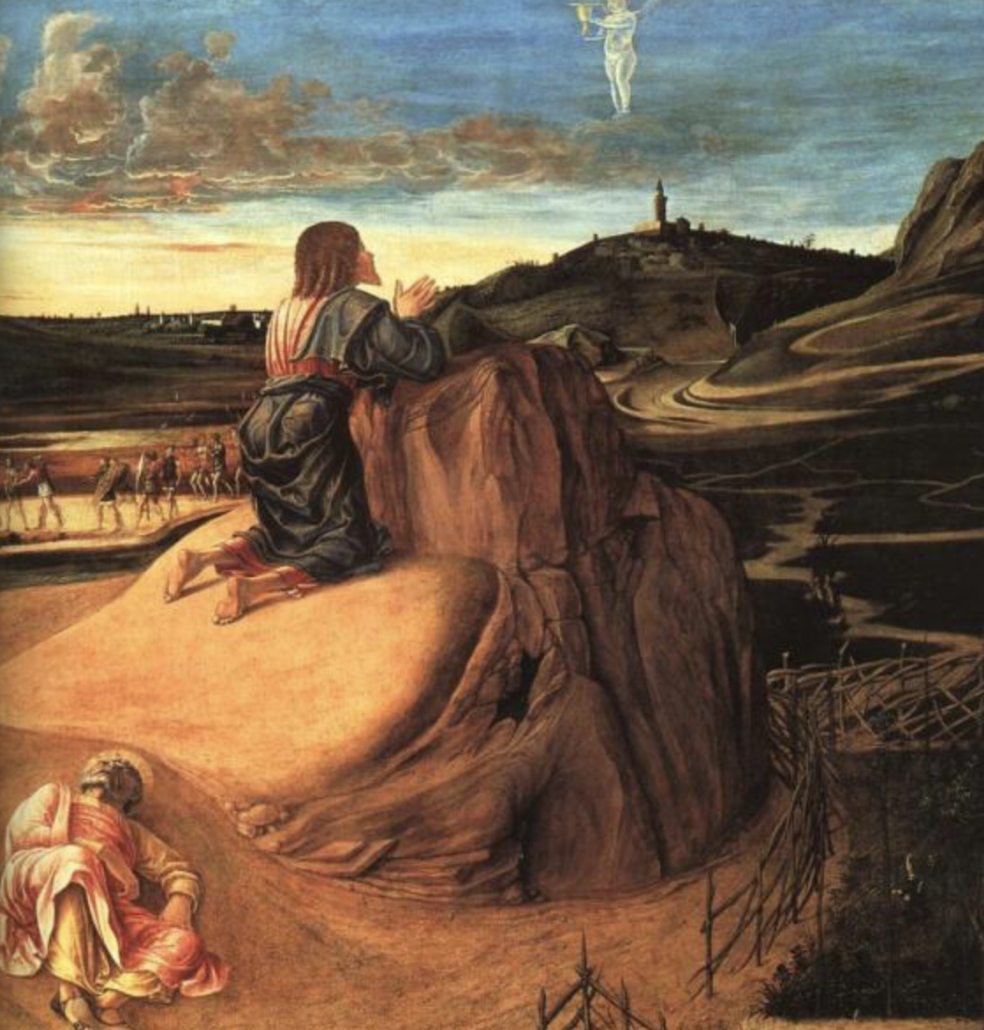
Faith in God includes one’s ongoing resolve to receive God’s moral character in Christ inwardly, and to belong to God, in the reverent attitude of Gethsemane; Christ in you is the inward agent-power of Christ working, directing at the level of psychological and motivational attitudes, towards a cooperative person’s renewal in God’s image as God’s beloved child; furthermore Gethsemane union with Christ as Lord calls for volitional cooperation and companionship with Christ, who empowers and guides how we think, not just what we think.
~Dr. Paul Moser, Philosopher Loyola University, Chicago
How are we to understand Good Friday and Easter from such a distance? How does it relate to our experience? Is it mere sentiment or something more profound? Andy Crouch in his book Culture Making: recovering our creative calling, (Chapter 8 “Jesus as Culture Maker”) has some brilliant insights into the difference that Jesus life, death and resurrection have for shaping the horizons of possibility (shalom and human flourishing) for societies, ancient and modern. He helps us grapple with the various dimensions of this sorrow and celebration. See also I Corinthians 15 and reflect on the meaningful quotes by other authors and leaders.
~Gordon Carkner
The Cross
He suffered the full weight of the human story of rebellion against God. He was literally impaled on the worst that culture can do–an instrument of torture that stood for all the other cultural dead ends of history, from spears to bombs, gas chambers to waterboards. Like all other instruments of violence, a cross is cultural folly and futility at its most horrible. (141)
The core calling of [Jesus] life is not something he does at all in an active sense–it is something he suffers. The strangest and most wonderful paradox of the biblical story is that its most consequential moment is not an action but a passion–not a doing but a suffering. (142)
On Good Friday, love embraced suffering as Jesus drank the bitter cup. Dr. Martin Luther King Jr. self-consciously followed the same journey of the suffering death of Jesus, the way of the cross, as he promoted civil rights for African-Americans in the Southern USA in the 1960s. He worked hard to replace the perverted symbol of the cross which was used as a justification for aggression, hate and violence—e.g. as an instrument of the Ku Klux Klan. His life quest was to restore the cross as a symbol of love, mercy, justice and non-violence. He incarnated a form of extreme love, a committed non-violent protest against systemic injustice.
~Iwan Russell-Jones, former BBC Filmmaker and Professor of Faith and the Arts, Regent College
Can Beauty Save Us? by Jimmy Myers, with permission.
This is the image of a Jewish man from Nazareth, crucified. In fact, his is the face of “the King of the Jews” and yet, it is supremely grotesque, bearing all the marks of suffering. His face reveals real forsakenness; his body aches of real bodily torture and real agony. His corpse lies mangled and bloodied, and his eyes…proclaim the dreadful word that causes all who hoped in him to shudder: death. There is nothing at all glamorous, desirable, or romantic about this image of the crucified One. But, of course, what is so profound about the face of this human is that his is also the face of God. His face radiates the Beauty of divinity, for he is Light from Light uncreated, the perfect image of the Father. He is, as Hebrews 1:3 says, “the radiance of the glory of God and the exact imprint of his nature.” The beauty of this person, wholly man and wholly God, lies in the mystery that he brings salvation to the world not by excluding suffering but by uniting himself to it. He refuses to recoil from a world that has become repellent; he does not laugh at the dereliction of others; he does not look at all that is bad and conclude, “all is well.” He does not stand far off. In his beauty, he comes near and embraces the “ugly” ones. He associates with strange and lonely and exiled folk, bringing the outcast in. He is the servant who suffers, and, protesting against “the way things are,” he laments “My God, my God, why have you forsaken me?” He exemplifies and creates a people committed to what David Hart calls “strange, impractical, altogether unworldly tenderness” to those whom Nietzsche would have annihilated…. He brings the whole festival of divine grace to a world that has excluded itself from it and invites…humanity to take part, to enjoy a feast of resurrection where all divisions, segregation, and exclusion are transcended, where all have their place at the supper of the Lamb, where all, who see the face of the Beautiful One and in that seeing are transformed, are inundated and radiated by Beauty itself. In a word, to paraphrase St. Athanasius, he becomes the Ugly One so that we, the original ugly ones who have made this world ugly with our violence, might become beautiful. This reveals the scandalous message of the Christian aesthetic regime, an alternative regime to that of our time: Beauty saves the world, but only by facing the Ugly head on and actually uniting himself to the regime of the Ugly. We cannot be saved by beauty as long as “beauty” is held captive by immanent attempts to achieve transcendence. The thought that we can be saved by immanent beauty is the presumption of a contemporary secularity that thinks that humanity can ever slowly, by carefully putting one foot above the other, ascend the ladder towards infinite beauty that awaits an enlightened race of humans. The truth that will always confront all of us at the top of that ladder, however, is the face of the God who, beyond history, came into history and became ugly, mangled, and ripped apart by deep dereliction and thorns, a face that unbearably whispers: you can only be saved by the beautiful one who has become the ugly one. In other words, the Ugly one alone can save us, the man of sorrows, acquainted with grief, whose divine Beauty is manifest in his descent to become—Jesus of Nazareth. (Jimmy Myers, Can Beauty Save Us?www.firstthings.com)
~ Peter Barber, Ph.D. Student Religious Studies at UBC~
The two principal assertions of Girard’s hermeneutical model are ‘mimetic desire’ and ‘scapegoating’. Mimetic desire is the idea that humans do not experience being and identity autonomously, but always only through an Other, a model for one’s desire. This could be an older sibling, an exemplar or a mentor. Desire and by extension ‘being’ is borrowed. This essential feature of human nature accounts for the enormous learning capability (the physical apparatus for which is now identified as the brain’s mirror neuron system), and is a positive basic feature of human existence. And yet, since desiring and being is through a model other, two or more persons desiring the same object(s) or things could end in rivalry over the object(s). This can and often does result in occasioning conflict and seeming to necessitate, in the estimation of the rival(s), the need for sacrifice of the Other, in order to gain the being blocked or inhibited by the model.
It is in this way that scapegoating regularly results from mimetic desire going sideways, as just described. Positive learning descends into destructive violence, the desire to destroy what you admire. The term scapegoat is chosen by Girard because it encapsulates our cultures’ reception of the spirit of Christ’s revelation throughout history, that sacrifice of the other is not ‘good’, is not even necessary, but is the false transfer of responsibility for rivalry and violence off of oneself and entirely onto the Other. The transferal is followed by destruction of the Other for his/her guilt, and for the danger or social pollution they still pose, in blocking access to the desired object(s). It threatens social chaos, and the scapegoat is sacrificed to restore peace and order.
Professor of Indigenous Theology at the Vancouver School of Theology
Can We Handle the Truth and Take Responsibility for Reconciliation?
Wednesday, March 10, 2021 @ 4 PM
Abstract
In the wake of the Truth and Reconciliation Commission report on residential schools, Canadians have often viewed Christianity as the enemy of Indigenous people. But there is another side to the story, claims Professor Ray Aldred. Almost two-thirds of Indigenous people in Canada actually call themselves Christian and appreciate what they have learned from Christian leadership over the years. Aldred notes that there is currently real hope for a better day, a way forward for our Indigenous people. This hope begins in community, in rethinking our identity, who we are and where we have come from. In this address, he will show the need to tell the truth and use human imagination to heal relationships with the land/creation, with family, clan and community, and with the Creator. At the heart of Indigenous peoples’ quest for healing is a shift in identity from shame to dignity of heritage. Mohawk writer Patricia Monture notes that key to this shift is a decision to take responsibility for all relationships, “Responsibility is at the heart of Indigenous freedom and self-determination.” We must strive to live in harmony with all things and all peoples, including the new visitors. We also wish to heal our treaty covenant relationships: through the threefold strategy of telling the truth, listening to one another, and seeking a common plan to repair the damage of abuse. Employing the principles of restorative justice, the difficult task of retelling our stories offers an important, creative way forward. These stories help us revisit the pain, face reality, and rediscover the good roots of our heritage. These vital steps constitute the effective direction of hope, as Ray has discovered through much experience.
Biography
Reverend Dr. Raymond C. Aldred holds a Master of Divinity from Canadian Theological Seminary, and a Doctor of Theology from Wycliffe College, Toronto School of Theology. Currently he is the Director of the Indigenous Studies Program, whose mission is to partner with the Indigenous Church around theological education. He is professor of Theology: Narrative, Systematic, Indigenous at the Vancouver School of Theology on the UBC campus. A status Cree, he is ordained with the Christian and Missionary Alliance Church in Canada. Born in Northern Alberta, he now resides with his wife in Richmond. Formerly Ray served as the Assistant Professor of Theology at Ambrose Seminary in Calgary, Alberta. He is former Director for the First Nations Alliance Churches of Canada, now a committee member, where he works to encourage Indigenous churches. Ray also has had the privilege of addressing several college conferences and meetings to raise awareness of these issues. He and his wife, Elaine, are involved in ministry to help train people to facilitate support groups for people who have suffered abuse.
We are very sad and disturbed by the discovery of the unmarked graves in Kamploops recently
https://youtu.be/J9-O8VYYlps The Big Idea: Relativism and the Struggle for a Stable Society with Dr. Gordon E. Carkner, Meta-Educator with UBC Postgraduate Students.
Many people today confuse science as a practice with scientism, a harmful ideology. This seminar offers a critique of scientism and shows how it restricts our thinking and does damage to the human quest for a fulsome, robust meaning. Dr. Gordon Carkner, someone who has studied both in the hard sciences/medical science and the humanities, shows the way forward out of the grip of scientism to a more whole understanding of knowledge. He points in the direction of a fresh paradigm and offers some excellent resources.
Dean & Professor of Theology, Corpus Christi College
Critical Realism: An Enduring Epistemology for Science and Theology
Wednesday, January 27 at 4:00 p.m.
Abstract
Critical Realism emerged as a way of thinking about knowledge in the mid twentieth century. After disillusionment with positivism and straightforward empiricism, critical realism (CR) established itself as a way that many scientists and scholars think about how knowledge is won and progress achieved. This realization came with an associated insight that reality is made up of different strata of reality: molecular, biological, psychological and spiritual, rather than a picture of reductionism of various entities to simple parts. Borrowing from the historian of science Ernan McMullin, the Canadian philosopher Bernard Lonergan and several other thinkers, I want to affirm two things about CR: 1) it best describes how to affirm reality in judgments whilst conceding the variety of historical paradigms that have affected how we know things to be true. 2) CR can help us understand how to do theology, notably with respect to scriptural testimony and doctrinal claims that were written and formulated in different cultures and in accord with different assumptions than our own.
Biography
Dr. Paul Allen specializes in systematic theology, the science-theology dialogue and theological anthropology. He taught at Concordia University prior to coming west. His publications include his doctoral dissertation, published as Ernan McMullin and Critical Realism in the Science-Theology Dialogue and (with Peter M.J. Hess), Catholicism and Science. More recently, he has written Theological Method: A Guide for the Perplexed (London: T & T Clark, 2012) as well as articles in journals such as Zygon: Journal of Religion and Science, The American Catholic Philosophical Quarterly, Heythrop Journal of Theology and Neue Zeitschrift für Systematische Theologie und Religionsphilosphie.
Everything is New in 2020 in Light of the Incarnation
He Comes, God is Coming; Can You Feel It? Can You See It?
God’s word of love becomes flesh in us, is embodied in us, is enacted through us, and thereby trust is forged between word spoken and the reality of which it speaks, between the words we speak and transcendent realities to which we point. The Word became flesh … a human life … a work of art … a prophetic Word, shaping a new humanism … a new community … a new social imaginary. Integrity is his name. God with us is the hope of a new creation, a new covenant, new purpose, abundant new life, a new age breaking in.
Peter Paul Rubens, Adoration of the Magi (1609-1629) Photo: Wikimedia Commons
Gordon Carkner reads his Advent Reflections
He comes: At just the right time, it was kairos time, richer, deeper, more meaningful than chronological time. He comes to dwell among us in incarnate human flesh: pulsating corpuscles, arms and legs running to greet us, face filled with compassion, hands breaking bread to feed the masses, words that give life and vision, that fire the imagination about justice, righteousness and human passion. Here lies the great invitation to counter nihilism, violence, lies, will to power, division.
The season of Advent means there is something on the horizon the likes of which we have never seen before…. What is possible is to not see it, to miss it, to turn just as it brushes past you. And you begin to grasp what it was you missed, like Moses in the cleft of the rock, watching God’s [back] fade in the distance. So stay. Sit. Linger. Tarry. Ponder. Wait. Behold. Wonder. There will be time enough for running. For rushing. For worrying. For pushing. For now, stay. Wait. Something is on the horizon. (Jan L. Richardson, Night Visions: Searching the Shadows of Advent and Christmas)
It is high time to slow down and search the deeper things of life, reach higher than ever before for a transcendent I-Thou encounter with divine Otherness. It is time to ponder the big question of meaning, purpose and identity. The profound light from heaven dispels darkness, confronts evil, frees the oppressed. Indeed, there is more here than meets the eye, there is plenty of wonder to captivate. Where are our best philosophers, historians and scholars, poets and scientists? What say they about the dramatic Christ event? There are clues to a great turn in history: both fulfilment and promise. What kind of thunderous inbreaking is this? What’s the meaning of this virgin birth, this epiphany of grace, these angelic visitations, these strangers seeking wisdom? Advent is a sign of good things to come for Mary, for the Jewish people, for the whole world. It speaks of infinite hope and goodness amidst despair and disappointment.
We have touched him with our hands, rubbed shoulders, gone for long walks, felt his robust embrace, dined and broken bread together. We heard wisdom from his lips that set our minds and hearts on fire. We have been embraced by his care and inclusion. How did he know us at such depth? At the end of it all, we have captured a mission that drove us to reach the world. It was a compelling message: dikaiosune justice, caritas grace and agape love, one that drills down deep into human culture. Deep calls to deep. We saw him die and rise again, ascend through the heavens. He has inaugurated an economy of grace and goodness, humility and compassion, justice for the poor. He conquered death itself.
The pregnant Mary sings her Magnificat, praising an awe-filled, enthusiastic Yes to God’s work in and through her womb: Things hidden for centuries become so crystal clear this holy night, so completely riveting, earth-shaking. Insight has set up a new epistemology, a new way of knowing and being that includes love at its core. We have entered a new world, one where agape love is the main game in town, the infinite game, the end game. Peace-making, reconciliation and blessing (shalom) shape our relationships, our posture towards others and the world. We feel refreshed and renewed.
It is a new playing field, a paradigm shift has taken place, a new human narrative has emerged with fresh interpretations of our raison d’être, our role in the bigger scheme of things. We need poets, we must invent new language, new metaphors to capture the wonder of what is happening. Infinite meets finite, like a comet burning through the atmosphere. Divine goodness ushers in hope of healing. A new future is born. Our people have waited and longed for this for centuries, believing he would come, if only in their wildest dreams. Their faith feeds on divine promise to covenant-keeping Abraham, Isaac, Jacob, and David, the prophets. Once upon a time, we could only hope for such wondrous things. Now they are palpable, life-transforming, future-altering, here.
You keep us waiting. You, the God of all time, want us to wait. For the right time in which to discover who we are, where we are to go, who will be with us, and what we must do. So thank you … for the waiting time. (John Bell, quoted in The Westminster Collection of Christian Prayers, compiled by Dorothy M. Stewart)
Sincere Christian believers claim Jesus of Nazareth as God’s Word (his divinelogos) made flesh, embedded in human culture and time. God’s speech is embodied, full-blooded, not flat or lifeless, not reductionistic or atomistic, no mere words. It is a divine move, a communicative action, that changes the universe of our perceptions. It is poetic-prophetic-pedagogical, a profound speech act, full of living spiritual vitality and deep truth. The language of incarnation leverages the whole world and transforms individuals along with society. It is strategically, intensively integrated with the human story, not a figment of our imagination. There is much to grapple with as we see in scholar Jens Zimmermann’s thoughtful Incarnational Humanism.
Christ the creative wisdom of God, and God’s active Word in creation, is enfleshed in the temporal-historical dimension of our world as the concrete Jewish Messiah, Jesus the Christ…. This is the Word through whom all things were made, and the Word hid in the eternal bosom of God, the Word who spoke through the prophets, the Word whose mighty acts defined the history of Israel. In Jesus the Christ this Word has become flesh, and the eternal has become temporal, but without ceasing to be eternal…. In Christ temporality and eternity are conjoined…. In the incarnation, creation, the world, time and history have been taken up into the God-man, who is the center of reality…. Faith and reason are inseparable because their unity is in Christ. (J. Zimmermann, Incarnational Humanism.)
Divine speech act starts with creation: God spoke and the heavens, the stars, the seas, the plants and trees, all living creatures, man and woman came into existence, in abundance. They continue to do so through his grace: creatio continua. God’s Word, his will for humanity, was enacted in particular places and times. It makes space for new drama, new dynamics today, for tragic optimism, for hope, justice and compassion in our confusing world. God has carved out space and time for his presence. When humans are addressed by God, they are drawn up into divine dialogue. Come, follow me; Be with me; Learn from me. Something profound occurs when humans take up such a great opportunity to reason and commune with their Creator, to grapple with this profound reality, to take on Jesus’ yoke, his kingdom mandate and his mantle of Lordship. They are identified, loved and valued by their divine mentor and source of life, their moral compass, wisdom and identity.
But God is present in reality no matter what unreality our practice and our ponderings imply. He is forever trying to establish communication; forever aware of the wrong directions we are taking and wishing to warn us; forever offering solutions for the problems that baffle us; forever standing at the door of our loneliness, eager to bring us such comradeship as the most intelligent living mortal cannot supply; forever clinging to our indifference in hope that someday our needs, or at least our tragedies will waken us to respond to his advances. The Real Presence is just that, real and life-enhancing, ushering in a new age. Nor are the conditions for the manifestation of his splendours out of the reach of any of us! Here they are: otherness, openness, obedience, obsession. (The Captivating Presence by Albert Edward Day)
As perlocutionary act, the incarnation is a robust speech act that produces an effect, an existential impact in those addressed through God’s very utterance. God’s Word has indeed impacted all human culture spheres: Science, the Arts, Ethics and Religion, given birth to our great universities. Brilliant Swiss theologian, Hans Urs von Balthasar, sees the Word of God revealed in three powerful ways: through Creation, Scripture, and most profoundly the Incarnation. These are three different types of language, each powerful, complementary, integral to the divine voice. They open new spaces for human meaning and identity, spawning new fields of articulacy. Jesus is the Articulate Word that makes sense of us.
These words use both traditions of semantic logic, take advantage of the full human linguistic capacity like Charles Taylor says in The Language Animal: designative and constitutive. Jesus, the transcendentone who takes on human flesh, brought the fullness of heaven to earth and in so doing, showed that the Unity and Trinity of God need not be destroyed when expressed in the multiplicity of the world. This includes statements, images, concepts, personhood and judgments. He is the ‘Superword’ (Überwort) above all words, the very speech of God (Balthasar). Everything hinges on whether God has spoken. The alternative is cosmic silence, the Absolute or Dasein (Being) remains silent beyond all words, as in Zen Buddhism.
To have found God, to have experienced him in the intimacy of our being, to have lived even for one hour in the fire of his Trinity and the bliss of his Unity clearly makes us say: Now I understand. You are enough for me. (Carlo Carretto, a desert monk, from The God Who Comes)
In the year of COVID-19, 2020, in late modernity, in our divided world, the incarnation is God’s megaphone to awaken the world spiritually (hear the angels trumpets). Those who discern the dawn should awaken the world. This magnificent event calls us to fullness of being as the Imago Dei, amidst all our confusion, challenges, conundrums, contradictions and existential struggles. Make room for the God who comes, give ear to the God who speaks, allow yourself to be embraced by the loving God who includes, and calls you into his most noble conversation this Advent Season. Enjoy his presence.
~Dr. Gordon E. Carkner, Meta-euducator, Graduate & Faculty Ministry, UBC
Advent is a season for prayer and reformation of our hearts. Since it comes at winter time, fire is a fitting sign to help us celebrate Advent… If Christ is to come more fully into our lives this Christmas, if God is to become really incarnate for us, then fire will have to be present in our prayer. Our worship and devotion will have to stoke the kind of fire in our souls that can truly change our hearts. Ours is a great responsibility not to waste this Advent time. (Edward Hays, A Pilgrim’s Almanac)
Reading is great for your mental and spiritual health. Read like your life depended upon it. Here are some of our suggestions for Christmas gifts or personal enrichment. Stay alert; the world is changing.
Religious Freedom in Islam: The Fate of a Universal Human Right in the Muslim World Today. Daniel Philpott (Oxford University Press).
Light from the Distant Stars. Shawn Smucker
Ten Arguments for Deleting Your Social Media Accounts Right Now. Jaron Lanier
In Search of the Common Good: Christian Fidelity in a Fractured World. Jake Meador
Confronting Christianity: 12 Hard Questions for the World’s Largest Religion. Rebecca Loughlin.
Adorning the Dark: Thoughts on Community, Calling and the Mystery of Making. Andrew Peterson.
The Gospel in Gerard Manley Hopkins: Selections from his Poems, Letters, Journals and Spiritual Writings.
The Price of Tomorrow. Jeff Booth
Reading Romans with Eastern Eyes: Honor & Shame in Paul’s Message & Mission. Jackson W.
His Testimonies, My Heritage: Women of Color on the Word of God (edited by Kristie Anyabwile).
The Second Mountain: The Quest for a Moral Life. David Brooks (Random House).
Virginia Stem Owens, Wind River Winter (Regent College Publishing, 2001).
Daniel Taylor, In Search of Sacred Places: Looking for Wisdom in Celtic Holy Islands (Bog Walk Press, 2005).
For the Life of the World: Theology that Makes a Difference. Miraslov Volf & Matthew Croasmun.
Recently posted on YouTube: The Existential identity Crisis of Millennials.
Senior Fellow, Institute for Advanced Studies in Culture
Senior Fellow, Miller Center of Public Affairs
University of Virginia
Audio Only File of John Owen
Abstract
Three decades after its supposed permanent global triumph, democracy is in trouble nearly everywhere. In the United States, Europe, Asia, Africa, and Latin America, constitutional self-government is on the back foot, as polarization destroys societal trust and anti-liberal populist movements and leaders gain power. Autocracy is becoming even more entrenched in the two giants, China and Russia. Some other countries proclaim the desire to be more like them. Once seen as an inevitability, democracy now appears a fragile achievement. In world politics, there is an evolutionary dynamic which the international environment selects for some types of state. Since World War II, the United States and other mature democracies have deliberately tried to preserve democracy at home by shaping the international environment through a liberal-internationalist foreign policy. In the language of evolutionary theory, they have engaged in niche construction, altering their environment to “select for” constitutional self-government, and “select out” authoritarianism. They enjoyed great success, but in recent decades, the niche has actually come to undermine democracy, favoring autocracy. Liberalism itself has been transformed from its earlier classical forms to a cosmopolitan version that seeks to erase all barriers to economic and social interaction in the name of individual fulfillment. Such cosmopolitan liberalism has provoked a cultural and economic backlash that acts to jeopardize constitutional democracy itself. China and Russia meanwhile are constructing their own niches, reshaping the international order to select for autocracy. Defending democracy from the outside will require a reformed liberal internationalism that will de-polarize electorates, restore solidarity among democracies, and be less inclusive of authoritarian regimes. As the most powerful constitutional democracy, the United States retains the most important role in this reformation.
Biography
John M. Owen is Ambassador Henry J. and Mrs. Marion R. Taylor Professor of Politics, and a Senior Fellow at the Institute for Advanced Studies in Culture and the Miller Center of Public Affairs, at the University of Virginia. Owen is author of Confronting Political Islam (Princeton, 2015), The Clash of Ideas in World Politics (Princeton, 2010), and Liberal Peace, Liberal War (Cornell, 1997), and co-editor of Religion, the Enlightenment, and the New Global Order (Columbia, 2011). He has published scholarly papers in the European Journal of International Relations, European Journal of International Security, Global Policy, International Organization, Internationale Politik und Gesellschaft, International Politics, International Security, International Studies Quarterly, Perspectives on Politics, and several edited volumes. His articles have appeared in Foreign Affairs, The Hedgehog Review, The Hill, The Washington Post, National Interest, TheNew York Times,and USA Today. He is a former Editor-in-Chief of Security Studies; he serves on its editorial board and that of International Security. Owen has held fellowships at Harvard, Stanford, Princeton, Oxford, the Free University of Berlin, and the WZB Berlin Social Science Research Center. He is a recipient of a Humboldt Research Prize (2015). He holds an AB from Duke, an MPA from Princeton, and a PhD from Harvard. In Fall 2020, he is a Visiting Professor in the Political Science Department at the University of British Columbia.
Karl Mannheim 1942: “With the coming of the Renaissance and Liberalism, Christianity failed to remain the basic ferment and integrating force in social life… The spiritualization and regulation of human affairs, public and private, has gradually been left to the competing institutions in society… This secularization produced a stimulating variety of human experience… But the fact that the competing value systems cancelled each other out led to the neutralization of values in general. This is one of the reasons why liberal society at its present stage is handicapped in resisting the spiritual and political challenge coming from the totalitarian states… A liberal and competitive economy and its society can function quite well with neutralized values as long as there is no threat from within or without which makes a basic consensus imperative… [in which case] liberal education for intelligent partisanship… must gradually be replaced by a new education for responsible criticism, wherein consciousness of the whole is at least as important as awareness of your own interests… Such a new morality can only be achieved if the deepest sources of human regeneration assist the rebirth of society”.
Tolstoy predicts the current epidemic of fake news: “The more men are freed from privation; the more telegraphs, telephones, books, papers, and journals there are; the more means there will be of diffusing inconsistent lies and hypocrisies, and the more disunited and consequently miserable will men become” (The Kingdom of God is Within You – 1893).
Also Recommended: Netflix Documentary called Social Dilemma
You may not always have a comfortable life and you will not always be able to solve all of the world’s problems at once but don’t ever underestimate the importance you can have because history has shown us that courage can be contagious and hope can take on a life of its own. ~ Michelle Obama