Posted by: gcarkner | July 25, 2014

Dawkins-Lennox Debate September 22, 2014

Dialogue for the Curious Cranium

Think Again!

Oxford Biology Professor Richard Dawkins

debates

Oxford Mathematician/Philosopher Dr. John Lennox

at UBC

  • Monday, September 22 @ 4:00 p.m.
  • Woodward IRC Room 6

This is a film of a recent debate followed by a panel discussion with

Dr. Dennis Danielson English Department UBC, and Dr. David Helfand, President of Quest University

 Paper on Scientism as a Barrier to Knowledge by Dr. Gordon Carkner SCIENTISM:Apologeetics Canada

 Screen Shot 2014-08-30 at 1.00.11 PM

Some Quotes from Famous Scientists to Spark the Discussion Prior to the Debate

https://www.youtube.com/watch?v=UlR3bOsoAdA Alister McGrath, University College, London  responds to New Atheism

“Faith is the great cop-out, the great excuse to evade the need to think and evaluate evidence… Faith is belief in spite of, even because of, the lack of evidence…Faith is not allowed to justify itself by argument…  Faith being belief that isn’t based on evidence is the principal vice of any religion”

~Richard Dawkins

“There is something infantile in the presumption that somebody else has a responsibility to give your life meaning and point… The truly adult view, by contrast, is that our life is as meaningful, as full and as wonderful as we choose to make it.”
― Richard DawkinsThe God Delusion

“Do you really mean to tell me the only reason you try to be good is to gain God’s approval and reward, or to avoid his disapproval and punishment? That’s not morality, that’s just sucking up, apple-polishing, looking over your shoulder at the great surveillance camera in the sky, or the still small wiretap inside your head, monitoring your every move, even your every base though.”
― Richard DawkinsThe God Delusion

“The only watchmaker is the blind forces of physics.”
― Richard DawkinsThe God Delusion

“Indeed, organizing atheists has been compared to herding cats, because they tend to think independently and will not conform to authority.”
― Richard DawkinsThe God Delusion

A Blogger’s Summary of Lennox’s Arguments about the nature of science and reality in God’s Undertaker: Has Science Buried God? which responds to Dawkins. http://craigjosling.blogspot.ca/2012/05/summary-of-gods-undertaker-has-science.html

“The existence of consciousness is both one of the most familiar and one of the most astounding things about the world. No conception of the natural order that does not reveal it as something to be expected can aspire even to the outline of completeness. And if physical science, whatever it may have to say about the origin of life, leaves us necessarily in the dark about consciousness, that shows that it cannot provide the basic form of intelligibility for this world.” 

Thomas Nagel Philosopher in Mind and Cosmos

“The common belief that . . . the actual relations between religion and science over the last few centuries have been marked by deep and enduring hostility is not only historically inaccurate but actually a caricature so grotesque that what needs to be explained is how it could possibly have achieved any degree of respectability. “ ~Colin Russell, Historian of Science

“Note that I am not postulating a ‘God of the gaps’, a god merely to explain the things that science has not yet explained. I am postulating a God to explain why science explains; I do not deny that science explains, but I postulate God to explain why science explains.  The very success of science in showing us how deeply ordered the natural world is provides strong grounds for believing that there is an even deeper cause for that order”.

~Oxford Philosopher Richard Swinburne

[The issue here is that, because God is not an alternative to science as an explanation, he is not a God of the gaps.  On the contrary, he is the ground of all explanation: it is his existence which gives rise to the very possibility of explanation, scientific or otherwise.]

 “Because there is a law of gravity, the universe can and will generate itself from nothing”.~Stephen Hawking and Mlodinow in “The Grand Design”.

Arno Penzias (Nobel prize-winning discoverer of the cosmic background microwave radiation): “Astronomy leads us to a unique event, a universe which was created out of nothing, one with the very delicate balance needed to provide exactly the right conditions required to permit life, and one which has an underlying (one might say “supernatural”) plan” (Cosmos, Bios and Theos, Margenau and Varghese eds., Open Court, La Salle III,1992 p.83).

“You, your joys and sorrows, your memories and ambitions, your sense of personal identity and free will are in fact no more than the behaviour of a vast assembly of nerve cells and their associated molecules”. ~Francis Crick

“There is not the slightest shred of scientific evidence that life is anything other than a stupendously improbable accident.  It’s often said that life is written into the laws of physics; well, it’s not – any more than houses or television sets are.  It is consistent with those laws, but they alone will not explain how it came to exist….For a hundred years the debate has been dominated by chemists, who think it’s like baking a cake: if you know the recipe, you can just mix the ingredients, simmer for a million years, add a pinch of salt, and life emerges.  I don’t think that is ever going to be the explanation, because life is not about stuff, about magic matter; it’s about a very special type of information processing system.  And the whole subjects of information theory and complexity theory are very much in their infancy… A law of nature of the sort we know and love will not create biological information, or indeed any information at all.  Ordinary laws just transmit input data into output data.  They can shuffle information about but they cannot create it … I have come to the conclusion that no familiar law of nature could produce such a structure from incoherent chemicals with the inevitability that some scientists assert” (Paul Davies, op cit, p.20).

“A common sense interpretation of the facts suggests that a superintellect has monkeyed with physics, as well as chemistry and biology, and that there are no blind forces worth speaking about in nature.  The numbers one calculates from the facts seem to me so overwhelming as to put this conclusion beyond question” ~Cambridge astronomer Sir Fred Hoyle, The Universe: past and present reflections (regarding the resonances in energy levels in H, Be and C).

Sir John Polkinghorne, for instance, himself an eminent quantum theorist, rejects the many-universe interpretation.  “Let us recognise these speculations for what they are.  They are not physics, but in the strictest sense, metaphysics.  There is no purely scientific reason to believe in an ensemble of universes.  By construction these other worlds are unknowable by us.  A possible explanation of equal intellectual respectability – and to my mind greater economy and elegance – would be that this one world is the way it is, because it is the creation of the will of a Creator who purposes that it should be so” (One World, SPCK, London, 1986 p. 80).

“Natural selection, the blind, unconscious, automatic process which Darwin discovered …is the explanation for the existence and apparently purposeful form of all life, has no purpose in mind… is the Blind Watchmaker” (Richard Dawkins).

The tendency towards a pure reason or pure faith are really impossible to actualize; there  are no pure domains of reason and faith. They are intertwined. One cannot get rationalism without the other extreme of fideism; both are forced categories; rationalism needs faith to be fideism for its very survival. Nietzsche claimed that there are only interpretations; positivists claim that there are only facts. What should we believe whatever our starting point or prejudgments? It is perhaps a life-long quest to understand the nuances of this relationship. Marquette intellectual D. Stephen Long helps our quest offering fresh insight and much to ponder in his profound bookSpeaking of God:  theology, language and truth. Stephen was a past guest speaker at UBC in the GFCF series.

~Gord Carkner

See also posts within this blog on A Fine-Tuned Universe? and on Alvin Plantinga, Where the Conflict Really Lies, Markers of Scientism

https://ubcgcu.org/2013/10/15/david-bentley-harts-provocative-take-on-naturalism/  David Bentley Hart comments on naturalism as an explanatory regime.

Key Insights from a Course by John Lennox Summer of 2014

  • DNA is a language, a semitic code. It involves billions of bits of information (3.5 billion base pairs).
  • Scientists are beginning to accept that there is a ‘singularity’ at the origin of life–they are giving up on a scientific transition from inanimate matter  to biological life. The attempt to see how a chemical soup  can emerge into life has failed. Emergence is not the answer. Evolution must start with biological life.
  • Many top biologists (e.g. James Shapiro, William Provine, Robert Reid, Lima de Faria, Eric Davidson) are having doubts or second thoughts about the mechanism of natural selection. They are joined by atheist philosopher Thomas Nagel (Mind & Cosmos).
  • Insight about Information in a System: information must be inputted; a biological system doesn’t create info; information is not physical or material. Structures that bear information cannot arrive by emergence.

 Our Two Distinguished Panelists

Professor David J. Helfand, President and Vice-Chancellor, Quest University Canada; President, American Astronomical Society, Professor of Astronomy, Columbia University (on leave). He has spent 35 years as Professor of Astronomy at Columbia University, where he served as Department Chair and Co-Director of the Astrophysics Laboratory for more than half that time. He is the author of nearly 200 scientific publications on many areas of modern astrophysics including radio, optical and X-ray observations of celestial sources from nearby stars to the most distant quasars. He is engaged in a research project designed to provide a complete picture of the birth and death of stars in the Milky Way.

But most of all, David is an inspirational teacher, who received the 2001 Columbia Presidential Teaching Award and the 2002 Great Teacher Award from the Society of Columbia Graduates. He has a deep concern about the state of the modern research university which he sees as dysfunctional, in part because of the impossibly large number of functions which the research university is expected to fulfill in 21st. century North America and in part because of the low priority given to teaching excellence. Because of these concerns, he has taken the radical step of pioneering a university dedicated to innovative teaching. David believes that he is a better cook than he is an astronomer and, ambiguously, colleagues who have sampled his gastronomic delights agree. We welcome him as a major public intellectual and a personal friend of many of us.

Dennis Danielson professor of English at the University of British Columbia, is a literary and intellectual historian who has made contributions to Milton studies and to the early modern history of cosmology, examining scientific developments in their historical, philosophical, and literary contexts. His books include Milton’s Good God: A Study in Literary Theodicy (1982) and the Cambridge Companion to Milton (1989, 1999), both published by Cambridge University Press. His subsequent work in the history of astronomy, especially The Book of the Cosmos: Imagining the Universe from Heraclitus to Hawking and The First Copernican: Georg Joachim Rheticus and the Rise of the Copernican Revolution, has engaged both humanities scholars and scientists in dialogue about the historical and cultural as well as cosmological meaning of Copernicus’s legacy. Danielson was the 2011 recipient of the Konrad Adenauer Research Prize from Germany’s Alexander von Humboldt Foundation. His new book Paradise Lost and the Cosmological Revolution is in press and scheduled for publication by Cambridge University Press in 2014.

Further Reading on Science & Religion

Polkinghorne, Sir John, One World: The Interaction of Science & Theology. Princeton. (physicist/theologian—leading light on Science & Religion)

Polkinghorne, Sir John, Exploring Reality: The Intertwining of ScienceReligion, Science and Providence.

McGrath, Alister. A Fine-Tuned Universe: the quest for God in Science and Theology. (Gifford Lectures)

Hutchinson, Ian. Monopolizing Knowledge.

Craig & Meister (eds.). God is Great; God is Good.

Gingerich, Owen, God’s Universe.

Collins, Francis, The Language of God. Free Press.

Pascal, Blaise.  Pensees.  Trans. A. J. Krailsheimer.  Harmondsworth, U.K.: Penguin, 1966.

Capell & Cook eds., Not Just Science: Questions Where Christian Faith and Natural Science Intersect. Zondervan

Jaki, Stanley, The Road to Science and the Ways to God. Chicago (Gifford Lectures on history of science)

Russell, Colin, Crosscurrents: Interactions Between Science & Faith. Eerdmans

Danielson, Dennis (ed.), The Book of the Cosmos. Perceus.

Plantinga, Alvin, Where the Conflict Really Lies: science, religion and naturalism. (a critique of the new atheist and the hegemony of Philosophical Naturalism)

King's College Cambridge

King’s College Cambridge

Lewis, C.S., Miracles. Macmillan (a classic)

Waltke, Bruce, “Gift of the Cosmos” (article on Genesis 1:1-2:4) Chapter 8 in   An Old Testament Theology, Zondervan, 2007.

Alexander, Denis, Rebuilding the Matrix: Science & Faith in the 21st Century. Zondervan (director of Faraday Institute in Cambridge, UK)

Burke, ed., Creation & Evolution: 7 Prominent Christians Debate. IVP UK.

Livingstone, D. N., Darwin’s Forgotten Defenders: The Encounter BetweenEvangelical Theology and Evolutionary Thought.

Owens, V.S., Godspy: Faith, Perception, and the New Physics.

Gingerich, Owen, “Let There Be Light” article on natural theology by America’s top Christian physicist at Harvard’s Smithsonian Institute.

Theology of Creation

Alexander, Denis, Evolution or Creation?: Must we Choose?

Capon, R. F.,  “The Third Peacock” in The Romance of the Word. Eerdmans

Gunton, C., The Triune Creator: a historical and systematic study. Eerdmans (English theologian)

Walsh & Middleton, The Transforming Vision. IVP (on Christian worldview)

Bouma-Prediger, S., For the Beauty of the Earth: a Christian vision of creation care. Baker Academic, 2010.

Nagel, Thomas, Mind and Cosmos.

Limits of Science

Medawar, P., The Limits of Science.

Schumacher, E.F. A Guide for the Perplexed. Abacus. (brilliant challenge to ontological reductionism)

Carkner, Gordon, Unpublished paper: “Scientism and the Search for an Integrated Reality” (several posts from this on the Blog)

McGrath, A. & J., The Dawkins Delusion? IVP 2007.

Lennox, John. God’s Undertaker: Has Science Buried God? Lion Books, 2011.

Jeeves & Berry,  Science, Life, and Christian Belief. Apollos Books.

Ward, Keith, Pascal’s Fire:  Scientific Faith and Religious Understanding.

Harper, Charles Jr. ed., Spiritual Information: 100 Perspectives on Science and Religion. Templeton Foundation Press.

Spencer, N. & White, R. Christianity, Climate Change, and Sustainable Living.  SPCK, 2007.

See also DVD Series called Test of Faith from Faraday Institute in Cambridge, UK

Screen shot 2012-08-17 at 11.20.43 AM

Posted by: gcarkner | July 14, 2014

Negotiating Postmodern Thought @ UBC

Why is postmodernism a good thing for Christian graduate students? Cornel West writes that “truth-claims about descriptions in science and religion are contextual, and for Christians, ‘Truth-talk’ precludes disinterest, detachment, and distance because Jesus Christ is the Truth, the Truth which cannot be theoretically reified into a property of an abstract description, but only existentially appropriated by concrete human beings in need.” Rather than having to shoehorn Christianity into our academic work in a way that presents some parochial Christian idea as The Right Way to Think About X, we have the freedom to approach our work joyfully as an outgrowth of our position as followers of Christ.

The applied linguist Suresh Canagarajah notes that postmodernism or post-positivism in the social sciences is hospitable to those with strong political or religious commitments because it unsettles the “old platform” of scientific inquiry, calling into question constructs of rationalism, objectivity, empiricism, disinterested knowledge, and so on. On the other hand, Canagarajah also writes: “postmodernism has only limited uses for me as a philosophical paradigm. I am prepared to abandon postmodernist discourses when my spiritual walk reveals richer orientations that illuminate faith and life better.” Read More…

Posted by: gcarkner | July 8, 2014

After Nihilism: Towards an Incarnational Outlook

Go Past Nihilism and Find a Better Orbit

Screen Shot 2014-08-21 at 4.56.14 PM

As we move beyond nihilism, we long to see culture reformed, heritage maintained, lives made whole, identities brimming with meaning. From one perspective, we want our full humanity back; we want the big picture on who we are, where we are and what our potential is. What is the discourse that can locate this renewal? Is it to be found in the language of incarnational humanism, an ancient tradition with many modern scholarly advocates? Language is an important means of God’s prophetic engagement with humans, the infinite in communion with the finite, all the while expanding the horizons of the finite. There is a profound significance about the Creator in dialogue with his creature, with his creation. We see this communication writ large in the incarnation; it is astoundingly important and yet often neglected today. How else can we engage agape love and the goodness of the divine in the fullest sense? It is a great gift (a bridge) to us humans which is meant to draw us upwards into a new dimension of life, a new caliber of thinking, finding a new centre to orbit around.

D. Stephen Long does an excellent effort of showing this complexity and nuances of this outlook in his important book God Speaking.

The certainties which the church has received as a gift require its participation in humanity’s “commom struggle” to attain truth. The human search for truth, which is philosophy’s vocation, is not set in opposition to theology’s reception of truth as gift. What we struggle to understand by reason we also receive by faith. No dichotomy exists between the certainties of faith and the common struggle by human reason to attain truth .… The truths humanity seeks by common reason (philosophy) and the certainties of faith can be placed over against each other such that each illuminates the other and renders it intelligible until the two ultimately become one, which is of course what the incarnation does in reverse. The concretion of the one Person illumines the natures of both divinity and humanity. (D. S. Long, God Speaking, p. 87)

Hermeneutic philosopher Anthony Thiselton says that the mystery of the incarnation is too profound for human discovery alone; it requires transcendent revelation and interpretation. Read More…

Posted by: gcarkner | July 2, 2014

Words to the Curious: Gord’s Summer Reads

Words to  the Curious: Summer Reading Possibilities for Cranial Inspiration

Screen Shot 2014-07-02 at 1.53.06 AM

Screen Shot 2014-07-02 at 1.53.47 AM

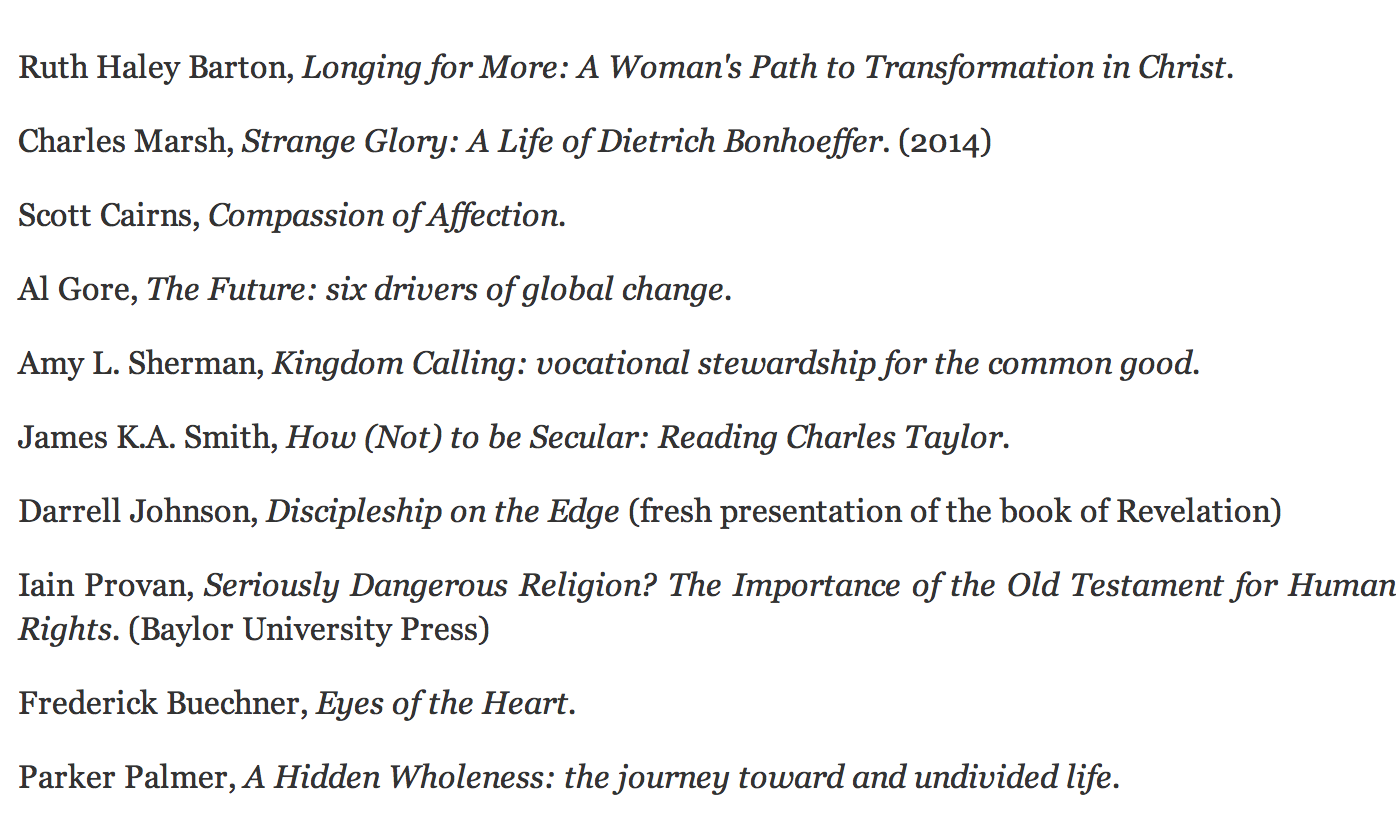
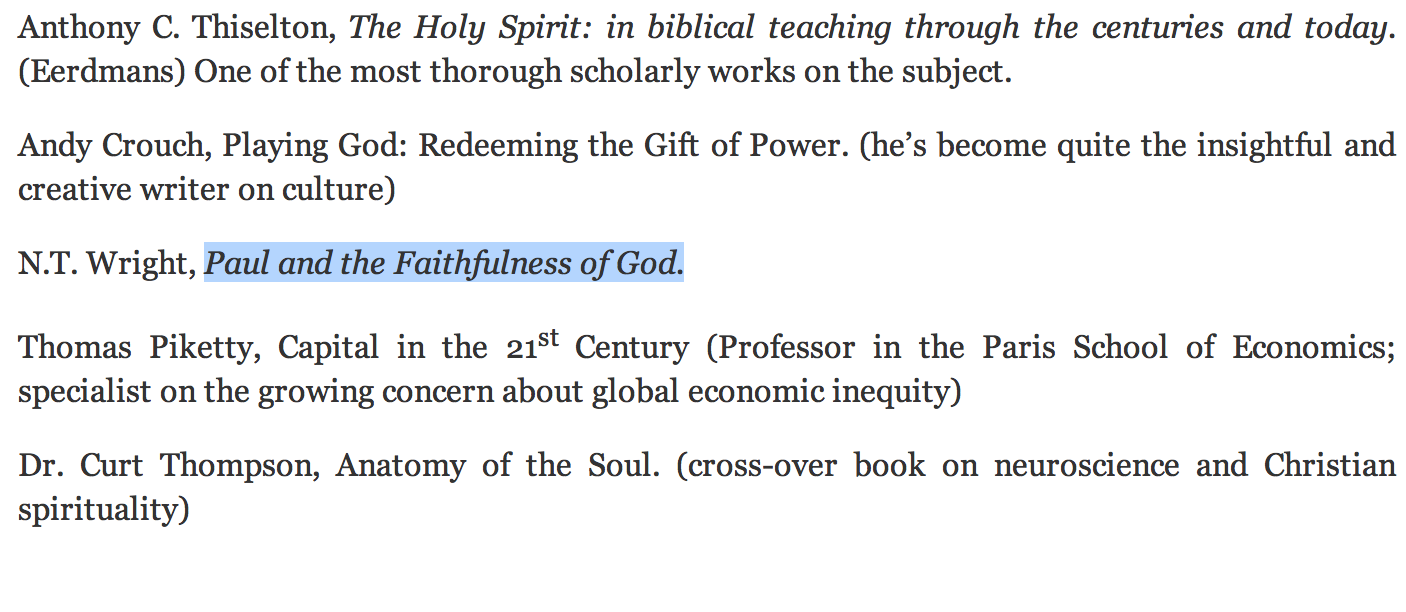
Who doesn’t want to read a stack of good books this summer? I’ve tried to offered a variety: spanning devotional to world affairs with some supercharged theology in the mix: excellent scholarship, the prophetic voice and people who brave the spiritual journey towards intimacy with the divine. Nihilism does not have the last word.


~Gord Carkner

Screen Shot 2014-06-24 at 7.05.30 AM

Posted by: gcarkner | June 7, 2014

Religious Discernment 101

It doesn’t matter what you believe; all religions are basically the same?

This is certainly a common sentiment, promoting tolerance and respect for difference. This is often the discussion in the clever TV show Little Mosque on the Prairie. One also notices such an exploratory sentiment in the movie Life of Pi. The trouble is, it’s a naive statement that lacks gravity and plausibility. It trivializes some of the most important discussions of our time. What a person believes about the ultimate meaning of life matters infinitely, especially to them. It also trivializes the Big Life Questions of purpose and meaning. Believers at least recognize the differences and their significance for how life is lived. They often risk torture and death for their beliefs, especially if they refuse to bow to an oppressive political regime which may not favour their religion. They quite literally stake their lives on these beliefs; that’s not trivial at all.

But are these believers mistaken? Does it really not make any difference what you believe? Are all religions at bottom the same? Is John Hick and other religious relativists correct after all, i.e. that plurality of cultures and religions within our globalized world means that pluralism (the ideology) is true? Has our late modern world trivialized truth too much for us to discern these issues?

Undoubtedly, there is much common ground between religions. Many accept a Creator and have some story of origins, plus a notable figurehead, a great or wise person with unusual insight, someone who can gather a significant following. All have a sense of good and evil, and a quest for peace.They want to solve an existential human problem.  There is often a search for enlightenment or truth about oneself and the world–the meaning question. They try to answer why we suffer at some level. Most foster worship and teach an ethic for living well, being responsible for one’s family and respecting one’s neighbour’s interests, concern for the poor. There are indeed many similarities; few would question that claim. There is also much that is good in most religions [We say this while knowing that there exists also bad religion which deceives, exploits and oppresses the individual, steals her freedom or livelihood, splits up families, takes advantage of the naive].

But the similarities are by no means complete. In fact, the differences are quite staggering upon further investigation. Take conceptions of the divine, for example. While Buddhism prefers the emptiness of Nirvana to any positive or definite idea of God, tribal religions are polytheistic, believing in many gods, like the ancient Greeks and Romans. And in between, we have everything from the impersonal Brahman of Hinduism to the intimate personal Lord of Christianity. And of course we have the fundamentalist Neo-Atheists (Dawkins, Dennet, Harris et al) who claim that God and religion is irrelevant and probably even harmful, a promoter of violence; science is all we need and all we can trust. There are also different analyses of what is lacking in the world (the brokenness within the human condition) and how this can be redeemed, repaired, or addressed effectively. There is a common quest, but different solutions, to fix us humans, a sense that we still have a long way to go, both in our character and identity development.

A further example is the Christian idea of the incarnation. That God bent on revealing himself to us entered history as a human being is a claim unique to the Christian faith, but it is absolutely essential to the integrity of that faith. Other religions might claim temporary manifestations of deity as an avatar or angel from time to time. Christianity alone rests on the assumption that God literally became man for our human identification, affirmation of the human journey, and salvation from self-harm or harm by others. If supernatural aid for our current problems is available, that is significant indeed; it ought to capture our attention and stimulate our imagination.

Are these beliefs all the same? One could hardly say that. They are at variance with each other: they are even contradictory on many points. They might conceivably all be wrong, but we fear that they cannot all be right on all points. The common thing is the spiritual quest for all humans. But here is the basis for dialogue: to understand and appreciate each other on campus. We are here at university from all round the world and from a grand diversity of religious atheist ideology backgrounds; we ought not settle for stereotypes but ask our friends what they actually believe and why. Learn from and respect your laboratory and research neighbour. Listen hard to what motivates and empowers them ideologically, religiously. Perhaps even take a comparative religions course.

We conclude that it does matter very much what you believe. Otherwise, let’s face it, we are shallow and anti-intellectual, unwilling to learn from someone different from ourself . All religions make strong exclusive claims; if one drills below the surface, each one believes they have the truth on many matters and the purpose of our existence. We need to examine these claims to determine which are true, which are most plausible. This can be a fun and enlightening exercise, stimulating you to understand your belief better and more critically. Considering that the majority of our world’s population espouses some faith, this is not trivial at all. Let’s keep the conversation going!

~Gord Carkner, PhD Philosophical Theology

Reference: Eerdmans Handbook on the World’s Religions; JND Anderson, The World’s Religions. See also the post called Dialogue on Worldviews, and the series on Moral Relativism. David Bentley Hart has some brilliant quotes on the natural and supernatural as well.

The religious relativist, while claiming to take every religion seriously, does not take any religion seriously. He does not appreciate what is at stake in religious disagreements.                                                                                                                                                                                          –Dr. Jay Newman,  Philosopher University of Waterloo

See also Jens Zimmermann, Hermeneutics: a very short history. (OUP 2015)

Screen Shot 2016-01-09 at 11.57.43 AM

Posted by: gcarkner | May 22, 2014

We Want Our Humanity Back

Recovering Our Humanity Involves a Courageous Moral Stance and Content

New 2018 Book Release on this theme: Craig M. Gay, Modern Technology and the Human Future: a Christian Appraisal, IVP Academic.

There are many forces in the world today that would seek to steal our humanity, our innocence, our dignity and self-respect, our higher calling in life, our good reason, our good faith, our deeper sense of purpose. There are forces that seek to dismiss our connection with a moral robustness and a transcendent horizon of meaning, seek to dumb us down. We are tempted to sell out to the cheaper definitions of the human experience, to live a trivial existence of narcissism and radical self-interest–the prideful consumer. At the end of the day, these cheap versions are lies and smokescreens, keeping us form deeper insights and wisdom of the ages. They set us up for a spectacular fall, prevent us from reaching our better self. People should not settle for cheap versions of humanity; they should expect and demand a full and whole humanity and pursue a thick self. Don’t miss the profound quotes at the bottom of the article, especially those from Abraham Heschel.

But who would deny that humans have ethical capacity and are skilled at apprehending the good and the true? There is often disagreement about ethical foundations but not this fundamental capacity to make ethical choices and reflect as ethical beings. From a materialist perspective it may seem enigmatic, but nevertheless a real phenomenon as noted by Charles Taylor in Sources of the Self. This is quite amazing for any animal. Without this critical ability, one could not expect good science or good relations among scientists, let alone justice and fairness of opportunity within an academic institution, a courtroom or a society. Science would be bankrupt without a tremendous amount of trust, critical thinking and peer review accountability. This is all about ethics and normative expectations; truth and goodness are both operative.

Nor is this moral capacity simply a mere product of evolution, although biologists such as Jeffrey Schloss at Westmont College are working on the evolution of altruism. The moral dimension of our humanity cannot be properly reduced to a survival issue or self-propagation. All humans by choice and desire participate in a quest for truth and struggle with their grasp of the ethical (except for psychopaths or sociopaths), the just, and the fair. Both truth and love are together needed for genuine knowledge according to the late Wittgenstein. [1]

In my PhD work, I was delighted to discover the deep genius of philosopher of the self Charles Taylor at McGill University. According to Taylor’s important tome Sources of the Self, [2] people are deeply embedded as moral creatures and universally have some relationship to the good; they cannot escape their moral capacity, behaviour or moral desires. They cannot escape being moral interpreters and interlocutors. I wrestled much with his position on the moral subject in my critique of Michel Foucault’s concept of moral self-constitution, which was rooted in radical freedom. Taylor, Canada’s premier philosopher, has many important things to offer to this philosophical anthropology conversation. You can read more about the parameters of his position in the GCU blog posts  entitled ‘Quality of the Will’. Read More…

Posted by: gcarkner | May 7, 2014

Paul Ricoeur: Une Grande Pensée


Screen Shot 2014-05-06 at 7.26.13 PMPaul Ricœur (1913–2005) was a French scholar widely recognized as one of the most distinguished philosophers of the twentieth century. In the course of his long career he wrote on a broad range of issues. He is best known for combining phenomenological description with hermeneutics. As such, his thought is within the same tradition as other major hermeneutic phenomenologists, Martin Heidegger and Hans-Georg Gadamer. In 2000, he was awarded the Kyoto Prize in Arts and Philosophy for having revolutionized the methods of hermeneutic phenomenology, expanding the study of textual interpretation to include the broad yet concrete domains of mythology, biblical exegesis, psychoanalysis, theory of metaphor, and narrative theory.

The major theme that unites his writings is that of a philosophical anthropology. This anthropology, which Ricoeur came to call an anthropology of the “capable human being,” aims to give an account of the fundamental capabilities and vulnerabilities that human beings display in the activities that make up their lives. Though the accent is always on the possibility of understanding the self as an agent responsible for its actions, Ricoeur consistently rejects any claim that the self is immediately transparent to itself or fully master of itself. Self-knowledge only comes through our relation to the world and our life with and among others in that world.

In the course of developing his anthropology, Ricoeur made a major methodological shift. His writings prior to 1960 were in the tradition of existential phenomenology. But during the 1960s Ricoeur concluded that properly to study human reality he had to combine phenomenological description with hermeneutic interpretation. For this hermeneutic phenomenology, whatever is intelligible is accessible to us in and through language and all deployments of language call for interpretation. Accordingly, there is no self-understanding that is not mediated by signs, symbols, and texts; in the final analysis self-understanding coincides with the interpretation given to these mediating terms. This hermeneutic or linguistic turn did not require him to disavow the basic results of his earlier investigations. It did, however, lead him not only to revisit them but also to see more clearly their implications. Read More…

Posted by: gcarkner | May 4, 2014

Problem of Moral Relativism … 3

Alternatives to Relativism

Ethical relativism denies that any objective, universal moral properties exist. It arose in the philosophical context of the dominance of empiricism and naturalism and the rejection of metaphysically abstract universals. It perpetuates the mindset that  we know how things really are for all people: i.e. that morals are relative to individuals or cultures. It is a universal claim that there are no universals. Nietzsche saw very clearly that if there was an end to God and traditional values, then the strong could impose their values on the masses. Domination would be widespread. Thus came his model of the ubermensch (superman) and the ethics of will-to-power.  There is a natural progression from relativism to will-to-power ethics (with the view that a human is just another thing in the world). William Golding’s book Lord of the Flies, which many of us studied in secondary school, is a graphic, heart-wrenching picture of unrestrained evil, where might makes right and bullying and scapegoating is the accepted social ethos. A group of boys marooned on a remote island make their own society, and the results are shocking. The twentieth century has trembled at the great atrocities and abuse of power by those who are without any fear of a transcendent being or any sense of obligation to a code of conduct or set of norms. They operate without accountability. We enter a Hobbesian world where it is ‘all against all’. See the BBC documentary on Nietzsche “Human all too Human” https://www.youtube.com/watch?v=3EGOwduWVKA

Moral philosopher R. Scott Smith argues (In Search of Moral Knowledge) that ethical relativism or subjectivism is a bankrupt view of the nature of morality; it utterly fails as a moral theory and a guide to one’s moral life; it results in morally inconsistent and untrustworthy behaviour. It leads to the complete demise of morality itself with absurd consequences:

We should not settle for a relativistically based tolerance, since it will not succeed in building a moral society or in helping people be moral.That kind of morality forces us to consider all ideas and ways of life as being equally valid, yet we can know that this is not the case … Nevertheless, tolerance (as respect  of people as having equal moral value) would make sense if a universal, objective moral basis exists for that equality. (162)

Relativism in the twentieth century has led us into some very dangerous political experiments; billions have been spent on war-making; human rights have been violated in terrible ways; imperialism ran rampant; multiple millions have perished. It is known as the bloodiest century in history.  British journalist Paul Johnson (A History of the Modern World: from 1917 to the 1990s) graphically illustrates the way in which the ethic of will-to-power has flourished in the soil of relativism during the twentieth century. In fact, we may well ask, Do we have one example in history of benevolent leadership without the restraint of traditional morality and the rule of law, i.e. a context where the governing authorities have absolute power whether tzar or proletariat leader? How indeed is Russia operating these days?

Without a moral plumb line, societies seem headed for personal nihilism and/or political tyranny. This dilemma was admitted by an atheist blogger: RationalSkepticism.org The ultimate end point is despair and ugly oppression, propaganda and control from the top. A subjectivist ethic is no ethic at all; it offers no hope for society or for psychologically healthy relationships. It consists in the blind leading the blind. It offers no reason to get along in society, no moral basis for law, no place to appeal when there is a dispute between parties. Morality must address the proper resolution of conflicts and call unjust behaviour to account. Relativism seems to lead us into some frightening conclusions both intellectually and experientially. We must ask whether there is not another paradigm that can be more intellectually sound, sane and just. Despite its popularity and opiate for the masses, relativism is both inconsistent and dangerous. Read More…

Posted by: gcarkner | April 24, 2014

Who Stole Our Humanity?…5

Restorative Moves to Recover Our Humanity and Dignity

Further on the quest to retrieve our deeper humanitas, we move beyond scientism’s caricature of human existence, towards a whole and healthy picture of persons. We want to recover our lost heritage as Christian humanists (David Lyle Jeffrey, Andy Crouch, Culture Making; Jens Zimmermann, Incarnational Humanism; Erasmus). What are we to make of homo sapiens sapiens? Under scientism, influential thinkers like Nietzsche and Skinner have charted a cultural course beyond good and evil, while also relieving us of our freedom and dignity. It is indeed a surprisingly unpleasant road to nihilism. Reductionistic anthropologies have led to much political oppression and abuse as seen under Pinochet, Pol Pot, Mao, Stalin, Mugabe and Hitler in the twentieth century, where the government became the pirate of the people. They live an atheism rich with a will to power and without human rights. Scientific materialism has morphed into political-economic exploitation, with massive human suffering and extensive violence and loss. We must protest this impoverished and exploitive view of persons and seek an alternative, one that is urgent in our age of global terrorism, economic challenges, shrinking resources and political flash points (see Al Gore, The Future: six drivers of global change. 2013).

Humans must be distinguished from nature. Certainly, a person is continuous with nature biologically; this is one of the reasons that human biology has been so successful. But we should not settle for views of our identity reduced to our biological origins or biological infrastructure; humans are not only a part of nature, they definitely stand apart from nature in significant ways. They are much more complex and sophisticated than animals or machines despite the similarities. We can do serious damage when we do not recognize these distinctions. Much that is deeply true about us transcends our biology, chemistry and physics. Humans are an order of magnitude different from animals in many capacities: e.g. human altruism goes far beyond genetic altruism. Consider Oscar Shindler, says Francis Collins head the National Institute of Health brain mapping program, who took incredible risks to save those who were not of his tribe or DNA. Read More…

Posted by: gcarkner | April 21, 2014

Personal Mission Statement: the Power of Focus

Mission Statement: the Power of Focus

See also Grit: the power of passion and perseverance by Angela Duckworth


One Fall Retreat a couple years ago, GCU folks began with listening to a profound talk by Dr. Gordon Smith, a theologian on the concept of Christian Pilgrims. Perhaps you can listen to this CD at some point.  You could find it in the Regent Bookstore or Library. Gordon’s main point is that there is a vast difference between a tourist and a pilgrim. Tourists make demands and complain a lot about the service, expressing an attitude of entitlement. Pilgrims give thanks as they journey, humbly seeking out the gems of a situation. This attitude of gratefulness is rooted in a strong belief in, and appreciation for, the goodness of God in each situation. A pilgrim sees the importance of making it a faith statement, a weekly affirmation that: “God is Good and Gives Good Gifts”. Indeed God is the highest and purest form of goodness, the standard to measure all human claims to goodness (D. Stephen Long). Trinitarian mutuality is rich in self-giving. Our response is to give thanks as a way of life (Ann Voskamp).

It is this very good God who invites us into his Sabbath Rest (Hebrews 4:1-13). Sabbath is not a mere passive ceasing from work, but rather a cultivation of this attitude of thankfulness on the journey, a deliberate faith walk. The image takes us back to the desert wandering period in the story of the Children of Israel. God invites them (and us) into a communion of love, as fellow givers rather than consumers. Ruth Haley Barton offers a balanced approach to Sabbath in a chapter in her volume Sacred Rhythms: Arranging Our Lives for Transformation. Some might resonate with Mark Buchanan in his thoughtful book The Rest of God: Restoring Your Soul by Restoring Sabbath. There are plenty of mentors to help us discover this Sabbath Rest.

Sabbath is the proper context for thinking about a ‘Personal Mission Statement’. It is important to take regular time out from our many activities, conversations and efforts in order to reflect on the big picture. It is key to a focus that can empower life and make it more meaningful. Below are some of our thoughts from the GCU retreat on a mission statement. It is core to what we want our life to mean and represent. Core to what we want to accomplish, essential to who we   are and what we fight for. One could say that it is the beam of wisdom that runs through a life—that on which other goals and objectives are hung. Few people (about 3%) take the time to dig deep, reflect upon and write such a statement. They assume this practice is for institutions, hospitals, governments or corporations.

A personal mission statement captures one’s narrative quest or “hypergood” to use a Charles Taylor term. It taps into our deep structure desire to make a substantial and important contribution. We think it is important for postgraduate students to take time to do this; otherwise life leads in a hundred directions without a focus, a formula for frustration and discouragement. We can get intensely busy and distracted by details and deadlines, and thereby lose the deeper meaning and the bigger picture of why we are in this program. We lose track of our life-focus trajectory. Read More…

« Newer Posts - Older Posts »

Categories