Posted by: gcarkner | March 29, 2013

Why Aren’t Things All Better?

Why Didn’t Everything, including Us, Become Perfect after the Cross?

Dr John Stackhouse Jr.


We often ask questions of the “Why didn’t God just . . .” variety. Why didn’t God just avoid the whole painful business of the Incarnation? Why didn’t God in particular just spare his Son the Cross? Why didn’t God just heal all the sick and raise all the dead at once in the career of Jesus? Why didn’t God just . . . and so on, and so on. In each of these cases, the Christian answer is the same: God elected either the best of the available choices or, indeed, the only choice available for God to pursue his purposes.

Jesus’ anguish in the Garden of Gethsemane the night of his betrayal is a key case in point. He badly wants to avoid the horrors to come and tells his Father so, begging him to find another path, to give him a different cup to drink. As he prays, however, Jesus becomes convinced once for all that there is no other path to take. So he willingly goes on to drink the cup of suffering and death. Apparently, even God couldn’t “just” wave a magic wand and make everything better. Quite the contrary.

The natural follow-up question, furthermore, might best be explained in a paradoxically similar fashion. Most people who encounter the Christian teaching about the Cross of Christ wonder why, if Jesus suffered all of that on our behalf, did evil and its effects not then immediately disappear from the world? Read More…

Posted by: gcarkner | March 29, 2013

Evil & Suffering Poses Deeper Questions

The Presence of Evil and Suffering Pushes to Deeper Thought  

Many people think that the problem of evil, with the suffering it brings, is a barrier to belief in God. Let’s face it; this is the big one that leads to much skepticism and troubled faith. Philip Yancey (Finding the Invisible God) thinks it the major apologetic challenge for God and Christian faith, although William Lane Craig claims that philosophers no longer worry about it. The New Atheists have much commentary on the topic; they want the suffering to stop as well. Let’s take it to a bit deeper level because for most of us, it is a problem or at least a confusion. The current conflict in Syria is just one nasty example. There is much wisdom to be garnered as we grapple with such major human concerns.

Aldous Huxley wrote: “In the form we have posed it, the Riddle of the Universe requires a theological answer. Suffering and enjoying, men [women] want to know why they enjoy and to what end they suffer. They see good things and evil things, beautiful things and ugly, and they want to find a reason–a final and absolute reason–why these things should be as they are.”

Here’s how the discussion often proceeds:

1. A God who is infinitely good and loving would not want evil to exist.

2. A God who is all·powerful could remove all evil, if he so desired.

3. Therefore, if God is both good and all-powerful, there would be no evil. Sounds forceful and convincing on surface.

4. But evil continues in the world. Evidence for this is in the news every day. That bugs everyone, both believer and skeptic!

5. Therefore, God (at least a good and all·powerful God) cannot exist. So people like Bertrand Russell conclude.

This argument is superficially convincing. But it has one major flaw. The third point does not follow logically from the first two. All that is required, if God were both good and all-powerful, is that evil would not exist forever. God would at some point have to deal with evil and remove it from his creation. It would require a final reckoning, or settling of the accounts. Read More…

Posted by: gcarkner | March 27, 2013

Epiphany of the Transcendent

Easter as Epiphany

Epiphanies are suggestive of transcendence. Michael Morgan (1994, pp. 56f)) points out that Charles Taylor sees a parallel between the epiphanies of art and poetry in the nineteenth and twentieth centuries and the I-Thou epiphany of religious encounter with the divine. Taylor elaborates the idea of epiphanies (1989, pp. 419f, especially 490-93). He sees Post-Romantic and modernist art as oriented to epiphanies, episodes of realization, revelation, or disclosure. Epiphanies and epiphanic art are about a kind of transcendence, about the self coming in touch with that which lies beyond it, a ground or qualitative pre-eminence.

Taylor reviews various ways of articulating epiphany in Sources of the Self (1989, pp. 419- 93). He articulates how God, inserted into this idea of epiphany, fits as a moral source (Sources of the Self, pp. 449-52). Epiphanies can be a way of connecting with spiritual and moral sources through the exercise of the creative imagination: sources may be divine (Taylor), or in the world or nature (Romantics), or in the powers of the imaginative, expressive self (Foucault).

These epiphanies are a paradigm case of what Taylor calls recovering contact with moral sources. A special case of this renewal of relationship between the self and the moral source is religion and the relation to God, which he sees in the work of Dostoyevski. The relationship to art parallels the relationship to religion. The self is oriented in the presence of the inaccessible or sublime, that which captures one’s amazement or awe, for example, when one’s eyes are riveted to a certain painting, and one’s inner emotions are deeply moved by a poem. One is taken beyond oneself, in an experience of transcendence; the experience involves both encounter and revelation. Read More…

Posted by: gcarkner | March 25, 2013

Evidence of a Resurrection?

Under Investigation: Some Allege that the  Resurrection of Jesus was a Hoax

If this statement is true, there is no evidence for the most central Christian belief next to the existence of God. That would be tragic indeed. As the Apostle Paul wrote to one of the first Christian churches, “If Christ has not been raised, our preaching is useless, and so is your faith” (1 Corinthians 15:14). Easter becomes pure myth without historical substance. This is a powder keg question.

But a reasonable and responsible person needs solid evidence. It is common historical knowledge that Jesus died on a Roman cross and was buried. And the biblical records indicate both that his tomb was found empty shortly afterwards and that a large number of people claimed to have spoken, walked and eaten with him after his death. These claims are indeed unusual, even  startling! They need explanation. We must decide whether there is a more plausible alternative than an actual physical, bodily resurrection. Much hangs on the answer.

Alternate explanations abound: 1) that thieves stole the body of Jesus; 2) that the Roman or Jewish authorities stole it; 3) that Jesus’ disciples stole it; and 4) that Jesus was not actually dead when buried and left the tomb on his own. Below we deal with each one briefly. Read More…

Posted by: gcarkner | March 20, 2013

The Age of Rights

Entering the Age of Human Rights and Pluralism: Public Religion in Canada from MacKenzie King to Trudeau

 George Egerton PhD, Professor Emeritus History, UBC

What wisdom can we find in the longer history of engagement between religion and politics in Canadian history which can shed some light on our present choices? These are some concluding remarks.

First, I would argue that the resistance of some fundamentalist Protestants and Quebec ultra-Catholics to the protection of human rights, an aversion mixed sometimes with xenophobia and anti-Semitism, is to be shunned by all Christians. Both Protestant and Catholic forms of Christianity developed rich theological rationales for human rights protection, both internationally and nationally; this framework should be powerfully sustained in contemporary theological and political engagements.

However, the leftist, social gospel wing of Protestantism, represented in such figures as John Humphrey, Frank Scott, King Gordon, and Arthur Roebuck, in embracing the human rights agenda often abandoned any legitimating reference to religious foundations which might prove embarrassing in the context of pluralism. The liberal Protestant Canadian churches have also in the main traveled this path, accommodating liberal cultural agendas of extending human rights without a sense of constraint when this process involved violation of classic religious teachings. The result has been not only debilitating internal division within these churches and the loss of a distinctive prophetic voice in culture, but also the loss of any religious conscience within the secularized governance of Canada. Read More…

Posted by: gcarkner | March 18, 2013

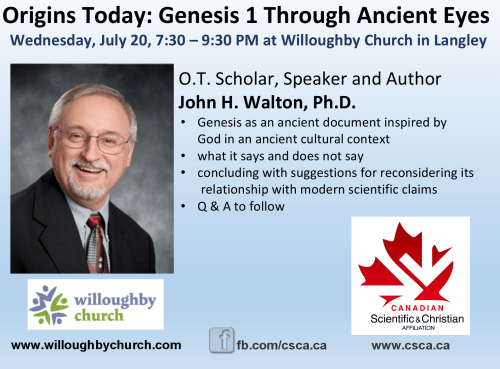
Visiting Scholar John H. Walton


Screen Shot 2016-03-27 at 8.44.00 PM.png

Abstract

Online Presentation:  http://the3rdchoice.org/podcasts/ and http://biologos.org/ecf/grantees/origins-today-genesis-through-ancient-eyes

See also DVD called “From the Dust” which can be obtained at iTunes.

According to Notre Dame Sociologist Christian Smith, 70% of American university students sense a conflict between science and religious faith. Therefore, this topic of Origins is one of the most pressing issues with which we must grapple on universities worldwide.

This lecture has occurred and revealed fresh, unexpected insights into the important and complex issue of interpretation of ancient biblical text. Dr. Walton has focused his research on the literature and cultures of the ancient Near East and the Hebrew Scriptures (especially Genesis 1-3), drawing important clues from ancient cosmology. His rigorous work offers a close reading of the creation narrative within its cultural and historical context. This reading raises important questions about appropriate biblical insights for modern science regarding the natural world (cosmology, biology, human origins).  It also explores a unique and fruitful philosophical framework for thinking about the cosmos and our place in it. Are today’s scientific conclusions regarding old earth, common descent, and origins of the human race actually in conflict with the Hebrew Bible? Our speaker will explain his scholarly and critical perspective on the matter. Read More…

Posted by: gcarkner | March 16, 2013

Nihilism is Not the Final Word

A Wager on Tragic Optimism

Nihilism does not have the last word. Life is difficult; we all agree. There is no facile formula that makes everything all better, despite what millions of pundits offer. To be human in our world (a very good, but also very broken world) means that we often witness and experience hardship, pain and suffering and violence against the neighbour. A local Vancouver pastor’s son was killed in a case of mistaken identity. Stupid, senseless violence swallowing the innocent, cutting short a whole life of potential. Will the killing and displacement (nearing two million refugees) and destruction in Syria ever quit?  The choices we have to make, the risks that have to be taken, the responsibilities that have to be carried are not easy. The formulae we learn early in life often break down. Life is a lot more complex than we once thought and dreamed To be human means to experience disappointments and broken dreams; one often hears of the post-university seven year run at the career wall. We don’t always get what we want, even when we train for it all the way to a PhD. There are no guarantees of high correlation between aim and achievement, expectation and event, merit and honour. To live is to suffer, like it or not, and sometimes it occurs by the hands of those we love, admire and trust most. To love well even at its best is to suffer, to be misunderstood. This can cause deep stress, even trauma. But it can also create the space in which true wisdom and character begin to emerge.

The critical issue seems to be our response to, negotiation of, the painful and disappointing experiences of life. Many of us try the irresponsible (impossible) route: to avoid suffering at all costs. However, to mature means that we must find meaning in our suffering and grow from and through it. This is the way of health: taking courageous responsibility to find answers to life’s problems, to confront the Big Questions. We must be constantly willing to grow and learn from our mentors. Rethink, revise, re-approach, re-engage life. Some of the great treasures of our human existence involve digging deeper than we ever thought possible. The narcissism of our day tempts us to give up, accept easy answers, throw in the towel far too quickly–a road to neurosis, un-health and perpetual immaturity. It is a cheap trick for those who don’t want to live deeply. Technology won’t work either, won’t make us more human or bypass pain. No deeper character will emerge without learning the art of negotiating suffering; we will continue to skate on the surface and grab onto the nearest mythology, ideology package or live a cliché. Deconstruction only goes so far and then we are left with nothing; without a sound worldview, without a centre, without reckoning with our narrative self, we can go all the way down and find only an empty fantasy.

Read More…

Posted by: gcarkner | March 11, 2013

Freedom & Identity

Sociologist Robert Bellah in his landmark book, Habits of the Heart, exposes the myth of radical freedom. Bellah’s team of researchers interviewed hundreds of Americans in various careers on the topic; the results revealed a struggle with a number of contradictions consequent to the philosophy of radical individualism. These contradictions were both emotional and cognitive. It seems that there is something deeply problematic with radical individualism. Bellah writes:

It is a powerful cultural fiction that we not only can, but must make up our deepest beliefs in the isolation of our private selves … There are truths we do not see when we adopt the language of radical individualism…. The major problem in individualism is its disregard for the social dimension of life, and the importance of that dimension in shaping the self. According to German sociologist Emile Durkheim the group (i.e. social solidarity) is a prerequisite for the identity of the individual. George Herbert Mead, another turn of the century sociologist, notes that meaning is a relational or interpersonal matter, not a mere individual phenomenon. The self is socially produced. (R. Bellah, Habits of the Heart. 1985, pp. 65, 85 & 123)

One can often imagine that the best growth occurs on one’s own, even during one’s greatest rebellion, but in fact one can only grow as a person while in direct and significant relationships, complementary partnerships with others. A person finds one’s true and soulful being in mutual love and communion. Some intellectuals believe that love is more basic to our identity than reason, although not against reason. One can attempt to be an individual alone but will fail to become a person on one’s own.

Read More…

Posted by: gcarkner | March 10, 2013

Alasdair MacIntyre: Recovery of Virtue

Screen shot 2013-03-10 at 5.46.40 PMAlasdair Chalmers MacIntyre (born 1929) is a Scottish philosopher primarily known for his contribution to moral and political philosophy but known also for his work in history of philosophy and theology. He is Senior Research Fellow at the Centre for Contemporary Aristotelian Studies in Ethics and Politics (CASEP) at London Metropolitan University, and an Emeritus Professor of Philosophy at the University of Notre Dame. During his lengthy academic career, he also taught at Brandeis UniversityDuke UniversityVanderbilt University, and Boston University.


Alasdair Chalmers MacIntyre was born 12 January 1929 in Glasgow, to John and Emily (Chalmers) MacIntyre. He was educated at Queen Mary College, London, and has a Master of Arts from the University of Manchester and from the University of Oxford. He began his teaching career in 1951 at Manchester University. He taught at the University of Leeds, the University of Essex and the University of Oxford in the United Kingdom, before moving to the USA in around 1969. MacIntyre has been something of an intellectual nomad, having taught at many universities in the US. He has held the following positions: Read More…

Posted by: gcarkner | March 6, 2013

Steven Bouma-Prediger: Protector of the Biosphere

Steven Bouma-Prediger is Professor of Religion, Head of Religion Department at Hope College in Holland, Michigan.

Steven Bouma-Prediger

Bouma-Prediger is an esteemed professor of religion and chair of the department of religion at Hope College in Holland, Michigan where he has taught since 1994.  His scholarship focuses on ecology and theology. Prior to coming to Hope, he was an assistant professor of philosophy and chair of the department at North Park College in Chicago. He holds an M.Phil. from the Institute for Christian Studies in Toronto, an M.Div. from Fuller Theological Seminary and a Ph.D. from the University of Chicago. His numerous publications include five books: Beyond Homelessness:  Christian Faith in a Culture of Displacement, co-authored with Brian Walsh; For the Beauty of the Earth:  a Christian Vision for Creation Care; Evocations of Grace: Writings of Joseph Sittler on Ecology, Theology, and Ethics, co-edited with Peter Bakken; The Greening of Theology: The Ecological Models of Rosemary Radford Ruether, Joseph Sittler, and Jurgen Moltmann; and, with Virginia Vroblesky, Assessing the Ark: A Christian Perspective on Nonhuman Creatures and the Endangered Species Act. He is also the author of numerous published scholarly articles.

http://www.hope.edu/academic/religion/fac_staff/bouma_prediger.html Academic Home Page


For the Beauty of the Earth (now in its revised second edition) won an Award of Merit from periodical Christianity Today in the theology and ethics category in the 2001 Book Awards program. In December 1999, he was elected the recipient of Hope College’s Outstanding Professor Educator  Award. This book comes highly recommended by UBC Professor Emeritus Geographer Olav Slaymaker.

Sample from the book: https://ubcgcu.org/2012/08/30/virtues-toward-creation/

~Steven was a speaker at UBC for the Graduate & Faculty Christian Forum in September of 2010. He lives a profound, integrated life and has an excellent knowledge of both environmental science and the biblical understanding of creation and creation care. He believes that we can recover the virtues of our relationship with our fragile blue green planet. He is one of the foremost thinkers in this arena of research–offering a sane way forward.

You might also benefit from insights from Cal DeWitt at University of Wisconsin or this blogger who is doing a PhD on Christian perspectives on the environment: Jeremy Bonham

http://theblueoakblog.wordpress.com/2013/04/07/contemporary-christian-environmentalism-a-case-study-by-jeremy-bonham/

« Newer Posts - Older Posts »

Categories