Posted by: gcarkner | June 5, 2024

Taylor versus Foucault on Freedom 3/

Proposition 3Redeemed freedom flourishes within a trinitarian horizon. Trinitarian divine goodness proves to be a fruitful plausibility structure within which to think about freedom and the moral self. Trinitarian goodness-freedom takes us to one more dimension of the self. It reveals new possibilities for identity, discovery, and personal transformation. It also adds sophistication to some of Taylor’s categories of the horizon of the good. It is in the life of the God-man Jesus that one can visualize this goodness-freedom dynamic.

What is full liberation? Michel Foucault, the philosopher of freedom, claimed that, “Ethics is the deliberate form assumed by freedom.” So what form will endure as a stable, longterm identity? What is the possibility of a transcendent paradigm shift in this conversation? The language of strong transcendence implies some dynamic that resides outside the economies of human experience, and human culture spheres: science, art, religion and ethics. It plays a key role in the drama of moral self-constitution and personal freedom through the validation of the self from a larger horizon of significance. We achieve more not less human meaning.

Here we propose a further recovery of ethics in partnership with trinitarian relationality. Jesus of Nazareth offers an exemplum of redeemed human freedom. In my PhD dissertation, I show that the human good could be linked through a transcendent turn to trinitarian goodness. Jesus’ life constitutes reconciliation, rather than enmity between goodness and freedom. In the philosophical turn towards transcendent goodness, Foucault’s ontology of liberty is subverted by the ontology of agape love without losing anything. We move from the aesthetic to the ethical and now the religious plane of existence (Kierkegaard), towards maturity.

How does Jesus’s life interpret freedom uniquely in light of this suggested turn to transcendent goodness? The interpretation starts as trinitarian theonomous goodness-freedom, a God-related freedom, that is qualified by transcendent divine goodness. It begins with the living God of the Christian story, who is constituted by a form of relation, mutuality and reciprocity, in which freedom is given to that which is Other. In this case, it is other Persons within the Trinity: Father, Son, and Holy Spirit. The Christian Trinity is a tri-unity of Persons with a history of self-giving freedom that defines God’s being as agape love. It is the constitutive good, the highest moral source and inspiration for human, finite goodness.

The position we are taking is clarified by British theologian, Alistair McFadyen, who reflects on the hermeneutic of freedom and self-giving within the Trinity. Human freedom, he claims, is grounded in, and defined by, God’s freedom.

God’s inmost being is constituted by the radical mutuality of the three divine Persons, in which they both give and receive their individuality from one another. In their intersubjectivity, there is the creative intention and recognition of subjectivity, and therefore transcendence in form of the integrity of personal identity, in the giving of space to one another. This giving of space is an interpersonal event, and must not be thought of as analogous to the evacuation of physical space. It is not a form of absence, but a way of being present with others in creative recognition of their autonomy within the relationship. It is a letting-be, rather than a letting-go: a structuring of the relationship so that it includes space and time for personal discreteness and autonomous response. Thus, the trinitarian life involves a circulation of the divine potentialities of being through the processes of self-giving, in the unity of which the three Persons receive their distinct personal identities. (A. McFadyen, 1995, 46-7)

This is the same gift of benevolent divine freedom that is expressed through the presence in the world of God the Son (Jesus of Nazareth) and God the Holy Spirit, the second and third Persons of the Trinity. God is a community of Persons in movement towards and present within creation, stimulating and opening up a future possibilities for robust human freedomBecause God is free, loving and relational, humans should be confident that they are not victims of fate, domination, and materialistic determinism. The character of redeemed freedom is creative and dynamic in its existential engagement with human sociality. Human freedom takes its cue from God, and flourishes within the ethos of God’s freedom. In fact, the dependence of human freedom on God secures its integrity. God creates the larger horizon for freedom, God affirms and validates human freedom within this order. Thus, the relationship between divine and human freedom is a profound gift.

God’s gift of freedom also entails God’s willingness to take/suffer the consequences of human freedom, even human assertions of autonomy and disbelief in God.

Knowledge of this goodness-freedom is not invented sui generis. It is offered through relationship with God as Trinity. God’s creation opens the latitude that affords space for human response in a non-coercive environment. It even includes the possibilities of human misunderstanding, rejection, disobedience towards and even disbelief in God. McFadyen, (1995,44) writes: “We find God subjecting Godself, first of all to the limitation of the incarnation in a human person; secondly, allowing Godself to be subject to human freedom—even to the extent of death—to bear the consequences of the human refusal of freedom.”

Human freedom is enhanced and empowered when there is a grateful response to the God who built into creation the very possibility and parameters of human freedom. The created, ordered ecology of relations is respectful of both divine sovereignty and a large degree of finite human choice and autonomy. Space is given for growth in individual integrity, uniqueness and particularity. This matches Foucault’s strong emphasis on the creativity in the self, without sacrificing many other positive infrastructural dimensions. At the end of the day, Foucault resists this limited but rich definition of freedom as a gift from God. He wants instead unlimited, unrestricted freedom for the self–radical autonomy–which falls into nihilism and narcissistic obsession with oneself.

Jesus, on the other hand, is the free and loyal Son of the Father, exemplifying the positive marriage between goodness, freedom and obedience, revealing its existential world impact. The irony of our discovery is that freedom as radical autonomy leads to a loss of self, crisis of identity and alienation from the Other. Jesus is completely free within a communion of love. In the practice of redeemed freedom, the human freedom of Christ vividly discloses God’s creative freedom–an important epiphany or revelation of strong transcendence.

[It is in the] Image of Christ, where freedom is exercised as rooted in the will of the Father and mediated in the power of the Spirit that the true character of the image of God is disclosed to us, both as the divine freedom for grace and as the human freedom of obedience …. Christ is … both the revelation of the divine freedom of grace and the disclosure of the human freedom of obedience, where obedience to the will of God the father is not the abrogation of human freedom but the form of its exercise. (Christoph Schwöbel, 1995, 80)

For Foucault, obedience to the Christian religion is negative and repressive, but in Jesus, it is never a contest between God the father’s freedom and his own. It entails an intimate cooperation rooted in this loving communion. Jesus reveals that modern freedom can be liberated from the weighty obligation to live self-reflexively out of one’s own power and resources. It also reveals a divine-human relationship rife with grace. This is carried on even in the midst of many attempts to oppress Jesus and repress his voice.

Form Works Beautifully with Freedom in this Furry Creek Waterfall

McFadyen illuminates some nuances of the divine-human interface of freedom, revealed through the incarnation.

[By] incarnation in the body of the crucified one implies that God’s freedom does not, after all, entail a transcendent aloofness from the world, but a form of involvement with it in which the divine being and freedom are staked. God subjects Godself to the risks, vulnerabilities and ambiguities of historical existence, including the risk of rejection, suffering and death, as well as of misinterpretation. God’s freedom and sovereignty must be of a radical kind: the freedom to give oneself in relation; to be with and in creation in ways that are costly to God, but which do not abrogate God’s sovereignty, freedom and transcendence. (A. McFadyen, 1995, 42)

In the incarnation, one sees God communicating and relating, not as a tyrannical, coercive, absolute sovereign, but vulnerably in and through the form of human individual, by uniting the divine freedom of self-giving agape love with that of a human being. I cover this idea in chapter 5. of my book, Towards an Incarnational Spiritual Culture. In the Christ event, one is confronted with a divine power that is highly personal, and which consequently has impact through forms of interpersonal communication and personal presence. This God posture makes creative appeal to human freedom. Divine freedom and will is the proper context of human freedom. It is not a divine monologue of commands, but a dialogue in which humans are intended and respected as subjects with free choice and freedom of speech. Abraham Joshua Heschel often says in his understated way, “God continues to be interested in human beings.”

Freedom and the moral self, its content and definition, was a central concern in my PhD dissertation. The upshot of this dialogue is that not all definitions of freedom are deemed equal. When freedom embraces goodness, it transforms freedom from an end in itself, to freedom as a benevolence toward the Other (agape love). Within the plausibility structure of trinitarian transcendent goodness, love becomes the content of freedom as well as freedom’s trajectory or raison d’être. The exercise of redeemed freedom takes seriously the human and divine Other, especially the weaker, more vulnerable Other. Schwöbel captures it succinctly.

The true measure of freedom is love as the relationship which makes the flourishing of the other the condition of self-fulfilment. Human freedom becomes the icon of divine freedom where the freedom of divine grace constitutes the grace of human freedom … That most poignant image of hope, the Kingdom of God, expresses the relation of free divine love and loving human freedom together in depicting the ultimate purpose of God’s action as the perfected community of love with his creation. The fulfilment of God’s reign and the salvation of creation are actualized together in the community of the love of God. (C. Schwöbel, 1995, 80-81)

More power to you in discovering rich, true freedom directed to the common good and God’s pleasure.

Gordon E. Carkner, PhD, Meta-Educator with UBC Graduate Students and Faculty, author of Towards and Incarnational Spiritual Culture: Grounding Our identity in Christ, Wipf & Stock, 2024.

McFadyen, A.I. (1995). Sins of Praise: the Assault on God’s Freedom. In C. Gunton (Ed.). God & Freedom: Essays in historical and systematic theology (pp. 36-56). Edinburgh: T. & T. Clark.

Schwöbel, C. (1995). Imago Libertatis: Human and Divine Freedom. In C. Gunton (Ed.) God & Freedom: Essays in historical and systematic theology (pp. 57-81). Edinburgh: T. & T. Clark.

Friendly Mama Bear on Blackcomb Mountain Slopes June 6, 2024

This siting 50 meters from me on the hiking trail ‘Little Burn’ added a thrill to my early morning hike. I was free to be in awe, wonder, and gratitude for creation; she was free to consume her morning breakfast of lush grasses.

Posted by: gcarkner | May 30, 2024

Taylor Versus Foucault on Freedom 2/

Proposition Two: Redeemed freedom by definition takes on a distinctively communal character; it is contextualized within a discussion and relationships between fellow interlocutors, against the backdrop of larger narrative which makes sense of self. Individual freedom gives up ground to community and makes space for the Other, in order to avoid some of the pitfalls of radical autonomy and provide for a richer moral experience.

This transformation of the Foucauldian thin aesthetic self is desirable under this proposal. The move is towards a deeper, more complex communal character of self, a thick self. Foucault articulates freedom as flight from one’s neighbour; the aesthetic self is part fugitive, part manipulator. Its context is reduced to a life of contest with the Other, within power relations and truth games. There is a certain validity to these concerns, but from the perspective of Taylor’s comments and those on trinitarian goodness, they lack vision for relationships that are other than manipulative, that is, relationships informed by love, compassion, and cooperation. In the light of this investigation, it is suggested that there is a need to rethink Foucauldian freedom in terms of a reconciliation between self and the Other, self and society, to put it metaphorically, in terms of self and one’s neighbour. The direction of reformulation/reassessment is the recovery of a social horizon, including a stronger concept of the social body, and the common good. This promotes the inspiration and courage to face the neighbour as a good. Lévinas encourages us to look into the face of the Other.

A radical pursuit of private self-interest, to the exclusion of the presence and the needs of the Other, is a far less tenable option after this critical dialogue. Foucault holds to a faulty assumption of chronic distrust, that is, that the Other will always try to control and manipulate my behaviour for their own purposes. Or they will try to impose their agenda on me–assumed hostility. Although such manipulation exists, this is a jaded and cynical perspective on human society, and the meaning of human relationships. The autonomy that modernity cannot do without, needs a dialectical relationship with community as a balance to one’s self-reflexive relationship to oneself. The nature of autonomy cannot be confined to a radical self-determination but must involve the possibility of recognition by and dependence upon other people within a larger horizon of significance. Flight is the easier and less complex default option. It is more challenging to take other selves seriously in terms of the good that they are, and the good that they can offer. I suggest that trust building (mutual listening) is a tentative but necessary exercise for the moral health of the self and society. Redeemed freedom can emerge through a wiser discernment and exploration of the communal dimensions of subjectivity, as freedom to cooperate with, and freedom to serve the Other.

This newly discoverable type of freedom is destined to find its fulfilment, not in a self- justifying control left alone in self-sufficiency, but in seeking out a communion of love, a healthy vulnerability, interdependency and mutuality, with an ear to the voice of the Other. It promotes the relocation of the dislocated self into a new narrative, a new drama which involves us, within the relational order of creation. Healthy human experience is intensely relational. One big weakness in Foucault’s quest for identity is that, by contrast, he assumes a denial of the social body when it comes to ethics and personal progress. This conclusion suggests the positive outlook for the future of the self will involve a communal experiment. The word discernment above speaks of exploring the potential of these relationships as they relate to a communal horizon of the good, the good that can be carried in the community and its narrative as Taylor articulates in his ethics of the good. It can lead to communion and friendship of a significant sort. Others can help one discern oneself, expand one’s understanding of oneself. This allows one to find spaces for both freedom and a deeper calling with responsibility.

Foucault highly values individual creativity, but he lacks appreciation for how this relates to communal creativity of interdependencies and complementarity. Fulfilment in community prevents the self from extreme forms of self-interest, narcissism, and solipsism (R. Wolin, 1986) which can be quite painful and alienating. Alister McFadyen (1995) offers a helpful reflection on this point concerning the deceptions and distortions of radical freedom.

The free pursuit of private self-interest has a naturally conflicting form, since the otherness of the individual means their interests must be opposed. One needs freedom from what is other in order to be oneself. Personal centeredness is essential, for autonomy is a private place that has to be protected by fencing it off from the sphere of relation and therefore from the otherness of God and one’s neighbours … Autonomy is something one has in self-possession, apart from relation to God and others in an exclusive and private orientation on an asocial personal centre…. Freedom and autonomy are had apart from relationship: they inhere within oneself. (35)

Foucault’s language of freedom has a mythological flavour that offers a mask for a disguised self-interest, the freedom to be and do whatever I want, even if it is harmful to others. Redeemed freedom reveals this outlook as a distorted reality-construction. M. Volf in Exclusion and Embrace (1996) shows how this reconciliation or redemption of sociality can occur even amidst the most abusive and oppressive of situations. He believes in the possibility of reconciliation and firgiveness–social healing. The lack of communal discernment is one of Foucault’s significant limitations.

In this anatomy of community, the good can be mediated and carried more fruitfully and robustly. One’s individual relationship to the good can be strongly enhanced by involvement with a group that allows the good to shape its identity. Not just any, but the right non-toxic community environment can provide a positive school of the good. Mirrored through others, the good can offer both accountability, encouragement, and empowerment to the self. Group covenant and commitment to one another sustains the self in its agency. The younger self in formation is released from the burden to invent its whole moral universe. Moreover, communal discernment supports the weak and challenges the strong with accountability, promoting societal justice. Moral self-constitution of this thicker, weightier, and more complex sort exceeds the capacity of the individual self. It requires a community. J. Habermas in response to Foucault argues that the preoccupation with the autonomy or self-mastery is simply a moment in the process of social interaction, which has been artificially isolated or privileged:

Both cognitive-instrumental mastery of an objective nature (and society) and a narcissistically overinflated autonomy (in the sense of purposively rational self-assertion) are derivative moments that have been rendered independent from the communicative structures of the lifeworld, that is, from the intersubjectivity of relationships of mutual understanding and relationships of reciprocal recognition. (Habermas, 1987, p. 315)

A moral journey in life requires narrative and communal reflection. This is the path to holism and peace-making in today’s tribal and fragmented world. In an important note, Charles Taylor points out something significant regarding the difference between the American and Continental European reception of Foucault (Taylor, 1994, 232). In America, Foucault is appreciated by those on the Left, those of a more egalitarian perspective (for example, pragmatic neo-liberal Richard Rorty at Berkeley) as a critique of power relations and the ubiquity of attempts to dominate, plus exposure of societal inequalities, or the liberation of women. Taylor balances this view, “But, saying that all human beings are equally worthy of respect is part of a different moral universe from Post-Romantic Bataille (one of Foucault’s sources of inspiration). The somewhat darker, more problematical, anti-humanist side of Foucault is better understood in France.” This is part of the revolutionary story of the aesthetics of power relations and truth games that would be wrong to hide. 

~Dr. Gordon E. Carkner, PhD Philosophical Theology

Carkner, G.E. (2024). Towards an Incarnational Spiritual Culture: Grounding Our Identity in Christ. Eugene, OR: Wipf & Stock.

Habermas, J. (1987). The Philosophical Discourse of Modernity. Cambridge: Polity Press.

McFadyen, A.I. (1995). Sins of Praise: the Assault on God’s Freedom. In C. Gunton (Ed.). God & Freedom: Essays in historical and systematic theology (pp. 36-56). Edinburgh: T. & T. Clark.

Taylor, C. (1994). Charles Taylor Replies. In J. Tully (Ed.) Philosophy in an Age of Pluralism: The philosophy of Charles Taylor in question (pp. 213-57). Cambridge: Cambridge University Press. 

Volf, M. (1996). Exclusion and Embrace: A theological exploration of identity, otherness and reconciliation. Nashville: Abingdon Press.

Posted by: gcarkner | May 29, 2024

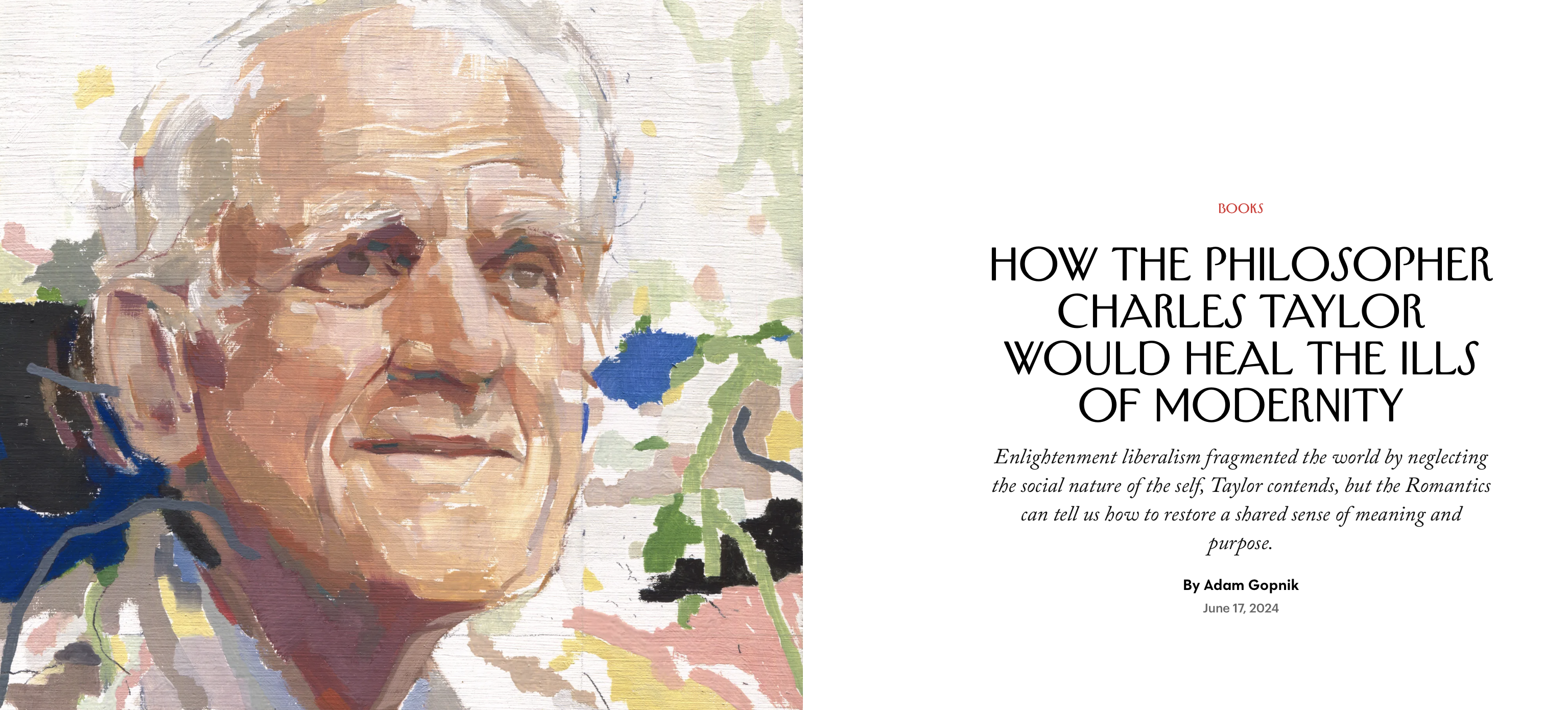
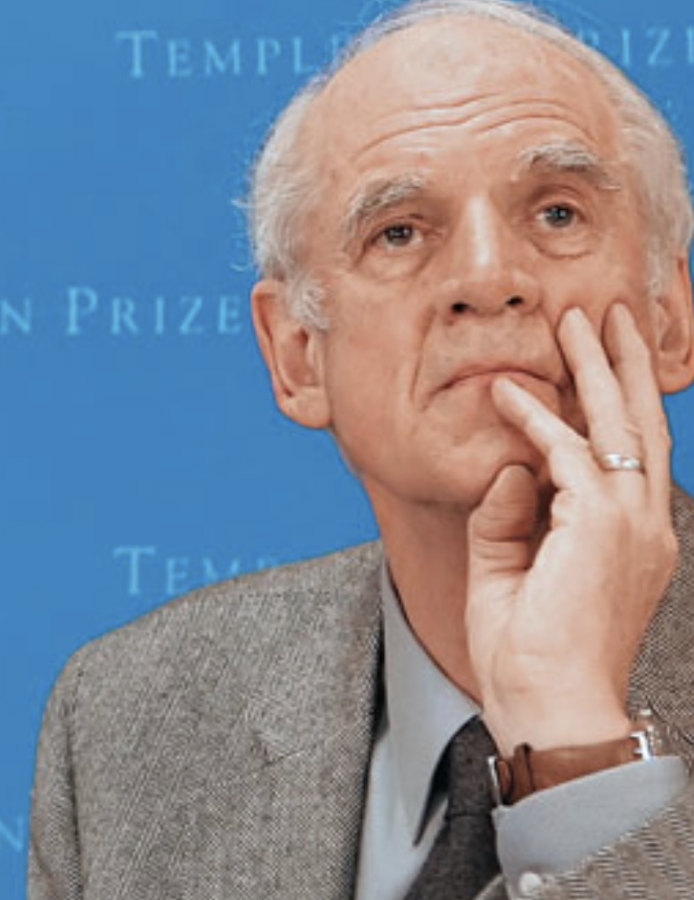
Taylor’s Wisdom: Commitment to the Good

Relation to the Good as a Key Element in Ethical Maturity and Conscientiousness

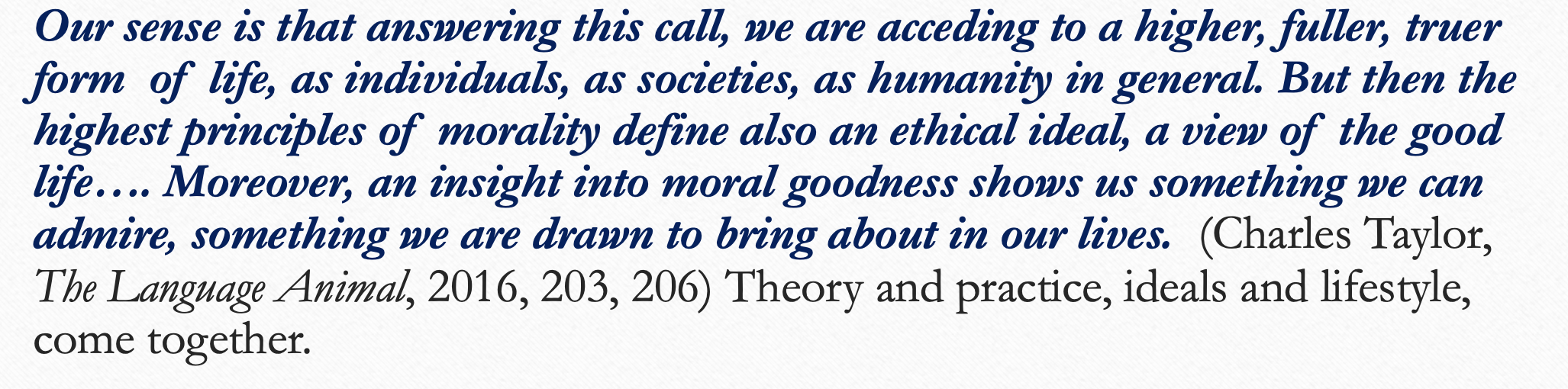
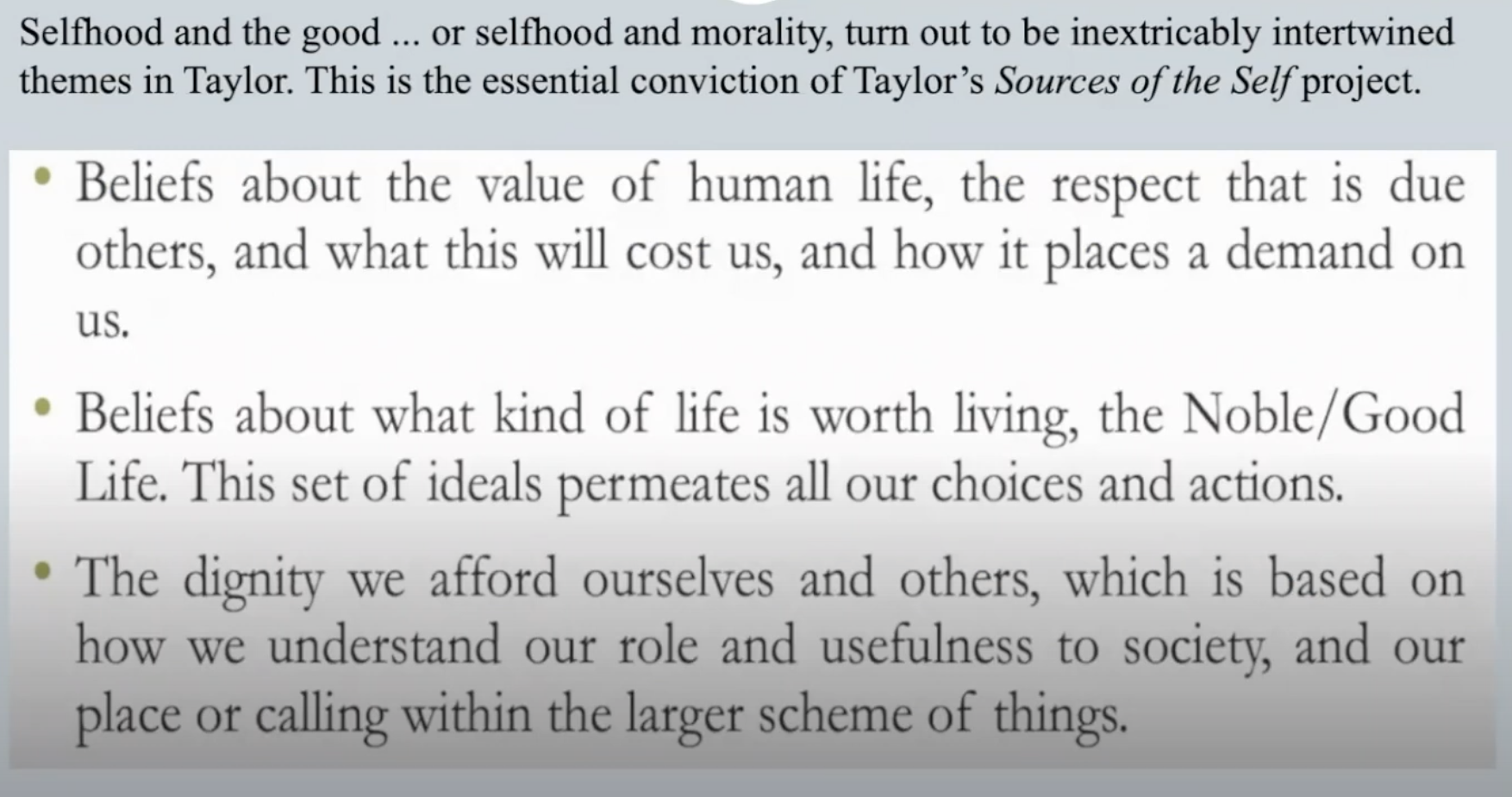
Charles Taylor takes the opportunity to fill out the picture/ecology of the moral self in more detail and to propose a vital relationship with the good as part of moral self-constitution. This addresses some of the dark implications of Foucault’s work on identity. Taylor’s analysis of morality is tightly interwoven with his analysis of the self in Western culture and that is very helpful as a critique of Foucault: Taylor (1989, 3) argues that the human self is an inherently moral entity; self is always situated in moral space: “Selfhood and the good … or selfhood and morality, turn out to be inextricably intertwined themes.” He does not settle for the self as a work of art, inventor or self, or artist of self. He wants more.

The moral ontology proposed by Taylor sets up a lively tension and contrast with Foucault; it challenges at points, it reveals what is hidden beneath the surface at other points, and it shows what is left out of the doctrine of aesthetic-freedom. Such a doctrine has become an ideology in today’s academic culture. This dialogue is deemed fruitful because there are insights to be gained by comparing and contrasting a more simple and minimalist ontology with a broader, richer, and more complex one. There is beauty in the simplicity of Foucault, of course, but there are serious problems of anti-humanism and potential for implosion into nihilism. Taylor’s discourse is a good route to comprehending/resolving Foucault’s skewed concept of freedom in context of a larger whole. Taylor is fair in raising some good questions on the one hand, and highlighting the insights of Foucault on the other. It is an important contribution to the current debate about identity. I begin with Taylor’s case for moral realism

Taylor’s argument for moral realism is five-fold. In terms of moral givens, he argues that certain perennial features of the self are present irrespective of culture or the way they are expressed or understood. He starts his analysis with the question of how humans operate as moral beings in their actual moral experiences in daily life, and with their reflection upon those experiences. So like Foucault, he is interested in praxis as well as theory. Beginning with humans and the way they experience morality, he claims that the most plausible explanation of morality is one that takes seriously the human perception of the independence of goods–we have an objective and subjective relationship with the moral good. He does not want to substitute a philosophical abstraction for how people live and think.

Firstly, he argues for the ubiquity of moral intuitions and judgments in human experience. We can all agree to this phenomenon. These are intuitions that transcend basic human desires for survival, sex, or self-realization. They are also referred to as second-order desires, strong evaluations or qualitative discriminations. All these terms are employed by Taylor. Note the important reference to the ‘quality of the will’. This concept of second-order desires appeals to the ancient idea of the good. Although interwoven with the self, it transcends the self in significant ways.

Secondly, he argues that there is a need for a larger moral picture to facilitate the task of making sense of moral experience (debates, deliberations, decisions, and actions). He calls this picture (map) a moral framework or horizon. Each framework is made up of several goods held together in a coherent relationship with one another, producing a moral worldview or social imaginary. The moral self is in a dialectical relationship with its framework; this is not a static set of conditions.

Thirdly, he recognizes that there is a key defining good within each moral framework, which he calls the hypergood. The hypergood is the highest/most important good and operates a controlling influence over the other goods within the framework. It defines the overall character of the framework and thus is central to the discussion of the moral self.

Fourthly, Taylor recognizes a narrative and communal texture to the pursuit of the good in moral self-constitution. Humans interpret their lives in narrative and communal terms as they pursue moral goods. This narrative articulation helps the individual to find a unity/continuity amidst the complexity of moral experience and a plurality of goods vying for one’s attention. This is key to making moral sense of life experience. It is also part of the quest of one’s life.

Fifthly, Taylor speaks of the sources of the moral, which he refers to as the constitutive good. The constitutive good (a category of moral motivation) gives meaning to and empowers the hypergood and the other life goods within the moral framework. It provides the constitutive ground of worth or value of the life goods, and empowers the self to live the good life. This is a very significant dimension that is often missed in moral deliberation.

Therefore, moral/spiritual identity is intimately interwoven with the pursuit of the good in Taylor’s ontology. This is essential to meaning and purpose. He discerns these five categories as basic givens, structural features that are common to the life of all morally healthy human beings. Taylor wants to problematize the occlusion or exclusion of such parameters, such qualitative distinctions for moral reasoning. He believes that within the life of the individual, there is a multiplicity of goods to be recognized, acted upon, and pursued. Taylor emphasizes the importance of being circumspect about these very significant goods. It entails a moral ontology of the self at its best, or most whole. It was not developed by Taylor specifically for a response to Foucault, but offers a useful framework for this dialogue on moral self-constitution. 

As a nominalist and anti-essentialist, Foucault has suggested that there is no objective, stable human moral nature either independent of culture or one’s historical formation, or alternatively independent of one’s own private self-construction. Therefore, on his view, the constructing forces of society and government are in tension with the constructing force of the individual self. This is the battle line for identity formation. Culture tends to determine the meaning one assigns to the world around, and what one takes as human and natural. Therefore, what is often called human nature is very temporary, contingent, local, and changeable. The quest for freedom means that change is necessary; every self is involved in the process of defining and shaping itself. In Foucault’s mind, there is no universal human nature other than either the ability to acquire a culture from society or the nature individuals construct themselves. Moral selves are either a cultural product or a self-made product, or perhaps some combination of the two. 

Foucault’s moral ontology of aesthetic-freedom entails a whole meta-position of relativism, multiplicity, difference, and diversity. We should not miss that it too is an ideology. It is one that excludes the moral good as defined by Taylor drawing on a historic understanding going back to the Greeks. For Foucault, there exists no ultimate or final moral position or common set of moral parameters, which is to be seen as hierarchically justified. In this, he agrees with many of his fellow late moderns. Attempts at claiming such justification would be seen by him as a fatal flaw. His relativist moral position means that he does not believe that it is possible to argue rationally for the superiority of one moral construction over another. We have said that this can lead to chaos, anti-humanism, or nihilism.

There is no totalizing or final position because that would be to court vulnerability to domination. All positions, according to Foucault, are seen as problematic and dangerous, implicated with power, regime-biased. Ethics, in his sense, is history all the way down or a historical-cultural predisposition or bias, and therefore must be constantly put under the critical knife. Moral self-constitution changes from place to place and era to era, and ultimately individual to individual. The moral vision he offers in an age of moral crisis and nihilism (loss of moral consensus) is that the self might gain increased control over self-construction and escape dominating power strategies. This tool can be of some help and provide a basis for dialogue with Taylor’s dynamic grappling with the good. For Foucault, the creativity and originality of self is the road to freedom from domination. It is clear by now that he does not offer hope for society as a whole in his ethics–no mutual or common good. Freedom has an individual shape and it is a contest, a struggle. Perhaps he has in mind the image of the Greek Olympic Games. One must assertively and proactively manage one’s own identity. This sets the stage for debate on moral ontology as it relates to the self. 

Taylor, C. (1989). Sources of the Self: The making of the modern identity. Cambridge, MA: Harvard University Press. 

Watkin, C. (2018). Michel Foucault. Philipsburg, NJ: P & R Publishing.

Posted by: gcarkner | May 27, 2024

Taylor Versus Foucault on Freedom 1/

Freedom, Identity and the Good

Proposition One: Redeemed freedom means that one refuses freedom as an ontological ground of ethics, and embraces a new definition of freedom within an ontology/frame of the moral good. Charles Taylor’s moral horizon of the good is offered as a lively and robust alternative to Foucault’s horizon of aesthetic-freedom.

Foucault’s idea of autonomous freedom as self-invention, self-interpretation, self- expression, self-legislation and self-justification is radical indeed. Schwöbel sums it up:

In deciding for policies of action which incorporate choices concerning the interpretation of our possibilities of action, of our goals of action and of the norms of action we attempt to observe, we decide the fundamental orientation of our lives. Such decisions are examples of self-determination. Self-determination is contrasted to determination by external authorities. (C. Schwöbel, 1995, pp. 62-3)

Aesthetic-freedom certainly has its appeal; it comes with a creative, youthful energy, to launch human subjectivity, overcoming the inertia and restrictions of governmentality and unhappy power relations. This is often attractive to young people with an edge of rebellion against authority. Foucault does not apologize for its élitist outlook. But this view of freedom has revealed a failure to offer sufficient direction for subjectivity, for a sophisticated use of the will. It lacks a platform for critical appraisal of our actions or choices. Thus, it shows a major deficit in equipping the individual for serious moral reflection, debate and action. It short circuits moral discourse by moving too quickly to praxis or action, without sufficient reflection on the reasons for such action, or the virtues or moral goods endemic to ethics. It can lead to moral autism (Matthew B. Crawford, The World Beyond Your Head, 183-93) with the loss of moral language needed to distinguish oneself, or even worse to nihilism, will-to-power and violence.

During the conversation with Foucault in previous posts, cracks and contradictions in his ideology of the aesthetic (Terry Eagleton) have emerged along with its potential dangers of overindulgence–of Dionysian proportions. The great philosopher Charles Taylor illuminates the darker side of Foucault’s artful freedom. The absolute sovereignty that Foucault gives to the individual for self-expression raises concerns: it may indulge in a fantasy of the human will. Foucault propounds a very optimistic philosophical anthropology of the aesthetic self (artistic work is worthy in and of itself, of course) with great faith in the creativity and imagination of the individual. At the same time, there is great cynicism about society and its institutions. He understands that domination can occur in corporate regimes of knowledge (making evil and oppression visible), but he is less open to acknowledge the potential evil in individual self-shaping and self-expression, radical self-control–aka expressive individualism. This is a major oversight/blind spot which is not acceptable in such a notable scholar.

Read More…
Posted by: gcarkner | May 24, 2024

Taylor Versus Foucault on Ethics

Foucault, by privileging the aesthetic hermeneutic of self, the ontology of freedom, and the power of the creative imagination, has managed to launch a whole new discourse for ethics; it is an ethics of aesthetic self-empowerment, and expressive individualism. For Foucault, the clear weight of bias in his discourse on subjectivity is towards a radical autonomy, not construction as a communal dialogue, nor was it a communal ethics. It is an ethics of the individual. This tends to skew Foucault’s theory of the moral self towards an ethics of self-interest or even narcissism (excessive self-care). According to Foucault, ethics means that the self studies the power relations within the social matrix, abstracts itself from the problematized social matrix, rethinks itself, and then imposes the newly invented self combatively onto society. “The understanding of value as something created gives a sense of freedom and power” (Taylor, 1991, p. 67). Foucault attempts to deal with self-constitution issue through his strong emphasis on the creative, constructive imagination. For him, the language of a transcendent good is repressed in self-making, in favour of the language of creative imagination and radical individual self-articulation. The grammar of the good is rethought and refigured in terms of the artistic self; self and its expression are taken as the proximate source of the good and the true. 

The sources of the self, to use Taylor’s language, are contained within the creative self. Once this is realized, suggests Foucault, individual freedom and power will emerge. Unlike other conceptions of transcendent moral sources in reason, nature or God, Foucault focuses on sources of the self within the self, in the register of moral empowerment. Such a perception of sources, such a “love affair with power” makes it possible to relativize, even marginalize the other and the social world. This gives one power over the other and the world, a power which could easily be abused by such a subject. It at least decreases vulnerability to the other. This is especially acute given Foucault’s emphasis on the kind of accountability that is merely a self-reflexive phenomenon, a responsibility to care for self as a prime directive. It produces a radical self-determining form of freedom: “It seems that significance can be conferred by choice, by making my life an exercise in freedom” (C. Taylor, 1991, 69). The one remaining virtue is choice itself. The kinder side of this, says Taylor, is that this is “taken as supports for the demands of difference” (C. Taylor, 1991, 69). But overall, it pushes towards the atomization of society–social chaos. 

Characteristics of the Aesthetic, Post-Romantic Self as gleaned from C. Taylor, 1989, 434-455: 

1. Art is superior to morality, and sees itself in conflict with the social moral order. 

2. Humans live in a chaotic or fallen natural and social world, rooted in chaos and the will to power. One can take an affirmative stance towards the world through seeing it as beautiful—seeing the world through an aesthetic lens. This is the only remaining basis for its justification. 

3. Being itself is not good as such, nor is human being per se taken as good. 

4. Hope resides in a strong belief in the power of the creative imagination to transfigure or transform the world and the self, or to reveal it afresh as beautiful. 

5. Language is a key means of changing the world, or at least the way one sees the world—key to one’s poetic self-expression, and re-writing of one’s self. 

6. This tends to result in an aesthetic amorality, a move beyond good and evil, an embrace or affirmation of violence and cruelty as well as patience and care. There can be no logical or moral distinction between them. We are experiencing this in Western culture and politics today.

Foucault would agree basically with Taylor’s placement of his project in the twentieth century cultural transition called the Post-Romantic Turn (Taylor, 1989, 434-55)30. The expressivism (desire for freedom of expression) of this tradition gives a higher, even a normative significance to the aesthetic, and opens a full challenge to the moral (Taylor, 1991, 63). Foucault wishes to transcend the code-morality with its universal intent towards normalization, by a new morality of the evolving ethics of the autonomous self. The pressing question at this stage of the argument is whether Foucault himself is captive to his own totalizing and unexamined impulse, the aestheticization of the moral self. There is a strong tendency in Foucault to celebrate the individual’s own powers to construct and interpret reality in a context shaped by immanence and the finite, and to deny the legitimacy of any binding moral horizon, any transcendent principle or ideal, or moral culture outside the self. Taylor (1989) sees the picture in the quote below. 

Foucault’s spiritual profile: an even higher estimate of the unrestricted powers of the imagination than the Romantics had, and hence a celebration of those powers … This subjectivism of self-celebration is a standard temptation in a culture which exalts freedom and puts such value on the creative imagination. (C. Taylor, 1989, 489, 490) 

According to this sentiment resulting from a strong atheism, all values are welcome to the table of open hospitality, indicating a moral levelling. The consequence is that nothing appears to be of ultimate value, better or worse, innately. Virtues and vices, good and evil are levelled and reduced to an individual’s stylization; only one’s individually chosen values remain–with the freedom to cherish them or discard them later. It is ethics as self-assertive politics; one posits and then promotes one’s values in the name of style. This is a Nietzschean embrace of it all in the name of beauty. There is no higher or lower morality, no higher or lower marks of authenticity in Foucault. They are all just expressions of the self, all legitimated in and of themselves. “Beauty is a satisfaction for itself … gives its own intrinsic fulfilment. Its goal is internal” (C. Taylor, 1991, 64). Also, “aesthetic wholeness is an independent goal with its own telos, its own form of goodness and satisfaction” (C. Taylor, 1991, 65). Taylor makes the connection between Nietzsche’s nihilism and Foucault on the issue of the aesthetic (C. Taylor, 1991, 60) 

It is here that one more clearly recognizes that Foucault’s project of the recovery of the subjective agency is threatened by a loss of meaning. There is a potential implosion into a fatal and tragic nihilism, self imploding in upon itself, without a broader horizon of significance and the recognition/validation by the other (triangulation). Foucault strategically sought to escape nihilism through the invention of the aesthetic self, but it has failed. Taylor (1989) notes that in this philosophical turn, there is a tendency to legitimate action and ethical behaviour according to beauty rather than by its inherent good. 

What in the universe commands our affirmation, when we have overcome the all-too-human, is not properly called its goodness but comes closer to being its beauty…. Part of the heroism of the Nietzschean superman is that he can rise beyond the moral, beyond the concern with the good, and manage in spite of suffering and disorder and the absence of all justice to respond to something like the beauty of it all. (C. Taylor, 1989, 454) 

The interpretative lens of goodness (perhaps even right and wrong) is exchanged for the lens of the beautiful. The beauty of it all makes all things tolerable. In William T. Cavanaugh’s (2024) language, this is a form of idolatry of the self. If Foucault’s ethics as artistic life is passed through such a repudiation of the moral, any socially empowering moral principle is recognized and yet demoted in favour of the individual’s controlled agenda over the self. This entails a distortion of reality and a distortion of the self. A prestigious place is given to one’s own inner powers of construing, imagining or interpreting the world, while making over the self. Self-confidence is encouraged, but sensitivity to, and responsibility for the other is wanting. 

Aestheticism naturally endorses violence and undercuts Foucault ‘liberating’ ethics. Taylor reveals the dark side:

 This is the revolt from within unbelief … against the primacy of life … from a sense of being confined, diminished by this sense of primacy. This has been an important stream in our culture, something woven into the inspiration of poets and writers—for example Baudelaire and Mallarme. The most influential proponent of this kind of view is undoubtedly Nietzsche, and it is significant that the most important antihumanist thinkers of our time—for example Foucault, Derrida, behind them Bataille—all draw heavily on Nietzsche. Nietzsche rebelled against the idea that our highest goal is to preserve and increase life, to prevent suffering. He rejects that both metaphysically and practically. He rejects the egalitarianism underlying this whole affirmation of ordinary life … Life itself can push to cruelty, to domination, to exclusion, and, indeed, does so in its moments of most exhuberant affirmation … There is nothing higher than the movement of life itself (the Will to Power). But it chafes at the benevolence, the universalism, the harmony, the order. It wants to rehabilitate destruction and chaos, the infliction of suffering and exploitation, as part of the life to be affirmed. Life properly affirmed affirms death and destruction. To pretend otherwise is to try to restrict it, hem it in, deprive it of its highest manifestations, which are precisely what makes it something you can say yes to. (Taylor, 1991, p. 27) 

Taylor, C. (1989). Sources of the Self: The making of the modern identity. Cambridge, MA: Harvard University Press. 

Taylor, C. (1991). The Malaise of Modernity. Concord, ON: Anansi. 

Cavanaugh, W.T. The Uses of Idolatry, Oxford University Press, 2024.

Taylor’s Concern with the Overreach of Aesthetic Self-Making in Morality 

This post explores a critical appraisal of Foucault’s ethics as aesthetic self-determination, which ultimately yields a full-orbed self-making or self-invention. A strategic starting point is with Taylor’s diagnostics of self-constitution in his book, The Malaise of Modernity (Taylor, 1991, 65-67). This chart is employed as a criteria grid to begin the critical examination of the robustness of Foucault concept of aesthetic moral self-constitution, which is lively in late modern culture today. It highlights what is present and what is excluded (the gaps); it leads us on a trajectory of opening up our awareness of the full dimensions of the self. Taylor begins by agreeing with Foucault that, in the West, one is self-consciously involved in one’s self-development, and that one’s identity, one’s spirituality, and one’s moral self are intimately linked; those dimensions are common to both philosophers. Both are also critical of a cultural over-emphasis on scientific definitions of the moral self. Their debate begins when one asks who and what else is involved in one’s self-shaping. 

In Taylor’s analysis, there are five significant criteria in the chart below, divided into categories A and B, indicators of the shape of one’s own moral self-constitution/formation. It is a chart which is respectful of the plurality of contemporary approaches. Taylor suggests that all five elements tend to be involved, in some combination, in the pursuit of an authentic life. 

Taylor’s Moral Self-Construction Diagnostics 

Category A (Creativity) 

(i) Creation and construction (as well as discovery) of the self. 

(ii) Pursuit of originality in one’s self-crafting. 

(iii) Opposition to the rules of society and even potentially to what one traditionally recognizes as morality, the moral sense, or the moral order. 

Category B (Social and Communal Accountability) 

(i) Openness to horizons of significance prevents one’s self-creation from losing the background that can save it from insignificance and trivialization (self-destructive tendencies). 

(ii) Self-definition needs to be developed in dialogue with significant others, that is, fellow moral interlocutors. (Taylor, 1991, 65, 66)

This chart is rooted in Taylor’s moral ontology of the good, but contains a broad application. While admitting the strong impact of the Post-Romantic Turn in philosophy (of which Foucault is a part), Taylor understands the existence and currency of the language of self-construction. [Post-Romantic Philosophy, in the late nineteenth early twentieth century, traces from Schopenhauer to Baudelaire to Nietzsche to Foucault.] Taylor takes Foucault seriously, even though he disagrees with him on certain key emphases. Taylor does not reject the Romantic and Post-Romantic traditions out of hand, but he does bring a critical reflection to bear on them. 

Taylor believes in both objective, social, and subjective components to ethics. He does not concede the legitimacy of just any form of self-construction, a view that puts him into a significant tension with Foucault’s perspective on the self. Referring back to the chart above, Taylor’s concern with Foucault (as with other Neo-Nietzscheans) is the extreme emphasis that he places on Category A (Creativity), and the near exclusion of an emphasis on Category B (Social Accountability and Mutuality). Moreover, he contests that Foucault’s radical nominalism, which denies the possibility of self-discovery along with self-creation (Ai); his problem is with what he considers an over-emphasis or skewing/unnecessary bending of reality. Taylor has a higher stake in, puts a higher value on, certain human and natural (even moral) givens than Foucault. Taylor is not a nominalist but a falsifiable moral realist.

Furthermore, Taylor questions the merits and overall legitimacy of category Aiii, that self-constitution should automatically, by definition, involve denial of the moral rules of society—the anarchic/narcissistic stance. This makes an idol of self and one’s choice. He does not have an inherent bias against social norms, but nor is he an uncritical social conventionalist. Taylor (1991, 63) can ask seriously why aesthetic self-making should necessarily pass through a repudiation of the moral and moral history. Also, why are all moral regimes and all humanisms written off so thoroughly by Foucault? Finally, his concern with Foucault is the inherent denial of the significance of category Bi and Bii, including the idea of moral horizons and the more social dimension of self-making, which includes important elements of triangulation (Matthew Crawford) in identity production. Foucault’s idea of moral self-constitution is extremely individualistic.

Taylor, as a more communitarian thinker, brings a fresh set of concerns to the table of discussion on the self. He suggests that, 

“What must be wrong is a simple privileging of one over the other (A over B) …. That is what trendy doctrines of “deconstruction” involve today … they stress (Ai) the constructive, creative nature of our expressive languages, while altogether forgetting (Bi). They capture the more extreme forms of (Aiii), the amoralism of creativity … while forgetting (Bii), its dialogical setting, which binds us to others …. These thinkers buy into the background outlook of authenticity, for instance in their understanding of the creative, self-constitutive powers of language … while ignoring some of its essential constituents.” (Taylor, 1991, pp. 66, 67) 

Taylor’s concern is that Foucault makes such a move, ignoring certain key constituents of self-articulation or self-constitution, such as the dynamics of Category B (Accountability). By abolishing all extra-self horizons of significance, and demoting the significance of dialogue with other moral interlocutors, morality can become a monologue, narcissistic, an abstract self-projection onto the world, rather than a source of communal conversation and cooperation–which is essential for one’s emotional health and sanity. It entails a kind of excarnation–living in one’s own head. It does not promote responsible citizenship or build community.

Bibliography:

Taylor, C. (1991). The Malaise of Modernity. Concord, ON: Anansi (also published as The Ethics of Authenticity).

Crawford, M. (2016). The World Beyond Your Head: On Becoming an Individual in an Age of Distraction.

Eagleton, T. (1990). The Ideology of the Aesthetic, Oxford: Blackwell

Posted by: gcarkner | May 17, 2024

Charles Taylor’s Wisdom

Taylor’s Case for Moral Realism in Sources of the Self.

Charles Taylor’s argument for moral realism is five-fold: In terms of moral givens, he argues that certain perennial features of the self are present irrespective of culture or the way they are expressed or understood. He starts his analysis with the question of how humans operate as moral beings in their actual moral experiences, and how they reflect upon those experiences. So like Foucault, he is interested in praxis. Beginning with humans and the way they experience morality, he claims that the most plausible explanation of morality is one that takes seriously humans’ perception of the independence of goods. He does not want to substitute a philosophical abstraction for how people live and think.

Firstly, he argues for the ubiquity of moral intuitions and judgments in human experience. These are intuitions that transcend basic human desires for survival, sex, or self-realization. They are also referred to as second-order desires, strong evaluations or qualitative discriminations: each of these terms is used by Taylor. One notes the important reference to the quality of the will. This concept of second-order desires appeals to the ancient idea of the good, one which although interwoven with the self, transcends the self in significant ways.

Secondly, he argues that there is a need for a larger moral picture to facilitate the task of making sense of moral experience (debates, deliberations, decisions and actions). He calls this picture (map) a moral framework or horizon. Each framework is made up of several goods held together in a coherent relationship with one another, producing a moral worldview. The moral self is in a dialectical relationship with its framework; it is not a static set of conditions.

Thirdly, he recognizes that there is a key defining good within each moral framework, which he calls the hypergood. The hypergood is the highest good and operates a controlling influence over the other goods within the framework; it defines the overall character of the framework and thus is central to the discussion of the moral self.

Fourthly, Taylor recognizes a narrative and communal texture to the pursuit of the good in moral self-constitution. Humans interpret their lives in narrative and communal terms as they pursue moral goods. This narrative articulation helps the self to find a unity amidst the complexity of moral experience and a plurality of goods vying for one’s attention.

Fifthly, Taylor speaks of the sources of the moral, which he refers to as the constitutive good. The constitutive good (a category of moral motivation) gives meaning to and empowers, the hypergood and the other life goods within the moral framework. It provides the constitutive ground of the worth or value of the life goods, and allows the self to live the good life; this is a very significant dimension.

Moral identity is interwoven with the pursuit of the good in life in Taylor’s ontology. He discerns these five categories as givens, structural features that are common to the life of all morally healthy human beings. Taylor wants to problematize the occlusion or exclusion of such parameters, such qualitative distinctions for moral reasoning, because he believes that within the life of the self, there is a multiplicity of goods to be recognized, acted upon and pursued. Taylor emphasizes the importance of being circumspect about these goods. It is quite an ambitious and challenging proposal, a moral ontology of the self at its best, or most whole. It offers a useful framework for dialogue across differences of interpretation on moral self-constitution. 

Qualities of a Strong Identity for Philosopher Charles Taylor Humans at their best, their fullest, richest linguistic and social capacity

  • Their words and actions cohere-integrity.
  • They pursue what is of top significance without deviation. They pursue wholeness and unity of motives, not confusion, brokenness, and fragmentation.
  • They overcome dispersal, contradiction, or self-stifling: temptations to reduce themselves to something less or lower (the race to the bottom).
  • The results of this pursuit involve them in seeing better, believing better, loving better, and living a more wholistic life. We respect our future self by taking our present self more seriously through more responsible behaviour. Never forget that we are always situated in moral space, on a moral journey, we are thoroughly moral creatures. Morality is intimately entwined with identity, narrative, community, and spirituality.
Posted by: gcarkner | April 5, 2024

Christian Philosophy Continues to Flourish

William Lane Craig, PhD University of Birmingham, PhD University of Munich

Paul Gould, PhD Purdue University

Alvin Plantinga, PhD Yale University

James K. A. Smith, PhD Villanova University

Nicholas Wolterstorff, PhD Harvard University

Gary Habermas, PhD Michigan State University

Charles Taylor, PhD Oxford University

Jacques Maritain

Richard Swinburne, Fellow of the British Academy, taught at Oxford

Peter Kreeft, PhD Fordham University

Alasdair MacIntyre, one of the foremost professors of philosophy of ethics and politics

Jean-Luc Marion, student of Jacques Derrida

Eleanore Stump, PhD Cornell University

Peter Van Inwagen, PhD University of Rochester

J.P. Moreland, PhD University of Southern California

Jerry l. Walls, PhD University of Notre Dame

Alexander Truss, PhD UBC, PhD University of Pittsburgh

Follow Your Passion. You are not a Victim. You are a Visionary!

“Be who God meant you to be, and you will set the world on fire.” ~Catharine of Siena

UBC GFCF Distinguished Scholars for 2024-25

  1. Wednesday, September 24, 2024 @ 4:00 PM William T. Cavanaugh, The Uses of Idolatry

Abstract In this talk, our heavily researched speaker offers a sustained and interdisciplinary argument that worship has not waned in our supposedly “secular” world. Rather, the target of worship has changed, migrating from the explicit worship of God to the implicit worship of things. Cavanaugh examines modern idolatries and the ways in which humans become dominated and harmed by their own creations. While Cavanaugh is critical of modern idolatries, his argument is also sympathetic, seeing in idolatry a deep longing in the human heart for the transformation of our lives. Ranging widely across the fields of history, philosophy, political science, sociology, and cultural studies, Cavanaugh develops an account of modernity as not the condition of being disenchanted but the condition of having learned to describe the world as disenchanted. 

Biography William T. Cavanaugh, PhD from Duke University, is Professor of Catholic Studies and director for the Centre for World Catholicism and Intercultural Theology at DePaul University. He is the author of The Myth of Religious Violence, Oxford University Press, 2009; and The Uses of Idols, Oxford University Press, 2024. His specialty is political theology, economic ethics, and ecclesiology. 

2. November 7, 2024 @ 12:00 PM Denis Alexander. Finding God Through Dawkins: a Dramatic Irony 

Abstract The so-called ‘New Atheism’ movement that came to prominence in the earlier part of this century has now declined. However, it has left in its wake an intriguing residue of religious and cultural consequences. One of the most prominent spokespersons for the movement has been Professor Richard Dawkins from Oxford University. The 2023 Kregel book, co-edited by Alister McGrath and Denis Alexander, Coming to Faith Through Dawkins, comprises twelve essays written by twelve different authors from five different countries and describes how the works of Dawkins and other New Atheist writers were influential in leading them from atheism or agnosticism to Christian faith. This lecture will review the roots of the New Atheism movement, and why it has led some former skeptics to Christian faith. 

Biography Denis Alexander, a noted geneticist, biochemist, and cancer researcher is the Founding Director (Emeritus) of The Faraday Institute for Science and Religion, Cambridge, where he is Emeritus Fellow of St. Edmund’s College. He is past Chair of the Molecular Immunology Programme and Head of the Laboratory of Lymphocyte Signalling and Development at The Babraham Institute, Cambridge. Dr. Alexander’s latest books are: Is There Purpose in Biology? Oxford: Lion, 2018; and Are We Slaves to Our Genes? Cambridge University Press, 2020. He gave the 2012 Gifford Lectures at St. Andrew’s University. 

3. Thursday, January 30, 2025 @ 4 PM Jeremy Begbie, Professor of Theology and Music, Duke University C. S. Lewis and Unfulfilled Longing: An Exploration through Music 

Abstract C. S. Lewis famously spoke of fleeting experiences of joy he had early in life, a longing for something this world cannot satisfy. Dr. Begbie will creatively explore this through music, comparing this pre-Christian unfulfilled desire with Christian hope. 

Biography Jeremy Begbie is the Thomas A. Langford Distinguished Research Professor of Theology at Duke Divinity School, and McDonald Agape Director of Duke Initiatives in Theology and the Arts. He teaches systematic theology, and specializes in the interface between theology and the arts. He is Senior Member at Wolfson College, Cambridge, and an Affiliated Lecturer in the Faculty of Music at the University of Cambridge. His books include Theology, Music and Time (Cambridge University Press); Resounding Truth: Christian Wisdom in the World of Music (Baker/SPCK); and Music, Modernity, and God (Oxford University Press); and Abundantly More (Baker). He is a very engaging speaker who has taught widely in the UK and North America, and delivered multimedia performance-lectures in many parts of the world. 

4. Tuesday, March 4 @ 12:00 PM Quentin Genuis Rethinking Medical Ethics in Light of the Good

Abstract What features define human life and the value of the individual? How do individuals and communities understand and withstand suffering and pain? What is good dying? In our time, the essential human questions are often viewed primarily as bioethics issues. In reality, these are not exclusively medical or bioethical inquiries. Rather they are complicated and challenging ethical questions with which all human beings and societies must grapple. How does Christian philosophy and theology inform these life and death questions at deeper, more foundational levels? 

Biography Dr. Quentin Genuis MD is an Emergency Physician at St. Paul’s Hospital in Vancouver, and the Physician Ethicist for Providence Health Care. He holds a Master of Letters in Ethics from the University of St. Andrews, Scotland. He teaches in academic, clinical, professional, and lay settings on a variety of issues related to bioethics. His research and writing interests include the autonomy debates, end-of-life care, compassion, human dignity, addictions, and theological anthropology. 

See: Towards an Incarnational Spiritual Culture: Grounding Our Identity in Christ by Gordon E. Carkner PhD, Wipf & Stock Publishing, 2024

Posted by: gcarkner | February 23, 2024

Abigail Favale Brings Clarity to Gender Ambivalence

Abigail Favale

Professor Notre Dame University

Examining the Sources of Gender: Why Sexual Difference Matters

Two Resources as Follow-up to the Lecture: 

1. First, an expert guide on youth gender medicine that Abigail co-wrote with a pediatric endocrinologist; this gives a thorough overview of the research on gender medicine for young people. 

2. Second, the study from Finland on the question of suicide mentioned in the discussion, with an analysis of the study here

Abstract  How do contemporary theories of gender compare to the understanding of gender in the Christian imagination? This talk will provide a sketch of two distinct paradigms–the “gender paradigm” and the “Genesis paradigm”–and bring those two frameworks into conversation with one another, highlighting points of consonance and dissonance between them.

Biography  Abigail Favale, Ph.D., is a professor in the McGrath Institute for Church Life at the University of Notre Dame. She has an academic background in gender studies and feminist theory, and writes regularly about these topics from a Catholic perspective. She is the author of The Genesis of Gender: A Christian Theory (Ignatius 2022) and Into the Deep: An Unlikely Catholic Conversion (Cascade 2018), as well as numerous essays and articlesAbigail’s essays and short stories have appeared in print and online for publications such as First ThingsThe Atlantic, Church Life, and Potomac Review. She was awarded the J.F. Powers Prize for short fiction in 2017. 

See also Carl Trueman, The Rise and Triumph of the Modern Self; and Gordon E. Carkner, Towards an Incarnational Spiritual Culture https://ubcgcu.org/coming-soon/ .

Quotes from Favale’s Book

Difference between men and women have too often been used to justify a strict hierarchy of value and roles between the sexes. In the effort to reject this, feminists thought has typically regarded sexual difference itself with hostility and has downplayed difference in order to affirm equal dignity.

We must engage the vital questions of personhood, sex, identity, and freedom at the level of a worldview. The gender paradigm affirms a radically constructivist view of reality, the reifies it as truth, demanding that others assent to its veracity and adopt its language.

The Gender Paradigm (feminism’s offspring): According to the gender paradigm, there is no creator, and so we are free to create ourselves. The body is an object with no intrinsic meaning; we give it whatever meaning we want, using technology to undo what is perceived to be “natural”. We do not receive meaning from God or our bodies or the world–we impose it. What we take to be “real” is merely a linguistic construct; ergo we should consciously wield language to conjure the reality we want. To be free is to transgress limits continually, to unfetter the will. “Woman” and “man” are language-based identities that can be inhabited by anyone. Because truth is just a story we tell ourselves, all self-told stories are true.

Creation/Genesis/Biblical Paradigm: We are unities of body and spirit; our bodies are an integral part of our identity that connect us to the created order and serves as a bridge between our inmost being and the outer world, and a sacramental sign of the hidden mystery of God. Both man and woman are made in God’s image, and our sexual difference is part of the goodness of the created order, signalling that we are made for reciprocal love. We have been granted a share in the divine power of language in order to make words that reveal the truth about ourselves and our world.

Michel Foucault is the god-father of contemporary gender theory. Angela Franks aptly describes the Foulcauldian view of sex, which now holds supremacy in our culture. Sex for Foucault, is about “bodies and pleasures”…. Bodily sex has been divorced from procreative potential, reduced to appearance and pleasure-making.

John Money’s malleable and disembodied concept of gender swept through the academy, becoming thoroughly entrenched in feminist theory and the social sciences…. Sex refers to biology, and gender refers to social meanings attached to sex…. Ultimately the concept of gender has driven a wedge between body and identity.… This has paved the way to an even more fragmented and unstable understanding of personhood. Because gender is no longer anchored in bodily realities, it has become a postmodern juggernaut, impossible to capture, impossible to name. Unlike sex, gender can be continually altered and deployed, and we are witnessing a wide proliferation of its meaning.

Judith Butler, godmother of gender theory … argues that gender is an unconscious and socially compelled performance, a series of acts and behaviours that create the illusion of an essential identity of “man” and “woman”. In this view, gender is entirely a social construct, a complex fiction that we inherit and then repeatedly reenact. 

In culture today, we are seeing a gnostic split between body (sex) and soul (gender). We now have an inherently unstable concept of gender. The concept of gender has driven a wedge between body and identity. “Gender” can be continually altered and redeployed, and we are witnessing in real time the wild proliferation of its meaning. From the trans definition, gender identity is seen to be located in the mind. Others see it as merely a social construct. 

“The more I study what gender has become, the more it feels like an empty signifier, a word that is only a shell, conveniently waiting to be filled with whatever meaning is most useful. There is a gender category for every proclivity, every flick of mood, every possible aesthetic: Agender, Bigender, Trigender, Demigender, Demifluid, Demiflux, Pangender.” Abigail Favale

There are people in turmoil and the gender paradigm has become the dominant lens for interpreting that turmoil, and that’s not good. We are living in an era when our young women are increasingly deciding they would be better off as men. Many young women are rebelling against the hypersexulaization of the female body, but in doing so, they are turning against the body itself. The female body, in our shared imagination, no longer signals creation, nourishment, and primal compassion, but rather the prospect of sterile pleasure.

Medicalizing the Problem: The affirmation approach encourages violence to the healthy body rather than carefully working through underlying causes of psychological distress and considering ways of managing that distress that does not cause physical harm.

The new wave of pop gender theory offers a choose-your-own-adventure self. This framework, which has captured our cultural imagination, fragments personhood into mix-and-match categories of gender identity, gender expression, sexual orientation, and biological sex.

A Different Way of Seeing: Considering oneself as a being who is created moves the discussion of identity to new ground, setting the frame of a transcendent order–an order beyond the natural that sustains its existence and safe-guards its meaning. To be a creature rather than an accident, establishes the human person as a being-in-relation with the divine. We are not alone in the cosmos…. When we see the world as a created cosmos, this transfigures everything: embodiment, sex, suffering, freedom, desire–this is gathered up into an all-embracing mystery, an ongoing interplay between human and divine…. Once understood as created, selfhood, including one’s sex, becomes a gift that can be accepted, rather than something that must be constructed.

We are confronted in our time with two divergent understandings of freedom: on the one hand, freedom according to postmodernity, an open-ended process of self-definition whose only limit is death; on the other, freedoms an ever-deepening sense of belonging and wholeness, not only with oneself, but in relation to all that is.

Why Faith is Vital to Good Scholarship

Christian graduate students demonstrate their faith (of the richness and variety in Hebrews 11) every day on campus. This faith, which is deeply relevant for academic and personal life, is rooted in historical experience, in hope and in God-ordained promise. Christ-centered and incarnate faith is a fulcrum that can move the world and leverage the future. On one side it is a private treasure and pursuit; on the other hand it is public truth for all (Lesslie Newbigin).


In our journey at UBC, we maintain that Christian faith is good for everyone no matter their background (even the neo-atheist). Robust faith involves a persistent search for both understanding and wise integrity; it can open the doors of insight and improve one’s relational skill and sensibilities at the same time.


Dynamic faith, located in a quest to grow up into full maturity in Christ (Eugene PetersonPractice Resurrection), will expand the horizons of academic research, and offer wisdom on managing projects, funding, time and talent. It is worth breaking a couple drill bits to get down into the deeper layers of weighty, God-honoring faith. It a faith worthy of testing.


Too many students miss out on the opportunity to grow as a person while doing their PhD; they are skill heavy and maturity light and and can leave UBC morally naive. The current public exclusion of faith from academic discourse is nothing short of a tragedy. So agrees Douglas Todd the Vancouver Sun religion and ethics editor in his June 9, 2012 piece called “Can Higher Education Recover its ‘Soul’?” University of Florida’s history professor John Sommerfield says that the secularization of the university has gone too far, to the detriment of its own stated purpose of training future leaders.


David Adams Richards, famous Canadian novelist, in his bold book God Is: my search for faith in a secular world.refuses the stifling of the Christian voice in public: Faith to him is the essential key to freedom (a sure way out of human violence and self-destruction), and a key to wholeness of mind and life. It prevents power from having the last say. At the end of the day, faith is a boon for academia and often used without proper credit; one cannot do proper science without faith in certain key assumptions.


Faith and reason, when discovered and used in creative synergy, are very complementary, innovative and powerful; they do not properly exist in separate realms (D. Stephen Long, Speaking of God) but together. Faith rejects fantasy and superstition; it ultimately wants all of reality, not a reduced version of it.


The certainties which the church has received as a gift require its participation in humanity’s ‘common struggle’ to attain truth. The human search for truth, which is philosophy’s vocation, is not in opposition to theology’s reception of truth as a gift. What we struggle to understand by reason we also receive by faith. No contradiction exists between the certainties of faith and the common struggle of humans to attain truth. The truths humanity seeks by common reason (philosophy) and the certainties of faith can be placed over against each other such that each illuminates the other and renders it intelligible until the two ultimately become one, which is of course what the incarnation does in reverse. The concretion of the one Person illumines the natures of both divinity and humanity. (D. Stephen Long p. 87)


Let’s enjoy the adventure of bringing faith and scholarship together in mutual enrichment.

Dr. Gary Habermas on Transformation in Scholarship on the Resurrection:

http://www.youtube.com/watch?v=ay_Db4RwZ_M

Posted by: gcarkner | January 18, 2024

Chris Watkin Offers a Fresh Vision for Culture

Christopher Watkin

Lecturer Monash University, Australia

The Bible as a Tool for Changing Culture

Wednesday, February 14, 20244:00 PM

Live Video Recording

Abstract

The question of the relationship between Christianity and culture increasingly takes centre stage in debates both within and outside the church today. This talk reflects on how a constructive, nuanced and—to many modern ears—fresh vision for contemporary society can be drawn from a rich engagement with the Bible’s storyline, guided by Augustine’s magisterial work City of God. What might it look like to reimagine Augustine’s mode of engagement with late Roman society in our own cultural moment of late modernity? 

Biography

Christopher Watkin (PhD, University of Cambridge) is senior lecturer in French studies at Monash University in Melbourne, Australia. He is a scholar with an international reputation in the area of modern and contemporary European thought, atheism, and the relationship between the Bible and philosophy. His published work runs the spectrum from academic monographs on contemporary philosophy to books written for general readers, both Christian and secular, and include Difficult AtheismFrom Plato to PostmodernismGreat Thinkers: Jacques Derrida. His recent impressive 2022 tome with Zondervan Academic is Biblical Critical Theory: How the Bible’s Unfolding Story Makes Sense of Modern Life and Culture.

Companion Volume: Towards an Incarnational Spiritual Culture

Now available on Amazon and local Bookstores.

The paradigm of the gift places us in the posture of recipients. We receive existence, we receive meaning, and we receive love. To be sure we are creative recipients, as we shall see in the chapters that follow, and receiving the gift of the universe certainly does not make us passive. But the fact remains that we are recipients nonetheless. The one thing we should not do with a gift is pretend we bought or made it ourselves. The giver is usually thanked, so our fundamental orientation to existence in the paradigm of the figure of gratuity is one of praise and thanksgiving.

To live and die by the dynamics of “making a name for ourselves” is to submit to a court of a public opinion which only allows certain achievements to count, and it is to give a warped view of life in which value is ascribed to our words and deeds according to the fickle tastes of the crowd. 

Over the past century or so, as values of duty, collective identity, and conformity have been overtaken by a premium on nonconformity and what philosopher Charles Taylor calls “expressive individualism,” we have been increasingly told that we live our best life when we go our own way, in the face of what “they” tell us to do. And so we obediently obey this ubiquitous social command to be our own master and blaze our own trail. (Christopher Watkin, Biblical Critical Theory)

The incarnation acts as the pinpoint focus to which all time before it is drawn, and from which all time after it radiates out…. At the incarnation, the narrative that began with the heavens and the earth converges on a single baby as it “sharpens at last into one small bright point like the head of a spear”…. As we move forward in time past the incarnation, we will witness not a further restriction but an explosion in the scope of the narrative as, by the end of the Bible, God’s plans are again seen to encompass the whole universe…. The incarnation is an event that splits time in two…. Of all the biblical events that irreparably alter the course of history and create an indelible “before” and “after,” the incarnation is perhaps the one that has left the deepest mark on modern culture. It gives rise to today’s most widely celebrated Christian festival, Christmas, and the contrasting juxtaposition of almighty deity and fragile newborn has captured the minds of countless artists and poets, as well as the hearts and imaginations of many believers…. “What makes the form of Christ attractive,” writes William Cavanaugh, “is the perfect harmony between finite form and infinite fullness, the particular and the universal.”… Christ bridges Lessing’s ditch with his own universal particularity, forever uniting the immediate and the ultimate, life and reality, experience and truth. (C. Watkin, Biblical Critical Theory, 349-51)

« Newer Posts - Older Posts »

Categories