
Abstract
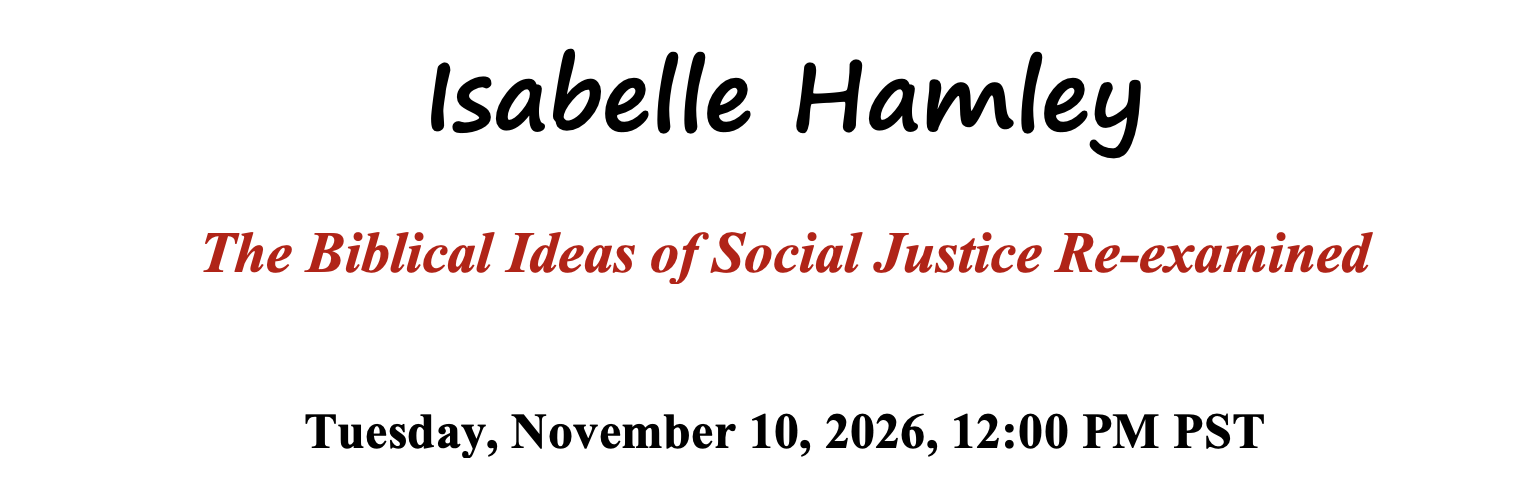
Justice is on everyone’s lips in contemporary culture. It permeates politics, social media, and public outcries. When we attend carefully, views of justice are diverse and often contradictory. Different cultures and sub-cultures shape various incarnations of justice. For those who look to the Bible as foundational text, justice is boldly present and varied: from the justice of the legal corpus, to the courageous truth-telling of the prophets. It also involves the radical ministry of Jesus to the poor, oppressed, and marginalized. How do these texts challenge us to reflect wisely on justice, to contribute to public discourse? Dr. Hamley will bring Scripture and culture into a riveting dialogue. The impact creates a pertinent guide to the justice quest in the modern world. The analysis also shows how people can be transformed by the strange justice of the God of the cross.
Biography
The Rev. Prebendary Dr. Isabelle Hamley is a minister, articulate speaker, and writer. She is Principal of Ridley Hall, an Anglican seminary on the University of Cambridge campus in the UK. The school trains women and men for lay and ordained ministry. She has previously held posts as chaplain to the Archbishop of Canterbury, and Theological Adviser to the House of Bishops. Her interests include Bible in the life of the church, how Scripture shapes a Christian response to justice, conflict, and violence. In theological anthropology, she studies the vital relationship between Christian faith and mental health. An ambassador for Sanctuary Mental Health, she co-chairs a strategic World Council of Churches working group on violence, conflict, peace, and reconciliation. Isabelle is the author of God, Justice, and Mercy: A Theological Commentary on Judges. SCM Press, 2021; and Embracing Humanity: A Journey Towards Becoming Flesh. BRF, 2024. Currently, she scribes a commentary on the Book of Ruth.
Some Thoughts on Biblical Justice
Biblical Justice centers on God’s character, impartial fairness, right relationships, and special concern for the vulnerable—rather than modern political ideologies of equal outcomes or class conflict. The term “social justice” is modern (often traced to the 19th century), but the underlying ideas of justice (mishpat in Hebrew) and righteousness (tzedakah/tzedeqah) appear throughout Scripture and are frequently paired. When joined, they describe living rightly before God and neighbor in society.
Core Foundations
- God’s character: God loves righteousness and justice (Psalm 33:5), shows no partiality and takes no bribes (Deuteronomy 10:17), and defends the fatherless, widow, and foreigner (Deuteronomy 10:18; Psalm 68:5). Justice reflects who he is, his character.
- Human dignity: Every person is made in God’s image (Genesis 1:27), so all have equal worth. Partiality—favoring the rich or the poor—is forbidden: “You shall not render an unfair decision. Do not favor the poor or show deference to the rich” (Leviticus 19:15; see also Exodus 23:3, 6).
- Summary of the requirement: “He has shown you, O mortal, what is good. And what does the Lord require of you? To act justly and to love mercy and to walk humbly with your God” (Micah 6:8).
Care for the Vulnerable
Scripture repeatedly highlights the “quartet of the vulnerable”: the poor, widows, orphans/fatherless, and foreigners/sojourners. Neglect or oppression of them is treated as a violation of justice, not merely a lack of charity.
Key provisions in the Mosaic Law include:
- Leaving gleanings in fields and vineyards for the poor and foreigner (Leviticus 19:9–10; Deuteronomy 24:19–21).
- Periodic debt release, the Sabbath year, and the Year of Jubilee (Leviticus 25), which returned land to original family holdings and prevented permanent concentration of wealth through inheritance loss.
- Protection in courts, against usury toward fellow Israelites in need, and against exploiting the powerless (Exodus 22:21–24; Deuteronomy 24:17; 27:19).
The prophets fiercely condemned exploitation, bribery, unjust laws, and empty religious ritual without justice (Amos 5:11–12, 21–24—“let justice roll down like waters, and righteousness like an ever-flowing stream”; Isaiah 1:17; 10:1–2; Jeremiah 22:3). True worship required defending the oppressed.
New Testament Continuation
Jesus announced His mission in terms of good news to the poor, freedom for the oppressed, and the Lord’s favor (Luke 4:18–19, quoting Isaiah). He taught love of God and neighbor as the summary of the Law (Matthew 22:37–40), illustrated cross-boundary mercy in the Good Samaritan (Luke 10), and identified care for the hungry, stranger, sick, and imprisoned with service to himself (Matthew 25:31–46). He showed no partiality yet consistently reached the marginalized.
The early church practiced voluntary sharing and mutual care (Acts 2:44–45; 4:32–35; note Peter’s words in Acts 5:4 affirming private property). James defines pure religion as looking after orphans and widows in their distress while remaining unstained by the world (James 1:27). Paul urges generosity from surplus to meet needs so that there may be equality of provision in times of scarcity (2 Corinthians 8:13–14), while also affirming work: “If anyone is not willing to work, let him not eat” (2 Thessalonians 3:10). Private property and honest labor are assumed as good (Exodus 20:15; Ephesians 4:28).
Distinctives of the Biblical Vision
Biblical justice is both personal (individual righteousness and integrity) and social (fair structures, protection from oppression, and community responsibility). It aims at shalom—right relationships, peace, and flourishing under God—rather than forced equalization of outcomes. Generosity is expected and commanded, yet it is primarily voluntary and flows from transformed hearts, not coerced redistribution by the state. Impartial application of one standard of law is essential; distorting justice for any group is condemned.
In short, the biblical idea is that God’s people must reflect His justice and mercy: uphold fair dealing and the rule of law without favoritism, actively protect and provide for those most vulnerable to exploitation, practice personal righteousness and voluntary generosity, and reject both oppression of the weak and systems that invert justice. This vision is rooted in covenant relationship with God and the equal dignity of image-bearers, not in secular theories of power, identity groups, or engineered equality.


Leave a Reply