Posted by: gcarkner | March 28, 2016

UBC Discussion on Our Place in the Cosmos


Dr. Pointon’s Slides of the Presentation The human haunted cosmos – Final April 1 2016 

Fairmount Lounge, St. John’s College, UBC

See also https://ubcgcu.org/2012/08/17/finding-the-god-particle/

See also blog posts on fine-tuned universe

Screen Shot 2016-03-29 at 11.16.00 AM

Posted by: gcarkner | March 23, 2016

The Power of Good Friday and Easter

Screen shot 2013-01-18 at 10.01.04 PM

Giovanni Bellini, The Garden of Gethsemane

Faith in God includes one’s ongoing resolve to receive God’s moral character in Christ inwardly, and to belong to God, in the reverent attitude of Gethsemane; Christ in you is the inward agent-power of Christ working, directing at the level of psychological and motivational attitudes, towards a cooperative person’s renewal in God’s image as God’s beloved child; furthermore Gethsemane union with Christ as Lord calls for volitional cooperation and companionship with Christ, who empowers and guides how we think, not just what we think.

~Dr. Paul Moser, Philosopher Loyola University, Chicago

How are we to understand Good Friday and Easter from such a distance? How does it relate to our experience? Is it mere sentiment or something more profound? Andy Crouch in his book Culture Making: recovering our creative calling, (Chapter 8 “Jesus as Culture Maker”) has some brilliant insights into the difference that Jesus life, death and resurrection have for shaping the horizons of possibility (shalom and human flourishing) for societies, ancient and modern. He helps us grapple with the various dimensions of this sorrow and celebration. See also I Corinthians 15 and reflect on the meaningful quotes by other authors and leaders.

~Gordon Carkner

The Cross

He suffered the full weight of the human story of rebellion against God. He was literally impaled on the worst that culture can do–an instrument of torture that stood for all the other cultural dead ends of history, from spears to bombs, gas chambers to waterboards. Like all other instruments of violence, a cross is cultural folly and futility at its most horrible. (141)

The core calling of [Jesus] life is not something he does at all in an active sense–it is something he suffers. The strangest and most wonderful paradox of the biblical story is that its most consequential moment is not an action but a passion–not a doing but a suffering. (142)

On Good Friday, love embraced suffering as Jesus drank the bitter cup. Dr. Martin Luther King Jr. self-consciously followed the same journey of the suffering death of Jesus, the way of the cross, as he promoted civil rights for African-Americans in the Southern USA in the 1960s. He worked hard to replace the perverted symbol of the cross which was used as a justification for aggression, hate and violence—e.g. as an instrument of the Ku Klux Klan. His life quest was to restore the cross as a symbol of love, mercy, justice and non-violence. He incarnated a form of extreme love, a committed non-violent protest against systemic injustice.

~Iwan Russell-Jones, former BBC Filmmaker and Professor of Faith and the Arts, Regent College

https://ubcgcu.org/2014/04/17/good-friday-by-malcolm-guite/ Good Friday Poem by Malcolm Guite Read More…

Posted by: gcarkner | February 20, 2016

Political Scientist Examines the Secular-Religious Debate

Screen Shot 2016-02-20 at 4.16.52 AM

Response by Dr. Olav Slaymaker, Professor Emeritus, Geography

Audio File Thomas Heilke   http://ubcgfcf.com/2016/01/05/thomas-heilke-on-religions-engagement-with-the-secular/

Full Biography For Thomas Heilke

 Thomas Heilke received his Ph.D. from Duke University in 1990. After 23 years as a faculty member and a variety of administrative positions at the University of Kansas, he has been Professor of Political Science and Associate Dean of the College of Graduate Studies UBC Okanagan since January, 2014. He is the recipient of three teaching awards, and has written on a variety of topics in political philosophy, including civic friendship, political theology, the political thought of Friedrich Nietzsche, Eric Voegelin, John Howard Yoder, and Thucydides, and Anabaptist political thought. He has authored or co- authored four books and edited or co-edited six further volumes. His work has appeared in journals that include American Political Science Review, Political Theory, Polity, The Review of Politics, and Modern Theology. Among his published books are Voegelin on the Idea of Race: An Analysis of Modern European Racism (1990); Nietzsche’s Tragic Regime: Culture, Aesthetics, and Political Education (1998); Eric Voegelin: In Quest of Reality (1999). He co-edited with Ashley Woodwiss The Re-Enchantment of Political Science: Christian Scholars Engage Their Discipline, (2001). He belongs to the American Political Science Association and the Phi Beta Delta Honor Society for International Scholars. Read More…

Posted by: gcarkner | February 9, 2016

Is Excellence Killing Us ?

 Is Excellence Killing Us?

Screen Shot 2016-02-10 at 7.12.12 PM.png

High performance, excellence, superior effort: Who would argue against that? Think of all those famous leadership books. But Matthew Crawford, senior fellow at the University of Virginia’s  Institute for Advanced Studies in Culture, detects a flaw in the quest for excellence. He has some vital insights on a current dilemma facing students and faculty today. In his brilliant 2015 book, The World Outside Your Head: on becoming an individual in an age of distraction, he suggests that our quest for radical individualism and autonomy is leading us into a unhealthy moral autism. We are actually losing our agency, our moral skill. Matthew calls this the ‘cult of sincerity’, i.e., that you yourself can be the source of the norms by which you justify yourself–a radical responsibility for which we may not really be prepared. It offers too much self-sovereignty of the wrong kind. He notes that we actually need others (friends, family, colleagues) to check our own self-understanding–through triangulation–to tell us we are doing OK, that we are good or excellent (or sometimes not up to scratch). How else do we avoid the narcissistic assumption that we are the centre of the universe and can do no wrong.

One thing that sets us apart as humans is our desire to justify ourselves; we never act without moral implications, says Crawford. That might come as a shock to anyone caught up in the spirit of sterile scientism or objectivism. We all need a web of people that we respect and feel accountable towards, and a healthy set of norms to guide relationships and mutual expectations, build trust in an uncertain world. Charles Taylor agrees (Sources of the Self) that morality requires an understanding of how certain goods operate within our psyche and our community. See the posts on ‘Qualities of the Will’ in this blog. Matthew appreciates Iris Murdoch, who was a mentor to Taylor during his PhD work in Oxford. Murdoch believed in the recovery of the ancient language of the good, in certain ideals that transcend human desires and decisions. If we take time to reflect, we see that humans are social and moral animals all the way down.

Ah There’s the Rub: Matthew Crawford notes that in times of cultural flux, where it is unclear what the rules or norms are in the greater society, it is quite difficult for us to understand ourselves socially. We feel isolated, disempowered, uncertain, afraid to make moral judgments. This leads to an existential problem, an angst. As a result, we become victims of the values of the marketplace–productivity, performance, usefulness, cash-out value. The marketplace was never meant to set the standards of human relations or moral identity, but today our consumerism/capitalism ideology is quite strong; it is performance all the way down. Matthew’s friend, psychologist Alain Ehrenburg (Weariness of the Self), notes that this is leading to epidemic levels of depression in our current culture of performance. Enough is never enough; there is always more that we could do to pursue excellence. We are never good enough on these terms and conditions. What started out as an inspiring motivator (high quality work), has morphed into slavery. Alain writes:

Depression presents itself as an illness of responsibility in which the dominant feeling is that of failure. The depressed individual is unable to measure up; he is tired of having to become himself. In a culture of performance, the person reads the value and status of her soul in her worldly accomplishments.

Read More…

Posted by: gcarkner | February 1, 2016

Dialogue with the Modern University

US IVCF Grad-Faculty Conference + Bibliography
This past weekend, we hosted an online video symposium linking faculty and researchers (grad students) at eight university sites in the Midwest of the United States. Terry Halliday presented from Chicago, covering similar material to what has been posted on the list serve. But it is the first time many of our US participants had engaged with this material, which they found quite helpful, and for many gave a new perspective on our participation in university conversations.
As “the book guy” I was asked if I could provide a reading list of resources along the lines of the material Terry presented. I provided five suggestions in each of three categories–only a beginning to be sure but they are pasted below. The categories are: Dialogue, The University, and Thinking Christianly. They are also on my blog if you wish to access or forward that URL. It is: http://bobonbooks.com/2016/02/01/dialogue-within-the-university-a-reading-list/
The list reflects resources readily available in, and in some cases addressing the context in North America where our participants live. It was suggested that it would be helpful if we could develop this into a global bibliography and so I would welcome the contributions of others who know of resources, particularly those published outside North America in the three categories of this reading list.
Here is the list, which includes links to US publishers and links in the instances where I’ve reviewed the book:
Dialogue:
Crouch, Andy. Culture Making: Recovering our Creative CallingDowners Grove: InterVarsity Press, 2008. Explores how cultures are made and shaped and explores ways Christians     can engage with and create culture with pursuing “culture wars”.
Felton, Peter, H-Dirsen L. Bauman, Aaron Kheriaty, and Edward Taylor. Transformative Conversations: A Guide to Mentoring Communities Among Colleagues in Higher EducationSan Francisco: Jossey-Bass, 2013. Discusses how faculty can develop “formational mentoring communities” exploring questions of meaning, calling and values. Great conversational model. Reviewed here.
Hunter, James Davison. To Change the WorldNew York, Oxford University Press, 2010. Hunter challenges the rhetoric of “culture change”, shows the importance of cultural     elites, and explores the role of “faithful presence”. Reviewed here.
Muehlhoff, Tim. I Beg to DifferDowners Grove: InterVarsity Press, 2014. Muehlhoff explores communication strategies for difficult conversations with those with whom we differ. Reviewed here.
Volf, Miroslav. A Public Faith. Grand Rapids: Brazos Press, 2011. He argues that Christians can choose a third way of seeking the public good while remaining faithful to the core values of their faith. Reviewed here.
University:
Delbanco, Andrew. College: What it Was, Is, and Should Be. Princeton: Princeton University Press, 2012. He explores the history, current state, and his own future hopes for the university, with nods to the contribution of Christians to discussing important questions in the university. Reviewed here.
Kronman, Anthony. Education’s EndNew Haven: Yale University Press, 2007. A thought-provoking book by one who is dismissive of religious answers but wonders why colleges have given up on the big questions. Reviewed here.
Marsden, George M. The Soul of the American University: From Protestant Establishment to Established NonbeliefNew York: Oxford University Press, 1996. Explores the history of Christian engagement in the American university and the forces behind the establishment of secularism as the university’s stance.
Newman, John Henry Cardinal. The Idea of a University. South Bend, University of Notre Dame Press, 1982. John Henry Newman’s classic work on the liberal Christian university–one of the first to articulate a vision of faith and scholarship together. Not easy going but a foundational book. Reviewed here.
Wolterstorff, Nicholas, Educating for ShalomGrand Rapids: Eerdmans, 2004. A collection of essays that chronicles Wolterstorff’s developing thinking about the integration of faith, learning and practice in the higher education world. Reviewed here.
I find keeping up with articles published in The Chronicle of Higher EducationInside Higher Edand University World News (which gives me global coverage of university issues) helpful to staying aware of possible university conversations. I published a review post of higher education books here in June of 2014.
Thinking Christianly:
Milne, Bruce, Know the Truth. Downers Grove: InterVarsity Press, 2009. An outline of basic systematic theology with scriptures and discussion questions to make one think about what one believes. A predecessor to this book was critical in my early years of ministry in helping me think through the faith deeply for myself.
Neuhaus, Richard John. The Naked Public SquareGrand Rapids: Eerdmans, 1988. A foundational book reflecting a Christian perspective for how we engaged the public arena. A landmark book by the longtime editor of First Things.
Noll, Mark A. Jesus Christ and the Life of the Mind.  Grand Rapids: Eerdmans, 2011. Noll demonstrates the importance of Christology to thinking Christianly about various academic disciplines. A fine example of a historian thinking theologically about doing history. Reviewed here.
Walsh, Brian, and J. Richard Middleton. The Transforming VisionDowners Grove: InterVarsity Press, 1984. The authors show how Christian worldview can be basic to thinking Christianly about various academic disciplines. The book includes a “bibliography you can’t live without.”
Wolters, Al. Creation RegainedGrand Rapids: Eerdmans, 2005. Traces the themes of creation, fall, and redemption, and how these may inform our efforts to think Christianly about anything else.

Read More…

Posted by: gcarkner | January 25, 2016

Promote Dialogue on Life Trajectory


Screen Shot 2016-01-28 at 5.17.32 PM

  1. Worldview Discernment: mapping the pluralistic landscape of the various spiritual journeys we are likely to encounter in today’s society. Posture: refuse to be overwhelmed by difference and diversity of convictions. Mark Taylor (After God) at Columbia University defines religion as “an emergent, complex, adaptive system of symbols, myths and rituals with the function to give individuals and society a sense of meaning, purpose and direction, and to call into question every other system that gives life meaning, purpose and direction.” It both stabilizes and disturbs/disrupts, offers structure and order and paradoxically, calls into question every social construction, system or structure.
  1. Investigative Journalism: employing fruitful human questions to make deeper connections and find points of spiritual contact. Posture: that of a detective or reporter with a curious mind and a sensitive heart.
  1. Establish Common Ground, a Platform for Dialogue: finding the best in people as a point of non-defensive and non-offensive conversational entry. What are the assumptions we can make from our common aspirations, our creaturehood and our will to the common good, or key markers of human flourishing? Without a level playing field, you will not have a just discussion.
  1. Reckoning with Cultural Barriers to Faith: understanding and mobilizing idolatries, roadblocks, closed world systems, atheism, loss of transcendence as leverage in conversation. Every posture is vulnerable under critical scrutiny, whether the hegemony is scientific materialism, nihilistic skepticism, or a dogmatic fundamentalist religious perspective. This involves mapping the modern and postmodern perception worlds (social imaginaries) that people inhabit. There are also moral ideologies that prevent people from hearing what you are saying; one’s moral and intellectual bent are more interconnected than many people realize. Dialogue invites people to enter an open field or round table of discussion, rather than fighting like a trapped fox, who has been cornered. We can waste a lot of time if we are not in touch with these barriers.
  1. Communicative Potential of the Poetic/Prophetic Imagination: especially in the aesthetic oriented Postmodern/Late Modern Condition. Here we explore the language of epiphany, agape love and transcendence. Scientific rationality does not work here; Modernism has been called into question. Hermeneutics is more the game (Terry Eagleton, The Ideology of the Aesthetic). C.S. Lewis, J.R.R. Tolkein and the other Inklings were geniuses at this trade. Malcolm Guite is a fresh poet among others. Jens Zimmermann’s new book, Hermeneutics: a very short introduction, is very helpful. Certain literary forms can act subversively to get past a seeker’s defenses (Joseph Laconte, The Searchers). Poets like T.S. Eliot, Gerard Manley Hopkins,
  1. Biblical Narrative and the Jesus Story: always a fresh opportunity to commend Jesus in context of issues, aspirations and questions of one’s interlocutor. This pillar celebrates a robust Jesus story and kingdom teaching for today’s complex world. How indeed is Jesus the Yes and Amen to our fundamental human questions and our existential concerns? Be articulate, creative, intriguing, relevant, provocative, opening gates to insight and discovery. The video series Gospel of John has a fresh approach to depicting Jesus. We all must become creative storytellers; the Gospels give plenty of examples of various styles of capturing a person’s imagination. What kind of God does Jesus reveal to us?

Read More…

Screen Shot 2016-01-23 at 11.52.32 AM

Michael Polanyi is one the best critics of scientific/logical positivism, a caricature of science and its cultural impact (aka Scientism as ideology). He is well-known for showing that science is not pure objectivism, but a personal knowledge, an invested knowledge. Stereotypes of both science and religion/theology are harmful to all concerned. They are a barrier to true dialogue, progressive thinking and good understanding. We long to recover the full heritage and context of science and not to dumb it down. Polanyi was one of the greatest minds of the twentieth century, both a brilliant scientist and a brilliant philosopher, a polymath.

Scientism is the notion that natural science constitutes the most authoritative worldview or form of human knowledge, and that it is superior to all other interpretations of life. It assumes an immanent, Closed World System, which rejects the validity of any transcendent elements: there exists a strong attraction to the idea that we are in an order of nature and do not and cannot transcend it. In scientism, the study and methods of natural science have risen to the level of an ideology, and so have morphed into an oppressive and stifling methodological imperialism. Scientism also indicates the improper usage of science or scientific claims in contexts where science might not properly apply, such as when the topic is perceived to be beyond the scope of scientific inquiry (e.g. to determine a worldview such as scientific humanism or final purpose of life). The stance of scientism thus may indicate in an overconfident fashion a scientific certainty in realms where this is actually impossible, overreaching its proper limits in a process which can thereby ironically discredit science itself. See my paper at the bottom of this post.

Polanyi’s story of science is about the role of unspecifiable, tacit knowledge in expertise. His elaboration of personal commitment at the core of intellectual inquiry is understood as a craft skill. He demonstrates that scientific competence is transmitted through apprenticeship to authoritative teachers (supervisors).  So it is not just about the grant money. In the university, the survival of our traditions of intellectual apprenticeship should not be taken for granted. According to Polanyi, a scientist relies on a lot of knowledge that can’t be rendered explicit, and an inherent feature of this kind of knowledge is that it is “personal.” One has to receive it through a person’s influence and mentorship. He also believed that faith is involved at every level of scientific discovery. I wrote a paper on this a few years ago and was absolutely amazed at his insight.

Scientific inquiry is above all about practice, best understood as a kind of craft. Polanyi writes, “I regard knowing as an active comprehension of things known, an action that requires skill.” Polanyi’s point is that to have science, you must have scientists. Scientists are formed and mentored. They cannot be conjured out of thin air. “To learn by example is to submit to authority. You follow your master because you trust in his manner of doing things even when you cannot analyze and account in detail for its effectiveness.” Through submission to authority, in the context of the lab, one develops certain skills, the exercise of which constitutes a form of inquiry in which the element of personal involvement is ineliminable. This includes trust, which is a moral relationship between teacher and student, that is at the heart of the educational process. Scientific inquiry is a mode of personal knowledge that is socially incubated, beginning with imitation.

Bestselling  author Matthew Crawford applies the Polanyi critique of received modernity to modern agency and epistemology in The World Beyond Your Head: on becoming an individual in an age of distraction. See also Jens Zimmermann’s critique of positivism (employing Polanyi) in Hermeneutics: a very short introduction. (pp. 121-23) Read More…

Posted by: gcarkner | January 22, 2016

Discovery of Wisdom in Science and Theology

Screen Shot 2016-01-22 at 6.48.54 AM

Prof Tom McLeish, FInstP, FRS

Durham University

Professor in the  Department of Physics
Professor in the  Department of Chemistry
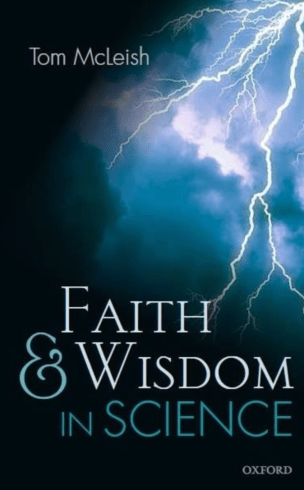
I think we have discovered an original thinker on the interface of science and Christian faith. Tom McLeish is a very accomplished prize-winning biophysics professor at Durham University. In 2014, he published a very important book called Faith and Wisdom in Science (OUP). He shows the common sentiment between the search for/love of wisdom about natural things in Job and other wisdom literature of the Bible and the history of scientific investigations. It stretches the mind and offers a new paradigm that avoids some of the traditional conflicts and narrow thinking of this discussion (on both sides).

Professor McLeish takes a fresh approach to the ‘science and religion’ debate, taking a scientist’s reading of the enigmatic and beautiful Book of Job as a centrepiece, and asking what science might ultimately be for. Rather than conflicting with faith, science can be seen as a deeply religious activity, and the current form of a deep and continuous thread in human culture.

Screen Shot 2016-01-22 at 8.22.45 AMReview of Faith & Wisdom in Science   McLeish_Alan_Gijsbers_Review

Tom McLeish is Professor of Physics at Durham University and also chairs the Royal Society’s education committee. After a first degree in physics and PhD (1987) in polymer physics at Cambridge University, a lectureship at Sheffield University, in complex fluid physics, lead to a chair at Leeds University from 1993.

He has since won several awards both in Europe (Weissenberg Medal) and the USA (Bingham Medal) for his work on molecular rheology of polymers, and ran a large collaborative and multidisciplinary research programme in this field from 1999-2009 co-funded by EPSRC and industry.

His research interests include: (i) molecular rheology of polymeric fluids); (ii) macromolecular biological physics; (iii) issues of theology, ethics and history of science. He has published over 180 scientific papers and reviews, and is in addition regularly involved in science-communication with the public, including lectures and workshops on science and faith. In 2014 OUP published his book Faith and Wisdom in Science. He has been a Reader in the Anglican Church since 1993, in the dioceses of Ripon and York.

From 2008-2014 he served as Pro-Vice-Chancellor for Research at Durham University. In 2011 he was elected a Fellow of the Royal Society. In 2012 he was made Vice-President of Science by the Institute of Physics (IoP).

See also GCU Spring Events for Barry Pointon Lecture on April 1 The Human-Haunted Cosmos  https://ubcgcu.org/gcu-events/ 

On Faith and Wisdom in Science:

“Can you Count the Clouds?” asks the voice of God from the whirlwind in the stunningly beautiful catalogue of nature-questions from the Old Testament Book of Job. Tom McLeish takes a scientist’s reading of this ancient text as a centrepiece to make the case for science as a deeply human and ancient activity, embedded in some of the oldest stories told about human desire to understand the natural world. Drawing on stories from the modern science of chaos and uncertainty alongside medieval, patristic, classical and Biblical sources, Faith and Wisdom in Science challenges much of the current ‘science and religion’ debate as operating with the wrong assumptions and in the wrong space. Its narrative approach develops a natural critique of the cultural separation of sciences and humanities, suggesting an approach to science, or in its more ancient form natural philosophy – the ‘love of wisdom of natural things’ – that can draw on theological and cultural roots. Following the theme of pain in human confrontation with nature, it develops a ‘Theology of Science’, recognising that both scientific and theological worldviews must be ‘of’ each other, not holding separate domains. Science finds its place within an old story of participative reconciliation with a nature, of which we start ignorant and fearful, but learn to perceive and work with in wisdom. Surprisingly, science becomes a deeply religious activity. There are urgent lessons for education, the political process of decision-making on science and technology, our relationship with the global environment, and the way that both religious and secular communities alike celebrate and govern science.

Posted by: gcarkner | January 14, 2016

Potential of the Secular-Religious Interface

Our understanding of the secular has evolved in significant ways over the past century, and this can often lead to confusion. Within modernity, how do those who most strongly identify as religious and secular discover their common cause? In this talk, Professor Heilke will drill down into that language and its surprising history. He will sharpen our understanding and propose creative ways of engaging with one another fruitfully across different visions of societal life. Vital issues of justice, public morality, civic and religious liberties are at stake as we seek sustainable ways forward for human flourishing and the common good. Rejecting the ideological culture wars, Dr. Heilke holds out hope to find a symbiotic interface between the secular and the religious voice. We all see from a limited perspective, and we can all discover our identity and public responsibility afresh through constructive dialogue and artful cooperation.

Screen Shot 2015-11-03 at 10.09.47 AM


Screen Shot 2016-02-05 at 12.24.34 PMSee also posts on Charles Taylor and the Immanent Frame.

Posted by: gcarkner | December 30, 2015

2015 in review

Screen Shot 2016-01-03 at 8.51.42 AM

The WordPress.com stats helper monkeys prepared a 2015 annual report for this blog.

Here’s an excerpt:

The concert hall at the Sydney Opera House holds 2,700 people. This blog was viewed about 9,500 times in 2015. If it were a concert at Sydney Opera House, it would take about 4 sold-out performances for that many people to see it.

Click here to see the complete report.

« Newer Posts - Older Posts »

Categories