Posted by: gcarkner | May 4, 2014

Problem of Moral Relativism … 3

Alternatives to Relativism

Ethical relativism denies that any objective, universal moral properties exist. It arose in the philosophical context of the dominance of empiricism and naturalism and the rejection of metaphysically abstract universals. It perpetuates the mindset that  we know how things really are for all people: i.e. that morals are relative to individuals or cultures. It is a universal claim that there are no universals. Nietzsche saw very clearly that if there was an end to God and traditional values, then the strong could impose their values on the masses. Domination would be widespread. Thus came his model of the ubermensch (superman) and the ethics of will-to-power.  There is a natural progression from relativism to will-to-power ethics (with the view that a human is just another thing in the world). William Golding’s book Lord of the Flies, which many of us studied in secondary school, is a graphic, heart-wrenching picture of unrestrained evil, where might makes right and bullying and scapegoating is the accepted social ethos. A group of boys marooned on a remote island make their own society, and the results are shocking. The twentieth century has trembled at the great atrocities and abuse of power by those who are without any fear of a transcendent being or any sense of obligation to a code of conduct or set of norms. They operate without accountability. We enter a Hobbesian world where it is ‘all against all’. See the BBC documentary on Nietzsche “Human all too Human” https://www.youtube.com/watch?v=3EGOwduWVKA

Moral philosopher R. Scott Smith argues (In Search of Moral Knowledge) that ethical relativism or subjectivism is a bankrupt view of the nature of morality; it utterly fails as a moral theory and a guide to one’s moral life; it results in morally inconsistent and untrustworthy behaviour. It leads to the complete demise of morality itself with absurd consequences:

We should not settle for a relativistically based tolerance, since it will not succeed in building a moral society or in helping people be moral.That kind of morality forces us to consider all ideas and ways of life as being equally valid, yet we can know that this is not the case … Nevertheless, tolerance (as respect  of people as having equal moral value) would make sense if a universal, objective moral basis exists for that equality. (162)

Relativism in the twentieth century has led us into some very dangerous political experiments; billions have been spent on war-making; human rights have been violated in terrible ways; imperialism ran rampant; multiple millions have perished. It is known as the bloodiest century in history.  British journalist Paul Johnson (A History of the Modern World: from 1917 to the 1990s) graphically illustrates the way in which the ethic of will-to-power has flourished in the soil of relativism during the twentieth century. In fact, we may well ask, Do we have one example in history of benevolent leadership without the restraint of traditional morality and the rule of law, i.e. a context where the governing authorities have absolute power whether tzar or proletariat leader? How indeed is Russia operating these days?

Without a moral plumb line, societies seem headed for personal nihilism and/or political tyranny. This dilemma was admitted by an atheist blogger: RationalSkepticism.org The ultimate end point is despair and ugly oppression, propaganda and control from the top. A subjectivist ethic is no ethic at all; it offers no hope for society or for psychologically healthy relationships. It consists in the blind leading the blind. It offers no reason to get along in society, no moral basis for law, no place to appeal when there is a dispute between parties. Morality must address the proper resolution of conflicts and call unjust behaviour to account. Relativism seems to lead us into some frightening conclusions both intellectually and experientially. We must ask whether there is not another paradigm that can be more intellectually sound, sane and just. Despite its popularity and opiate for the masses, relativism is both inconsistent and dangerous. Read More…

Posted by: gcarkner | April 24, 2014

Who Stole Our Humanity?…5

Restorative Moves to Recover Our Humanity and Dignity
Further on the quest to retrieve our deeper humanitas, we move beyond scientism’s caricature of human existence, towards a whole and healthy picture of persons. We want to recover our lost heritage as Christian humanists (David Lyle Jeffrey, Andy Crouch, Culture Making; Jens Zimmermann, Incarnational Humanism; Erasmus). What are we to make of homo sapiens sapiens? Under scientism, influential thinkers like Nietzsche and Skinner have charted a cultural course beyond good and evil, while also relieving us of our freedom and dignity. It is indeed a surprisingly unpleasant road to nihilism. Reductionistic anthropologies have led to much political oppression and abuse as seen under Pinochet, Pol Pot, Mao, Stalin, Mugabe and Hitler in the twentieth century, where the government became the pirate of the people. They live an atheism rich with a will to power and without human rights. Scientific materialism has morphed into political-economic exploitation, with massive human suffering and extensive violence and loss. We must protest this impoverished and exploitive view of persons and seek an alternative, one that is urgent in our age of global terrorism, economic challenges, shrinking resources and political flash points (see Al Gore, The Future: six drivers of global change. 2013).

Humans must be distinguished from nature. Certainly, a person is continuous with nature biologically; this is one of the reasons that human biology has been so successful. But we should not settle for views of our identity reduced to our biological origins or biological infrastructure; humans are not only a part of nature, they definitely stand apart from nature in significant ways. They are much more complex and sophisticated than animals or machines despite the similarities. We can do serious damage when we do not recognize these distinctions. Much that is deeply true about us transcends our biology, chemistry and physics. Humans are an order of magnitude different from animals in many capacities: e.g. human altruism goes far beyond genetic altruism. Consider Oscar Shindler, says Francis Collins head the National Institute of Health brain mapping program, who took incredible risks to save those who were not of his tribe or DNA. Read More…

Posted by: gcarkner | April 21, 2014

Personal Mission Statement: the Power of Focus

Mission Statement: the Power of Focus

See also Grit: the power of passion and perseverance by Angela Duckworth


One Fall Retreat a couple years ago, GCU folks began with listening to a profound talk by Dr. Gordon Smith, a theologian on the concept of Christian Pilgrims. Perhaps you can listen to this CD at some point.  You could find it in the Regent Bookstore or Library. Gordon’s main point is that there is a vast difference between a tourist and a pilgrim. Tourists make demands and complain a lot about the service, expressing an attitude of entitlement. Pilgrims give thanks as they journey, humbly seeking out the gems of a situation. This attitude of gratefulness is rooted in a strong belief in, and appreciation for, the goodness of God in each situation. A pilgrim sees the importance of making it a faith statement, a weekly affirmation that: “God is Good and Gives Good Gifts”. Indeed God is the highest and purest form of goodness, the standard to measure all human claims to goodness (D. Stephen Long). Trinitarian mutuality is rich in self-giving. Our response is to give thanks as a way of life (Ann Voskamp).

It is this very good God who invites us into his Sabbath Rest (Hebrews 4:1-13). Sabbath is not a mere passive ceasing from work, but rather a cultivation of this attitude of thankfulness on the journey, a deliberate faith walk. The image takes us back to the desert wandering period in the story of the Children of Israel. God invites them (and us) into a communion of love, as fellow givers rather than consumers. Ruth Haley Barton offers a balanced approach to Sabbath in a chapter in her volume Sacred Rhythms: Arranging Our Lives for Transformation. Some might resonate with Mark Buchanan in his thoughtful book The Rest of God: Restoring Your Soul by Restoring Sabbath. There are plenty of mentors to help us discover this Sabbath Rest.

Sabbath is the proper context for thinking about a ‘Personal Mission Statement’. It is important to take regular time out from our many activities, conversations and efforts in order to reflect on the big picture. It is key to a focus that can empower life and make it more meaningful. Below are some of our thoughts from the GCU retreat on a mission statement. It is core to what we want our life to mean and represent. Core to what we want to accomplish, essential to who we   are and what we fight for. One could say that it is the beam of wisdom that runs through a life—that on which other goals and objectives are hung. Few people (about 3%) take the time to dig deep, reflect upon and write such a statement. They assume this practice is for institutions, hospitals, governments or corporations.

A personal mission statement captures one’s narrative quest or “hypergood” to use a Charles Taylor term. It taps into our deep structure desire to make a substantial and important contribution. We think it is important for postgraduate students to take time to do this; otherwise life leads in a hundred directions without a focus, a formula for frustration and discouragement. We can get intensely busy and distracted by details and deadlines, and thereby lose the deeper meaning and the bigger picture of why we are in this program. We lose track of our life-focus trajectory. Read More…

Posted by: gcarkner | April 20, 2014

Easter Beckons: a Poem or Two

Easter Beckons

Come buds, birds, brilliant sun, blossoms all
Fair Spring is here to greet all souls as one
New notes sound forth from birds as harmonies waft
Gone the bleak winter with its chill and rain dark skies
Come are the spring lambs with twitching tails
New buds break forth to charm the eye with blossoms fair

The cheeks of chubby babes soak in the sun aloft their stroller craft
Moms chatter about the joy of giving new life
New life, resurrection’s legacy, hope spun soft in spider’s web
The scholar’s imagination soars amidst the cherry blossom’s bloom
There’s more to this human frame than mud shaped into motion
Signs of transcendence capture one’s dreams of what might be

Garden soil is stirred for seed to come and die, to give new life
Easter beckons Mary at empty tomb where once her Lord lay motionless
Darkness has been replaced by light so bright it hurts the eye
Doubts of disciples are washed from bloodshot orbs
Angst replaced by sudden joy as mysterious figure finds his way through wall
It’s a new world to discover, a new paradigm to ponder, eternity in time.


Sonnet for Easter Dawn

Malcolm Guite


He blesses every love which weeps and grieves

And now he blesses hers who stood and wept

And would not be consoled, or leave her love’s

Last touching place, but watched as low light crept

Up from the east. A sound behind her stirs

A scatter of bright birdsong through the air.

She turns, but cannot focus through her tears,

Or recognise the Gardener standing there.

She hardly hears his gentle question ‘Why,

Why are you weeping?’, or sees the play of light

That brightens as she chokes out her reply

‘They took my love away, my day is night’

And then she hears her name, she hears Love say

The Word that turns her night, and ours, to Day


N.T. Wright Did Jesus Rise from the Dead?

http://www.youtube.com/watch?v=KnkNKIJ_dnw

Posted by: gcarkner | April 17, 2014

Good Friday by Malcolm Guite

Good Friday; the Stations of the Cross

Malcolm Guite, Poet, Musician, Chaplain

Screen shot 2014-04-17 at 6.02.33 PM

Here is a complete sequence of sonnets for the Stations of the Cross. I am posting them a little before Good Friday, so that anyone who wishes to make use of them for personal devotion or reproduce them for use in their Church can do so. Please feel free to make use of them in anyway you like, and to reproduce them, but I would be grateful if you could include in any hand-outs a link back to this blog [http://malcolmguite.wordpress.com/2012/04/04/good-friday-the-stations-of-the-cross/] so that people who wish to can follow the rest of the sequence through the church year, of which these stations are a part and which will I hope, eventually form a book of sonnets for the whole church year.  ~Malcolm Guite

Stations

I Jesus is condemned to death

The very air that Pilate breathes, the voice

With which he speaks in judgment, all his powers

Of perception and discrimination, choice,

Decision, all his years, his days and hours,

His consciousness of self, his every sense,

Are given by this prisoner, freely given.

The man who stands there making no defence,

Is God. His hands are tied, His heart is open.

And he bears Pilate’s heart in his and feels

That crushing weight of wasted life. He lifts

It up in silent love. He lifts and heals.

He gives himself again with all his gifts

Into our hands. As Pilate turns away

A door swings open. This is judgment day.

II Jesus is given his cross

He gives himself again with all his gifts

And now we give him something in return.

He gave the earth that bears, the air that lifts,

Water to cleanse and cool, fire to burn,

And from these elements he forged the iron,

From strands of life he wove the growing wood,

He made the stones that pave the roads of Zion

He saw it all and saw that it is good.

We took his iron to edge an axe’s blade,

We took the axe and laid it to the tree,

We made a cross of all that he has made,

And laid it on the one who made us free.

Now he receives again and lifts on high

The gifts he gave and we have turned awry. Read More…

Posted by: gcarkner | April 6, 2014

The Wisdom of Abraham Heschel

The Wisdom of Abraham Joshua Heschel

Abraham Joshua Heschel was a Polish-born American rabbi and one of the leading Jewish theologians and philosophers of the 20th century. He was a prophetic genius, a voice deeply concerned about justice and human rights, and a strong advocate of Jewish-Christian dialogue. He had a profound insight into society and its discontents. Here are some quotes from his thought.

Philosophy can be defined as the art of asking the right questions… Awareness of the problems outlives all solutions. The answers are questions in disguise, every new answer giving rise to new questions.

Wonder (awe) rather than doubt is the root of all knowledge. Our goal should be to live life in radical amazement … get up in the morning and look at the world in a way that takes nothing for granted. Everything is phenomenal; everything is incredible; never treat life casually. To be spiritual is to be amazed.

The worship of reason is arrogance and betrays a lack of intelligence. The rejection of reason is cowardice and betrays a lack of faith.

What is the meaning of my being? … My quest is not for theoretical knowledge about myself … What I look for is not how to gain a firm hold on myself and on life, but primarily how to live a life that would deserve and evoke an eternal Amen. What am I here for?

To be human is to be involved, to act and react, to wonder and respond. For humans to be is to play a part in the cosmic drama, knowingly or unknowingly. Living involves responsible understanding of one’s role in relation to all other beings.

We cannot restrain our bitter yearning to know whether life is nothing but a series of momentary physiological and mental processes, actions, and forms of behaviour, a flow of vicissitudes, desires, and sensations, running like grains through an hourglass, marking time only once and always vanishing … Is life nothing but an agglomeration of facts, unrelated to one another–chaos camouflaged by illusion?

Humans are more than what they are to themselves. In reason the human may be limited, in will perhaps wicked, yet the human stands in a relation to God which one may betray but not sever, and which constitutes the essential meaning of life. The human is the knot in which heaven and earth are interlaced. God in the universe is a spirit of concern for life … We often fail in trying to understand him not because we do not know how to extend our concepts far enough, but because we do not know how to begin close enough. To think of God is not to find him as an object in our minds, but to find ourselves in him. Read More…

Posted by: gcarkner | April 1, 2014

Who Stole Our Humanity?… 4

Are We Missing the Bigger Picture?

Further on the quest to recover our humanity in the age of scientism: In this post, we find ourselves on a quest to retrieve excluded knowledge [1], addressing the refusal of the transcendent inherent in scientism, including that biases endemic to the New Atheists’ writing.[2] During the Cold War, the Soviets often constructed city maps that excluded churches, a practice that made it difficult for tourists to find some of the architectural and historical treasures. The agenda was to eliminate knowledge of religion or God (exclude/bury it). This practise  stands in the true spirit of scientism; it operates on a cosmic authority dilemma. Philosopher Charles Taylor offers some very useful discernment here; he notes that transcendence can be read from two opposite angles, both of which involve faith at some significant level, i.e. it goes beyond mere rational argument or evidence.

We can either see the transcendent as a threat, a dangerous temptation, or an obstacle to our greatest good. Or we can read it as answering to our deepest craving, need, fulfilment of the good. … Both open and closed stances involve a step beyond available reason into the realm of anticipatory confidence.[3]

This is a moral choice as well, not neutral, nor scientifically objective. Within today’s immanent frame, Taylor points out that things do go both ways; this is in fact true of professional scientists today. Many hold to the reality of the transcendent; many do not. Read More…

Posted by: gcarkner | March 25, 2014

Who Stole Our Humanity?… 3

Recovery of Humanity Involves Recovery of Language and Perspective

More on wisdom and scientific reason: Poetry, the language genre in which wisdom often appears to us, proceeds from the totality of human sense, imagination, intellect, love, desire, instinct, blood and spirit together.The metaphors of wisdom are equally important to the inductive scrutiny of science. Prudence, courage, justice, self-control, honesty and other virtues are deeply relevant to both one’s daily life and the entire scientific enterprise. Wisdom calls out to all humans and is relevant to all human endeavours; it is a stabilizing and sustainable influence.

It is clear to major decision-makers that technological, statistical and scientific expertise is always helpful, but nevertheless incomplete for adjudicating many issues that they face. It is necessary but not sufficient. Science, while it is a good method for investigating and manipulating the material world, is of much less value for deciding what to do with its knowledge–stewardship of the power of this knowledge. This requires ethics and a philosophy of what serves the common good. In light of this, twentieth century physicist, philosopher and historian of science, Pierre Duhem provocatively argues for the priority of metaphysics and religion over physics. He has the highest regard for physics but circumspectly realizes that it is only part of the picture of existence and only one part of the available human knowledge base. Psalm 90 to 103 gives a phenomenal range of wisdom, richness of insight about God and his world, and a tremendous motivation to study it in all its varied aspects. There is a holism of perspective which covers the various layers of meaning, and the extent of human curiosity.

Brilliant philosopher Calvin Schrag (The Self After Postmodernity) urges respect for the significance of all four culture spheres: aesthetics, ethics, science and religion.[1] Scientific reason, successful as it is, is only part of the human knowledge economy and it should not dominate, oppress or eliminate the other culture spheres. It should interact with them in balance and even tension, and benefit from their checks and balances, as well as their creative questions. Scientific insight is good but only one type of good. Can we find a balance in the relationship of these culture spheres in late modernity? Many top scholars such as Schrag and Alvin Plantinga believe that we can. Much wisdom is required by our best minds to strike the balance.

Read More…

Posted by: gcarkner | March 24, 2014

An Ode to Lent

The Season of Lent ushers in the Preeminent Celebration of the Christian Year, Easter.

N.T. Wright on Lent     http://www.youtube.com/watch?v=zY5nQAsscxM

See the compilation God For Us: rediscovering the meaning of Lent and Easter

edited by Greg Pennoyer and Gregory Wolfe

Lent. it is a season to slowly prepare our souls. it is a time to open ourselves to the presence of God in our lives and let angles feed us. It is a time to sit among the ashes, confident that love will abound in due time. it is a time to be washed by our tears into the water of new life, to come to ral transformation and newness ready to celebrate the feast that is given us at Easter. ~Ronald Rolheiser

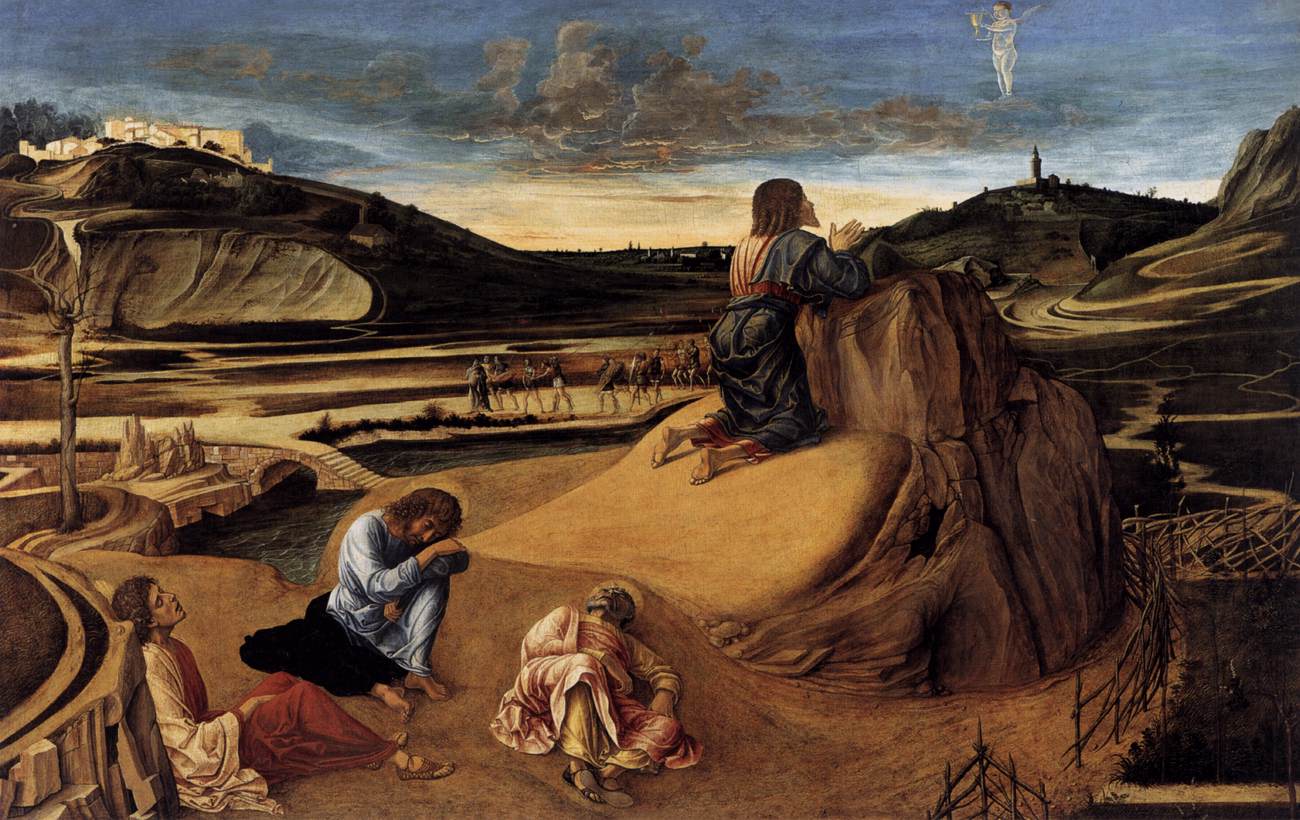
Giovanni_Bellini

Andy Crouch in his book Culture Making: recovering our creative calling, (Chapter 8 “Jesus as Culture Maker”) has some brilliant insights into the difference that Jesus life, death and resurrection have for shaping the horizons of possibility (shalom and human flourishing) for societies, ancient and modern. Note also classic poems by John Donne; and Christina Rossetti

The Cross

He suffered the full weight of the human story of rebellion against God. He was literally impaled on the worst that culture can do–an instrument of torture that stood for all the other cultural dead ends of history, from spears to bombs, gas chambers to waterboards. Like all other instruments of violence, a cross is cultural folly and futility at its most horrible. (141)

The core calling of [Jesus] life is not something he does at all in an active sense–it is something he suffers. The strangest and most wonderful paradox of the biblical story is that its most consequential moment is not an action but a passion–not a doing but a suffering. (142)

“On Good Friday, love embraced suffering as Jesus drank the bitter cup. Dr. Martin Luther King Jr. self-consciously followed the same journey of the suffering death of Jesus, the way of the cross, as he promoted civil rights for African-Americans in the Southern USA in the 1960s. He worked hard to replace the perverted symbol of the cross which was used as a justification for aggression, hate and violence—e.g. the Ku Klux Klan. His life quest was to restore the cross as a symbol of love, mercy, justice and non-violence. He incarnated a form of extreme love, a committed non-violent protest against systemic injustice.” ~Iwan Russell-Jones, Professor of Faith and the Arts, Regent College

Read More…

Posted by: gcarkner | March 19, 2014

Prayer of a Skeptic

The Prayer of a Student Skeptic

Screen shot 2014-03-19 at 12.57.36 PM

Dear God, Buddha, Allah, Plato, Krishna, Beings from other planets, Jesus, Confucius, Zeus, Ra, the Universe, the Great Principle, etc. Is anyone out there?  Pluralism is confusing. Could you get together, have a chat and send one representative to explain all this? So many worldviews on offer; so many games in town. How do I choose? How can I trust any of you? How do I know what’s true and bogus, aside from all the shouting, the rituals, images, many paths to peace and funny hats?

OK, right, this is awkward…. I don’t really believe in you anymore. I’m kind of still angry with Dad who dragged me and my sister to church and forced religion on our family. It’s just not cool with my friends to think or talk about spiritual things; they get creeped out. They are big on science, world politics and extreme sports. God talk is out of the question. I don’t want them even to know I’m thinking about this meaning and purpose stuff. They’ll think I’ve gone off my head.

One of my social science profs is keen about Nietzsche, will to power, self-assertion therapy. He loves Foucault and the power of self-invention and reinvention–freedom to be who we want to be. But it’s a big job to create one’s own universe of meaning. Daunting really. Practically I’m concerned about my career big time–medicine is my goal. Jobs are scarce and I want security and a chance to leave my mark. Is meaningful work too much to ask for? But a thousand other colleagues want the same thing. How’s that going to work? Competition for everything is brutal: professions, grad school, employment, mates.

Read More…

« Newer Posts - Older Posts »

Categories