Posted by: gcarkner | March 24, 2014

An Ode to Lent

The Season of Lent ushers in the Preeminent Celebration of the Christian Year, Easter.

N.T. Wright on Lent     http://www.youtube.com/watch?v=zY5nQAsscxM

See the compilation God For Us: rediscovering the meaning of Lent and Easter

edited by Greg Pennoyer and Gregory Wolfe

Lent. it is a season to slowly prepare our souls. it is a time to open ourselves to the presence of God in our lives and let angles feed us. It is a time to sit among the ashes, confident that love will abound in due time. it is a time to be washed by our tears into the water of new life, to come to ral transformation and newness ready to celebrate the feast that is given us at Easter. ~Ronald Rolheiser

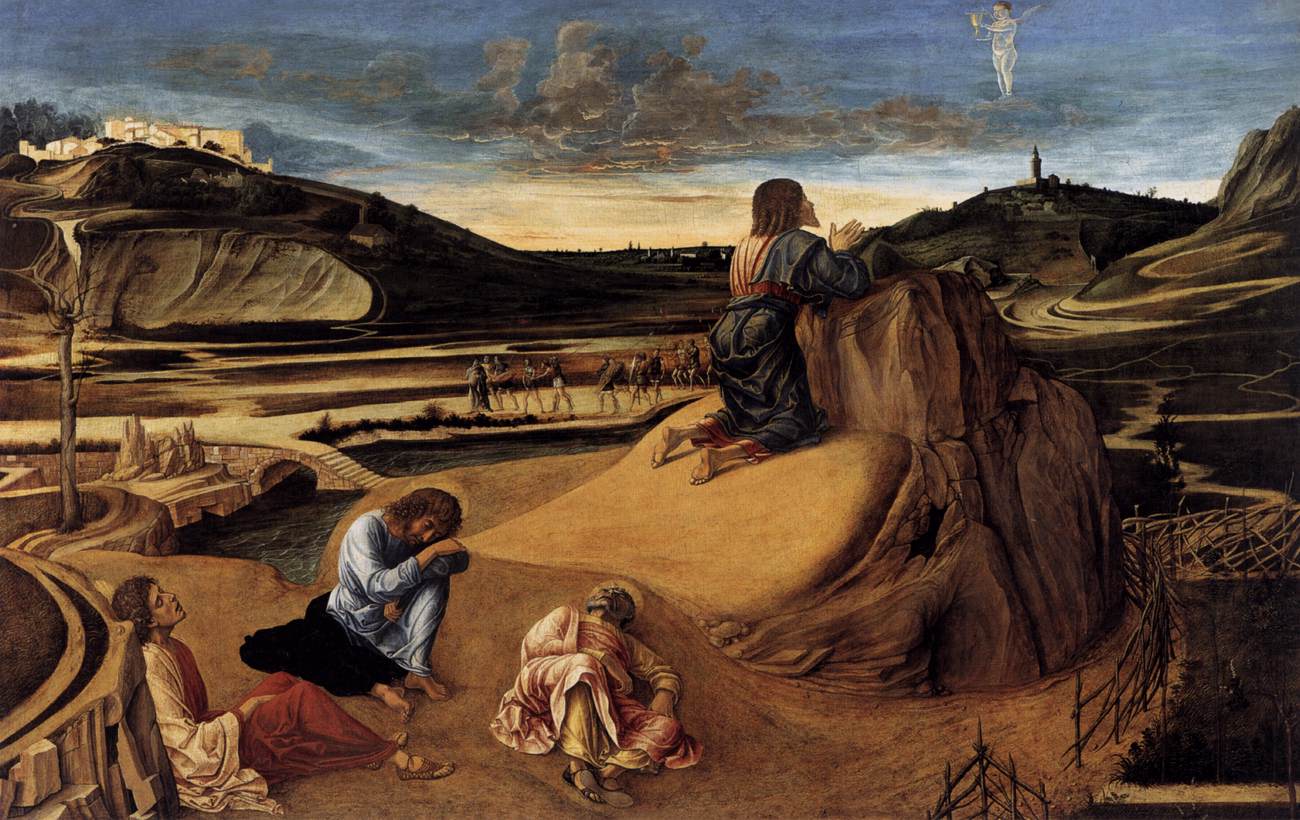
Giovanni_Bellini

Andy Crouch in his book Culture Making: recovering our creative calling, (Chapter 8 “Jesus as Culture Maker”) has some brilliant insights into the difference that Jesus life, death and resurrection have for shaping the horizons of possibility (shalom and human flourishing) for societies, ancient and modern. Note also classic poems by John Donne; and Christina Rossetti

The Cross

He suffered the full weight of the human story of rebellion against God. He was literally impaled on the worst that culture can do–an instrument of torture that stood for all the other cultural dead ends of history, from spears to bombs, gas chambers to waterboards. Like all other instruments of violence, a cross is cultural folly and futility at its most horrible. (141)

The core calling of [Jesus] life is not something he does at all in an active sense–it is something he suffers. The strangest and most wonderful paradox of the biblical story is that its most consequential moment is not an action but a passion–not a doing but a suffering. (142)

“On Good Friday, love embraced suffering as Jesus drank the bitter cup. Dr. Martin Luther King Jr. self-consciously followed the same journey of the suffering death of Jesus, the way of the cross, as he promoted civil rights for African-Americans in the Southern USA in the 1960s. He worked hard to replace the perverted symbol of the cross which was used as a justification for aggression, hate and violence—e.g. the Ku Klux Klan. His life quest was to restore the cross as a symbol of love, mercy, justice and non-violence. He incarnated a form of extreme love, a committed non-violent protest against systemic injustice.” ~Iwan Russell-Jones, Professor of Faith and the Arts, Regent College

Read More…

Posted by: gcarkner | March 19, 2014

Prayer of a Skeptic

The Prayer of a Student Skeptic

Screen shot 2014-03-19 at 12.57.36 PM

Dear God, Buddha, Allah, Plato, Krishna, Beings from other planets, Jesus, Confucius, Zeus, Ra, the Universe, the Great Principle, etc. Is anyone out there?  Pluralism is confusing. Could you get together, have a chat and send one representative to explain all this? So many worldviews on offer; so many games in town. How do I choose? How can I trust any of you? How do I know what’s true and bogus, aside from all the shouting, the rituals, images, many paths to peace and funny hats?

OK, right, this is awkward…. I don’t really believe in you anymore. I’m kind of still angry with Dad who dragged me and my sister to church and forced religion on our family. It’s just not cool with my friends to think or talk about spiritual things; they get creeped out. They are big on science, world politics and extreme sports. God talk is out of the question. I don’t want them even to know I’m thinking about this meaning and purpose stuff. They’ll think I’ve gone off my head.

One of my social science profs is keen about Nietzsche, will to power, self-assertion therapy. He loves Foucault and the power of self-invention and reinvention–freedom to be who we want to be. But it’s a big job to create one’s own universe of meaning. Daunting really. Practically I’m concerned about my career big time–medicine is my goal. Jobs are scarce and I want security and a chance to leave my mark. Is meaningful work too much to ask for? But a thousand other colleagues want the same thing. How’s that going to work? Competition for everything is brutal: professions, grad school, employment, mates.

Read More…

Posted by: gcarkner | March 18, 2014

Who Stole Our Humanity?… 2

Towards Recovering Our Humanity: Wisdom … 2

It is our conviction that if we are to become more human, science must be more engaged with and tempered by wisdom. Philosophy, of which science is a part, by definition is the love of wisdom that prompts persons to use all the skills of reason in the quest for truth, goodness and beauty. Rationalism unfortunately pits truth against beauty and goodness and against theology; we question this kind of prideful wisdom. Intellectual Jacques Maritain cautions that ‘science without wisdom is blind’;  it is therefore dangerous as a form of raw power without the tempering effect of wisdom. How is its insight and knowledge to be used well, for the best, for the common good?

There is a significant revival of virtue ethics today in academia. Upon deeper reflection, genuine knowledge is the cultivation of the virtue of wisdom, which entails that all knowledge must have a relationship with both the intellectual and the moral virtues. Science within its appointed limits attends to matters of fact, quantity, cosmic order, matter and anti-matter, the physical forces and the realm of stars and galaxies (the what and how questions). Wisdom, however, has a large vested interest in the qualitative conditions of life and research (the why questions): relationships, meaning, purpose, value, idea, narrative, appropriate application of knowledge and other meta-issues.

Read More…

A Review of Gore, A., 2013. The Future: Six Drivers of Global Change. Random House, New York. 558 pp.

Al Gore’s selection of the six key drivers of global change can be debated, but no one should underestimate the thought and vision that has gone into the writing of this book. If you are worried about investing in 558 pages of text I would strongly recommend that you read the final chapter (Conclusion) first. The range of recommendations is bound to impress and the evidence on which such recommendations are based should intrigue the reader to return to the opening chapter and stay the course. This is not another climate change peroration but a balanced warning in relation to the trajectory of the six major drivers of change, as perceived by Al Gore.

The six drivers are as follows:

  1. The emergence of a deeply interconnected global economy which is characterized by an expanding global wealth gap. Increasing speed of transactions, complexity, integration, capitalism in crisis and the changing nature of work.
  2. The realization of global electronic communication, a global brain, big data and the threat of “big brother”, a crisis in education and health care, the conundrum of the search for security and the loss of privacy.
  3. A new balance of political, economic and military power, the unpredictability of China, the growing influence of corporations,  the nation state in transition and the uncertain meaning of the decline in wars.
  4. Rapid unsustainable growth, exemplified by city growth, mass marketing, waste and pollution, continued population growth, family migration, refugees, soil erosion and dust storms.
  5. A revolution in genetics and materials science, ethical issues surrounding the genome, creation of new body parts, fertility control and GMOs.
  6. A new relation between the power of civilization and Earth’s ecological system, questions around mitigation of and adaptation to climate change, risks, fracking and species extinctions.

In his conclusion, Gore says that our decision about the way we choose to live will determine “whether the journey takes us or whether we take the journey”. He lays out his assumptions about human nature: intrinsic human nature does not change but aspects of human nature which we routinely express can and do change. Some genes are expressed while others remain inchoate and vestigial. Neuron trees grow dense and vibrant when they are used; others atrophy when they are not. Better education is essential but is not, in itself, enough. Read More…

Posted by: gcarkner | March 16, 2014

Who Stole Our Humanity?

Scammed Out of Our Humanity?

There are forces and ideologies in society which rob us of our dignity and freedom, of our very humanity. Scientism is one of those forces or perspectives which depletes or blocks a higher humanism. We have to say that it  is not conducive to a holistic or healthy view of humans. Its reductive character has contributed to the devaluing of people through a number of ideologies in the twentieth century, many of which are still in play in the twenty-first century. Dehumanization of persons is the result of treating them in terms of their machineness or their biological being alone.  Scores of books have addressed this topic. In a very devastating sense, modern culture is deprived of some of the richest interpretation of the nature of humanity that history has available.[1]

Is this a wise way to go? E.F. Schumacher captures the problem of scientism for personhood in rather shocking terms.

The Universe is what it is; but he who … limits himself to its lowest sides—to his biological needs, his creature comforts or his accidental encounters—will inevitably ‘attract’ a miserable life. If he can recognize nothing but ‘struggle for survival’ and ‘will to power’ fortified by cunning, his ‘world’ will be one fitting Hobbe’s description of the life of man as ‘solitary, poor, nasty, brutish and short’.[2]

Under the mythology of scientism, people are viewed as sophisticated cogs in the cosmic machinery, or simplified as the most intelligent animals (highest primates). All human characteristics, including mind or soul, are taken as explicable in terms of body (neuron networks, DNA makeup, biochemistry or physiology, or mere physics and chemistry). There is a philosophical reductionism at work, i.e. the higher is explained in terms of the lower, mind in terms of brain, human social behaviour in terms of physics and chemistry, or ant colonies (E.O. Wilson). Humans are appreciated mainly for their instrumental value: earning capacity, socio-political usefulness and their excellencies of giftedness. We saw this mentality lived out in the old Soviet Union, but often it exhibits itself in how people are treated in the West as well.

We briefly note here the distinct lack of wisdom in viewing humans as mere animals. This is the kind of reductionism that leads to alienation, human rights abuse, cynicism, even nihilism, as we see in the oppression by malevolent elites or dictators, or abusive employers of immigrants. The movie The Way Back depicts such brutish conditions of Stalin’s Siberian labour camps–the Gulags about which Solzhenitsyn wrote.[3] Scientism is easily exploited by a political ideology that is disconnected from the moral good; it carries the potential to be used in the most destructive ways on humans and the rest of creation, promoting a nihilistic anti-humanism.[4] Read More…

Posted by: gcarkner | March 9, 2014

Iain Provan Examines Two Cultural Mythologies

A Critical Examination of Two Myths that Drive Culture:

the Axial Age and Dark Green Religion

Dr. Iain Provan, Marshall Sheppard Professor of Biblical Studies, 

Regent College

Wednesday, March 12 @ 4:00 p.m.        Woodward (IRC) Room 6, UBC

Abstract

The contemporary world has been shaped in part by two important and potent myths.  Karl Jaspers’ construct of the “axial age” envisions the common past (800–200 BC), the time when Western society was born and world religions spontaneously and independently appeared out of a seemingly shared value set. Conversely, the myth of the “dark green golden age” as narrated by David Suzuki and others asserts that the axial age, and the otherworldliness that accompanied the emergence of organized religion, ripped society from a previously deep communion with nature. Both myths contend that to maintain balance we must return to the idealized past. In this lecture, Iain Provan will engage critically with both myths, explaining why we should not embrace them and why it matters if we do.

Biography 

With his doctorate from Cambridge University, Dr. Iain Provan has been the Marshall Sheppard Professor of Biblical Studies at Regent College since 1997. He was born and educated in the UK and retains strong family, academic, and church connections with his homeland. He received his MA at Glasgow University in Mediaeval History and Archaeology, his BA from London Bible College in Theology, and his PhD from Cambridge, where his thesis focused on the books of Kings, and was subsequently published as Hezekiah and the Books of Kings. Iain Provan’s academic teaching career took him to King’s College London, the University of Wales, and the University of Edinburgh, where he was a senior lecturer in Hebrew and Old Testament Studies. He has written numerous essays and articles, and several books including commentaries on Lamentations, 1 and 2 Kings, Ecclesiastes, and Song of Songs, and co-authored with Phil Long and Tremper Longman A Biblical History of Israel. Most recently he released Convenient Myths: The Axial Age, Dark Green Religion, and the World that Never Was., the concern of this talk. Iain is an ordained minister of the Church of Scotland; a Life Member of Clare Hall, Cambridge; and the recipient of an Alexander von Humboldt Research Fellowship. He and his wife, Lynette, have four children and he holds full credentials as a soccer coach in BC. Read More…

Posted by: gcarkner | March 4, 2014

Who Gave us Scientism?

The Historical and Philosophical Roots of Scientism

The scientific revolution in the seventeenth century owes much to the new techniques of empirical science: important advances in mathematics and the telescope are just two impressive examples. Radical empiricism, on the other hand, derives from John Locke and David Hume of Britain in the eighteenth century. This is the origin of sentiments towards scientism. Hume claimed that an idea was meaningless unless it had empirical grounds. He attempted to reduce all knowledge to scientific knowledge and even suggested the burning of all books that contained no quantities or matters of fact. The irony here is that Hume was also the first skeptic of scientific induction.

Read More…

Posted by: gcarkner | February 27, 2014

Denis Alexander on Science & Religion

Dr. Denis Alexander is a big advocate for the dialogue between science and religion, science and the Christian faith. He has made a substantial contribution in this field through speaking, writing and co-ordinating sessions at the Faraday Institute for Dialogue on Science and Religion at Cambridge University. His Test of Faith DVD series has helped people around the globe to think more robustly about the various issues of cosmology, neuroscience, genetics and origins. He has hosted an international lighthouse for this discourse. Denis has been a visiting lecturer for the UBC Graduate & Faculty Christian Forum. He is the author of impressive tome Rebuilding the Matrix:  Science and Faith in the 21st Century (Oxford: Lion Publishing, 2001). We think he represents the academic image of a scholar/scientist and a gentleman at its best.

Download Lectures from Faraday @  http://www.st-edmunds.cam.ac.uk/faraday/Multimedia.php, Read More…

Posted by: gcarkner | February 23, 2014

Self-Identity within Modernity

Modernity, Identity and the Self 

The ideology of Scientism assumes a certain kind of anthropology, one full of optimism about the possibility for both knowing and organizing the world. Homo autonomous is an independent, self-reliant, self-centering, self-integrating rational subject. This includes a heroic understanding of human subjectivity. One can trace how this was achieved during the Renaissance by means of a radical transformation or re-interpretation of the biblical story of Adam in light of the Greek myth of Prometheus–the self of heroic individualism. Included in this identity was a bedrock faith in the ability of the self to discover universal, binding truths of science, politics and morality. The belief in universal reason is coupled with individual autonomy–the ability of every human being to come to the right conclusions.

The modern self of Scientism has a tendency to be optimistic, often to an illusory degree. It draws confidence from the mood of the Enlightenment where science seemed to open up new possibilities for the self as active agent to carve out and control its own destiny. There was a strong belief in progress to the point of becoming a grand narrative or cultural mythology. One could leave behind the ties of authority, religion and medieval hierarchy. Modernity’s positive self-image is of a civilization founded on scientific knowledge of the world and rationl knowledge of value, placing the highest value on human life and freedom. Read More…

Posted by: gcarkner | February 18, 2014

Higher Education: Truth & Power

Can Truth Speak to Power?

French poststructuralist philosopher Michel Foucault’s (College de France) middle work is centered on power-knowledge or power/knowledge, and nowhere is power and knowledge more intertwined than in today’s university. As many readers know, Foucault is still one of the most quoted intellectuals in academia, especially in Europe. His thought and critique of culture continues to have an incredible influence across a huge spectrum of fields.

Knowledge to some degree is always implicated by, entwined with, power but that is not always a bad thing. Power is a condition of knowledge and therefore knowledge must take account of its involvement with power. Who gets to say such and such a proposition/declaration/claim is true, weighty, the way to go, or credible? In fact, it is often the person or persons who have earned their way up in the echelons of power—the ‘expert’, those who edit the journals, or lead a school of thought. We look for the most credible sources to make our case in our thesis proposal or dissertation. We locate our discourse or discussion among those who have earned their stripes the hard way, or whose ideas have met the test of time and application. Their opinion, even if we disagree with it, counts in the larger debates, many of which have been raging for centuries. It is a complex and fascinating relationship. Read More…

« Newer Posts - Older Posts »

Categories