Posted by: gcarkner | October 1, 2012

Quality of the Will

The Recovery of Positive Ethical Dialogue

Many people today are discouraged and confused by the moral drift in Western society and wonder if they can have any voice or influence in a world with such a strong emphasis on individual choice, subjectivist approach to values, aesthetic taste ethics and radical, self-defining (self-justifying) concepts of freedom. Freedom currently in the West is often claimed as an ontological position, a reality within which one can justifiably choose one’s own moral parameters and construct or re-invent the self. In his Sources of the Self (1989) and followed by A Secular Age (2007) Canadian philosopher Charles Taylor attempts to track and understand the moral soul of early and late Western modernity. The narrative is a complex one, but vital to comprehend if we are to truly understand ourselvesThere are many ideological forces at work and many experiments in promoting an ethics of happiness, or consequence, or situation, one of pleasure or principle. The focus of ethics can be radically different.

Religious people today can feel powerless and a bit odd, even guilty, for holding any moral convictions besides a consumeristic will that follows its desires. On this important topic, visiting Notre Dame Early Modern European History scholar Brad S. Gregory has a most profound Chapter 4. “Subjectivizing Morality” in his 2012 publication The Unintended Reformation. Many today feel themselves caving in or abandoning their inherited standards of behaviour under the weight of the cultural slippage–towards nihilistic relativism and radical individualism. Where can they turn for assistance, discernment and wisdom?

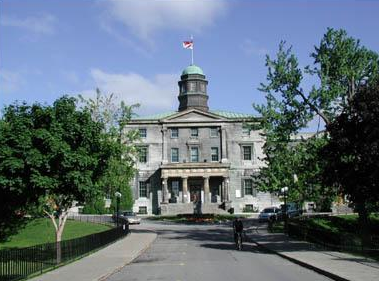
McGill University, MontrealMcGill University, Montreal where Taylor taught philosophy for several years

In the West, is there any basis left for normativity, for accountability, even for responsibility for the Other? Is it all just about my agenda, my choice, my naked will, or my aesthetic self-invention? “What is the quality of this choice, this will?” asks Taylor who retrieves an ancient idea of qualitative discriminations in ethics–the language of the moral good or goods (Part 1. of Sources of the Self). In what is  choice grounded, and how is it guided? We late moderns can be very naive about our Faustian deals when we make choice or expressivism an absolute within an ideology of unshackled freedom and self-determination. Post-Romantic philosophers like Michel Foucault offer an Art of Self or an ethics as aesthetics as a morality substitute in an age of nihilism and anomie (transgressive, norm-less existence).

This twelve part blog series on the Quality of the Will  suggests that preeminent Canadian philosopher of the self Charles Taylor can be of strategic assistance on the issue at hand. He wants to recover/retrieve a robust moral grounding in order to avoid contemporary solipsism (think Julia Roberts in the movie Eat, Pray Love). He believes that these goods can empower us as moral beings once again. They need not remain buried in contemporary moral discourse. Following in the footsteps of Oxford’s great philosopher Iris Murdoch, this project (Malaise of Modernity; Sources of the Self) entails a dynamic, adventurous and exciting recovery of the ancient language of the good and a renewal of a fresh social normativity–a renewal of moral discourse in the polis. Taylor employs an engaging language that a pluralistic audience can understand, both intellectually and practically. It resonates! One has to be willing to think harder and go much deeper than much contemporary thought on ethics and morals. We attest to the fact that is worth the effort, offering fresh hope for Western pluralistic cultures and sub-cultures.

This twelve part series outlines his monumental contribution to moral and ethical thinking (the ontology of the good). It reveals a phenomenological aspiration to the good inherent in most humans if they are willing t reflect more deeply with Taylor, an aspiration which can be a robust challenge to the ethical solipsism and Zarathustra will-to-power outlook so common today.

What are the valid and sustainable parameters of our current moral quest, our current quest for freedom, wholeness, identity within our various spiritual journeys, the quest for meaning in our lives? How do we map this in today’s world? Taylor is an avid moral geographer. Moral ontology is deeply important and central to all other discussions about the moral self; it offers the ultimate landscape (one might say infrastructure or deep structure) of the self. Therefore it remains central to engage the current debates of our day in the midst of a cultural loss of moral consensus, as astutely noted by philosopher Alasdair MacIntyre.

http://www.youtube.com/watch?v=5XC6DK1WkR4  Conversation (2012-06-16) with Charles Taylor rooted in A Secular Age Templeton Prize book.

We trust you will enjoy reading and reflecting upon, perhaps debating with, this series of posts as much as we enjoyed writing them.

~Gordon E. Carkner, PhD in Philosophical Theology, University of Wales

Dissertation: “A Critical Examiniation of Michel Foucault’s Concept of Moral Self-constitution in dialogue with Charles Taylor.” Find it in the British Library in London, Oxford University Library, or Oxford Centre for Mission Studies Library.

See also the blog series (12 posts) entitled Quality of the Will by Gord Carkner.


Related articles


Canadian philosopher Charles Taylor giving a l...

Canadian philosopher Charles Taylor giving a lecture at the New School in 2007. Charles Margrave Taylor, C.C., Ph.D., M.A., B.A., FRSC (5 novembre 1931, Montréal), est un philosophe québécois d’expression anglaise. (Photo credit: Wikipedia)

Posted by: gcarkner | September 29, 2012

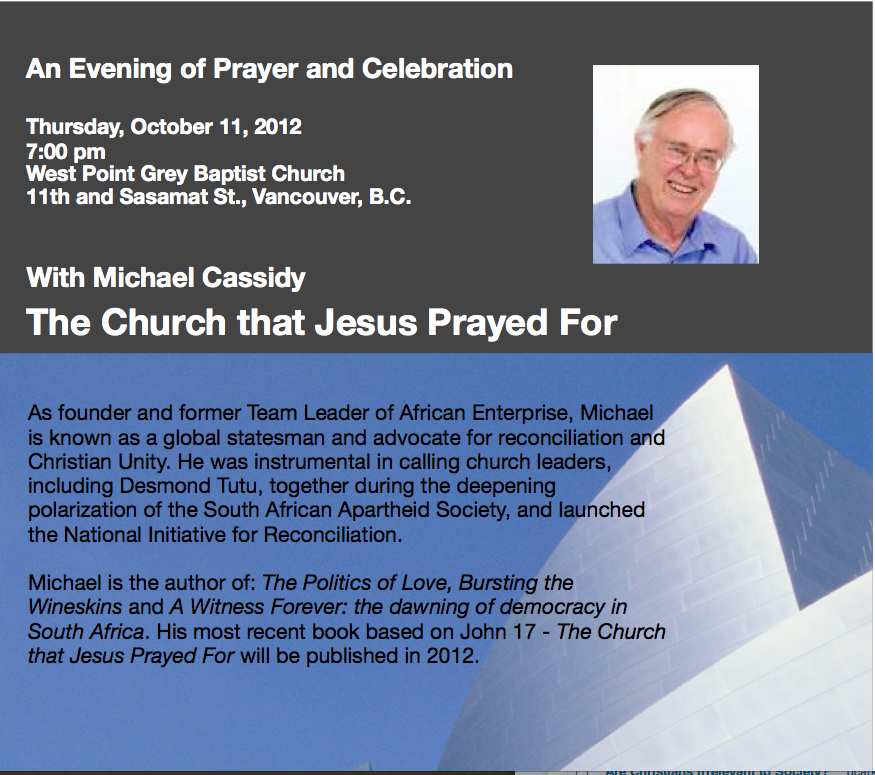
Michael Cassidy: Out of South Africa

5o Years of Work in Africa: Michael Cassidy

Info: Contact Ute Carkner <ucarkner@shaw.ca>  Sponsored by Outreach Canada (http://www.outreach.ca)

Posted by: gcarkner | September 29, 2012

Scientism Investigation continued…4

Scientism Entails Logical Problems as noted by Philosophers

This is the fourth instalment on the ideology of scientism as we bring it to the bar of academic scrutiny:

Scientism as a philosophical claim of knowledge monopoly becomes shipwrecked on its own rocks, so to speak. The key claim of empiricism or positivism (that only what is empirically testable is true) cannot be justified empirically. The argument lacks substance, and appears self-contradictory. Famous positivist A. J. Ayer himself eventually admitted that his system was bankrupt. The claim that only factual statements have validity is itself non-factual, speculative, even closed-minded. Let me explain. Read More…

Posted by: gcarkner | September 26, 2012

A Wager on Transcendence

Graduate Identity: a Wager on Transcendence

This idea emerges out of George Steiner in his important book Real Presences and Charles Taylor in his tome  Sources of the Self. We turn to the Arts for this portion of the postgraduate identity discourse. We agree that it is folly to try to prove absolutely the divine from the material stuff of the world, but it does not mean that there is no evidence or good reason to believe in the supernatural. We need not stifle the human imagination from the start. Charles Taylor in A Secular Age (p. 543) notes in his chapter titled “The Immanent Frame” that “we have come to understand our lives as taking place within a self-sufficient, immanent order, a constellation of orders, cosmic, social and moral…. This immanent order can tend to slough off the transcendent.” It can spin into a Closed World Structure (exclusive humanism), which hermeneutically refuses evidence of the divine; it can hold our minds captive in a way that makes atheism seem obvious. He notes that we early twenty-first century moderns tend to focus exclusively on human flourishing or self-fulfilment as our ultimate goal.

But Steiner carefully rebuts this outlook in his wager on transcendence; he claims that we need the transcendent to make sense of ‘otherness’ in the Arts (an element that is beyond the full control of the artist, but recognized by most artists and art appreciators). In a kind of aesthetic imaginative exercise, he appeals to convictions that are beyond typical rational verification or scientific falsification: “There is an art-act and its reception. There is in the experience of meaningful form, a presence. There is an irreducible autonomy of presence, of ‘otherness’, in art and text which denies either adequate paraphrase or unanimity of finding” (Real Presences, p. 213). He appeals to human intuition and common perception. Read More…

Posted by: gcarkner | September 24, 2012

Scientism Investigation continued…3

Part 3. Scientism is not honest about the methodological limitations of science

Let us extend the point in Part 2 of our scientism critical investigation. We must look briefly at science’s own self-limitations. Science or natural philosophy has its own integrity when it does not exceed its proper limits and seek to police the other questions we are allowed to ask, or invade illegitimately the territory of other disciplines. In general, science is appropriate to the study of cause-effect relationships at the physical level of being (efficient causes), but not appropriate to adjudicate questions of purpose, meaning or worldview (final causes). The following important limitations ensue. Read More…

Posted by: gcarkner | September 24, 2012

Prayer of a Curious Skeptic

Dear God, Buddha, Allah, Confucius, Plato, Krishna, Beings from other planets, Jesus, the Universe, Etc. Is anyone out there? Do you care? Can’t you have a meeting and send us one rep? This pluralism is really confusing.

OK, right, this is awkward. I don’t really believe in you anymore. I’m kind of still angry with my  father who dragged me to church and forced religion on our family. It’s just not cool with my friends you know to think or talk about spiritual things; they are all agnostics or atheists, singing the praises of Richard Dawkins or A.C. Grayling. They are big on science and extreme sports as the way to go. Is that faith?

One of my social science profs is keen on Nietzsche, will to power, self-assertion therapy. He also likes Foucault’s idea of self-invention. Is  Foucault a neo-Nietzschean? I’m concerned about my career big time–medicine I am hoping. At university, there is a litany of complaints about religion, every day. Perhaps you should send an envoy to address some of them? Science & Religion seem like oil and water or worse. Faith seems like wishful thinking or pure emotion, something for weaklings, an escape from reality. Be realistic they tell us. Be rational.

But just in the outside chance that you, whoever you are, wherever you are, whatever you are, are real and that my fellow agnostics, skeptics and atheists are a bit overconfident, I have some questions that I’ve wanted to ask. I heard of Justin Barrett, a cognitive psychologist from California, who claims that 90% of people around the world believe in some kind of supernatural being or ground of existence. He says believing in God comes naturally to us, that we are hard wired for religion. I have a lot of doubts, and I still have this hangup with my Dad.

Why are you so hidden if you run the universe? You have a very low profile for being so omniscient and omnipresent. A spot on CNN maybe to update humanity? At least a Facebook or Twitter account, I suggest.

What’s the deal with the terrible violence, human suffering and injustice? This is very disturbing. I just hate it. Can’t something be done to stop it? Do you care?

What is love anyway? I don’t get it. Frustrating, illusive stuff. Aren’t people just out to manipulate one another for their own interest? How do I sort out reality from fantasy here? Is it more than sex or an emotional high? My last boyfriend hurt me so much. It knocked me down for months.

I sense the need for more substantial meaning but I am afraid of looking the fool, hoping for too much and being disappointed. Partying is not doing it for me anymore. I’m so damn lonely. I really wonder if there is really anyone I can trust, even my friends. They are often manipulative and exploitive.

Things are so complex. Is there a formula for happiness I’m not getting? Does Brené Brown have the answer in her vulnerability discourse? Sometimes I think life, academics, parents, others expect too much of me. I feel guilty all the time in trying to meet others expectations. The stress is not fair!

So many worldviews on offer; so many games in town. How do I choose? How do I know what’s true and bogus, aside from all the shouting, the rituals, images and outfits?

It is an awesome universe and nature is fantastic; hiking, biking and skiing gets me high and feeling good, above my problems.  I am inspired by the beauty of these mountains and the vastness of the ocean, the size of the cosmos, the mystery of the early morning fog. That’s something that speaks to me. Are you in the fog?

I’m trying to be honest with myself, but it is really hard. Is it all just a game we play until we die, this search for self, identity and meaning? How do I get above my basic desires and fears, all this anger inside me? Are we humans any different than other animals? University seems so full of paradoxes and irony. Smart people do some really dumb things.

Morality confuses me, but I sense there is something to it, living for some good cause or some ideal, save the planet, feed the poor, cure a disease, help the refugees. I don’t like it when people cheat or lie to me. There have to be some trusted parameters for human relations.

I sense I need something to believe in more than work and romance, a source of inspiration beyond survival, paying bills, a mortgage. Is there an article or book I can read to sort this out? A class maybe? A brilliant person to mentor?

Please respond….Sarah <@sar_ah>

Posted by: gcarkner | September 23, 2012

Portrait of a Top History Scholar

MARK A. NOLL

History Department, Notre Dame, IN 46556 (574/631-7574); mnoll@nd.edu

EDUCATION B.A. (English), Wheaton College (IL), 1968 Summer Study (German) Middlebury College, 1968 M.A. (Comparative Literature), University of Iowa, 1970 (Thesis: “Novalis: Literary Relations and an Experiment in Translation”) M.A. (History of Christianity), Trinity Evangelical Divinity School, 1972 (Thesis: “Melchior Hofmann and the Lutherans”) M.A., Ph.D. (History of Christianity), Vanderbilt University, 1974, 1975

(Dissertation: “Church Membership and the American Revolution: An Aspect of Religion and Society from the Great Awakening to the War for Independence”) Read More…

Posted by: gcarkner | September 22, 2012

Regent Bookstore Mini-Tour

Regent Bookstore Tour: Apologetics Gold

UBC has a great bookstore as most students know, but Regent Bookstore, within Regent College, right at Gate One (Wesbrook Mall @ University Boulevard) is a not-to-be-missed intellectual goldmine on campus. I believe that it is one of the most comprehensive theological, faith and culture bookstores in Canada. They have so much good literature here. You simply have to check it out personally; I assure that you will not regret it.

*********************

The Carkner Tour: This week, I want to take you on a mini-tour of the Apologetics Section of the store. Read More…

Posted by: gcarkner | September 20, 2012

Are Christians Irrelevant to Society?

Are Christians other-worldly and irrelevant to life in this century?

That depends on one’s perspective. This accusation often rings true. Many Christians certainly seem other-worldly and even possibly irrelevant; many hide their head in the sand and wish for a quick end of the world. Where’s the courage, hope and compassion in that? But this does not reflect the main emphasis of the Bible, within which Christian teaching is located and inspired. Far from being other-worldly, biblical Christianity emphasizes the importance of this world in three major ways. Read More…

The Creative Challenge of Christian Humanism for Western Culture

Wednesday, February 23, 2012

Abstract

The question of who ‘we’ are and what vision of humanity ‘we’ assume in Western culture lies at the heart of hotly debated questions on the role of religion in education, politics, and culture in general. The need for recovering a greater purpose for social practices is indicated, for example, by the rapidly increasing number of publications on the demise of higher education, lamenting the fragmentation of knowledge and university culture’s surrender to market-driven pragmatism. The West’s cultural rootlessness and lack of cultural identity are also revealed by the failure of multiculturalism to integrate religiously vibrant immigrant cultures. Read More…

« Newer Posts - Older Posts »

Categories