Posted by: gcarkner | October 15, 2012

Critical Alternative to Scientism…Point 2

Beyond Scientism: Retrieval of Excluded Knowledge

In our recovery from scientism, we attempt to retrieve excluded knowledge, addressing the refusal of the transcendent inherent in scientism, including the biases endemic to the new atheists. During the Cold War, the Russians constructed a city map for Moscow which excluded churches, a practice that made it difficult for tourists. They were making a point; they wanted to eliminate knowledge and memory of religion in their quest for the New Man. Charles Taylor offers some very insightful discernment on this problem of the closed or one-sided mind. He notes that transcendence can be read from two opposite angles, both of which involve faith at some level, i.e. the belief goes beyond mere rational argument or evidence.

We can either see the transcendent as a threat, a dangerous temptation, or an obstacle to our greatest good. Or we can read it as answering to our deepest craving, need, fulfilment of the good. … Both open and closed stances involve a step beyond available reason into the realm of anticipatory confidence (Taylor, A Secular Age, 548 & 551). Read More…

Posted by: gcarkner | October 13, 2012

Quality of the Will…3

Charles Taylor and the Quality of the Will Part 3

Many people today attempt  to operate within a realm of moral neutrality. Is this realistic and liveable or some kind of fantasy? The focus is on the centrality of the autonomous will, or rational will (Kant) and it is problematic because of its thinness.  At times, it seems that this idea of the will is hollowed out so that it reduces to pure freedom of autonomous choice with no sense of responsibility for others. Ethics is reduced to lived experience as one chooses to live and stylize it (aesthetic solipsism like that i Foucault). Morality is defined, not through the conformity of behaviour with codes, or norms, but in reference to the intention and freedom of the subject, and thus, ultimately, to the way in which the indiviual will determines itself and judges/justifies itself. Charles Taylor raises serious questions regarding assumptions about a moral self that does not have any relationship to the good (or is in denial of this relationship). It becomes a self focused on its own desires and such an individual lobbies the government to protect the right to express those desires and indulge in decisions in one’s own self-interest. Read More…

Posted by: gcarkner | October 12, 2012

Albert Borgman on Technology

Albert Borgmann: a Philosopher of Technology

Albert Borgmann, a University of Montana philosopher of technology, gave a thoughful GFCF lecture last November 2011. Some of us had lunch with him at Sage’s Bistro at UBC following the lecture to pick his brain. Like Sam in the last blog post, he wants us to reflect on how technology is changing us, how it is more than a way of getting things done more efficiently or conveniently. Borgmann believes there is more than meets the eye, that technology is a form of culture that shapes our lives, values and relationships in certain ways, even if we are unaware of it. In general, technology claims and promises liberty and prosperity, to make life less burdensome and make us more wealthy and comfortable.

He believes that up to 1950, we had the ‘constructive phase’ of technology where in general it was supportive of human well-being; after that, according to Borgmann, we entered the ‘degenerative phase’ where technology became a burden and a distraction from important relationships, values and priorities. It now offers the good, the bad and the really bad. Read More…

Posted by: gcarkner | October 11, 2012

Smartphones and God Substitutes

Reflections on Smartphones

Theomania, the desire to be like a god, is alive and well today. Theologian Christoph Schwöbel notes that there is an interesting historical-cultural coincidence between the birth of radical concept of freedom and the denial of God in Western philosophy. He suggests that it results from humans attempting the kind of freedom one normally attributes to God—omniscient, omnipotent, infinite. This perspective on freedom tends to imply that the self must occupy or usurp the space once given to God in Western consciousness—human and divine freedom in a strange way are set up in a direct conflict and competition. This has dire consequences; the quest for immanent radical freedom can sacrifice unnecessarily much that is good in life, and perhaps to some extent my well-being.

[There emerges] a dislocation in the relational order: when they aspire to be more than human, they actually become less than human….We often find the radical conception of freedom as absolute and unlimited lies at the heart of many of the most dehumanizing tendencies…in modern history. Where freedom is seen as radically self-constituted, responsibility is restricted to the responsibility of agents to themselves, and it is at this point that the claim of radical autonomy cannot be distinguished from the escape into unaccountability.  (C. Schwöbel)

These radical individuals as they gain power and influence, grow in narcissistic tendencies and ultimately can become a law unto themselves; the scope of perceived moral responsibility ends with one’s self, one’s perceived needs, desires and creativity. The reigning ethos claims that I alone must reach my full potential and even create my own moral and intellectual universe. This posture constitutes a failure of freedom in a game of self-deception and illusion. From whence does our freedom really come? Here are some thoughts on modern personal technology from UBC Geography Grad Student, Samuel Johns: samuelgjohns@gmail.com Read More…

Posted by: gcarkner | October 9, 2012

Quality of the Will…2

Charles Taylor’s Case for Moral Realism

Indeed, who are we late moderns? Taylor challenges the current superficiality regarding moral convictions and the over-emphasis on living one’s desires into a trajectory of self-interest alone. His argument for moral realism is five-fold. In terms of moral givens, he argues that certain perennial features of the self are present irrespective of culture or the way they are expressed or understood. He starts his analysis with the question of how humans operate as moral beings in their actual moral experiences, and how they reflect upon those experiences. So he is interested in praxis as well as moral theory. Beginning with humans and the way they experience morality (the phenomenal dimension), he claims that the most plausible explanation of morality is one that takes seriously humans’ perception of the independence of moral goods. It has been my privilege to wrestle with Taylor’s engaging ideas for more than a decade; there is much depth to capture the best minds and the most fervent hearts. Read More…

Posted by: gcarkner | October 8, 2012

Paradigm Shift: Beyond Scientism

A Paradigm Shift in Understanding Reason

What is the way forward beyond the narrow thinking of scientism? Is there a path towards a more integrated and whole understanding of reason and reality itself? It is our conviction that science must be more engaged with, tempered by wisdom. Philosophy, of which science is traditionally a sub-discipline, by classical definition is the love of wisdom about natural things. This is a posture that prompts persons to use all the skills of reason in the quest for truth, goodness and beauty. Rationalism unfortunately pits truth against beauty and goodness, and this is epistemologically dysfunctional as we have seen. French philosopher Jacques Maritain boldly cautions that ‘science without wisdom is blind’, meaning that its explorations and usage requires insight from something other than science qua science. What are the new possibilities of a re-aquaintance of sapientia  and scientia  wisdom and science/knolwedge? Read More…

Posted by: gcarkner | October 2, 2012

Scientism Investigation continued…5

5. Scientism Impoverishes One’s View of Humans

Our ongoing investigation and critique of the ideology of Scientism continues here in Part 5. Ideas are not neutral; they have consequences. They affect how we live and treat each other in social and political theatres. Ideologies like scientism can put tanks and bombers in motion, justify militant imperialism, or selfish consumerism. We contend that scientism is not conducive to a holistic or healthy view of humans and society. It contains an anthropological defect and deficit; its reductive character has contributed to the devaluation of people. The consequences can be seen through the lens of  a number of ideologies and failed political experiments in the twentieth century (Paul Johnson, A History of the Modern World: from 1917-1990s). Will we fair better in the twenty-first? Read More…

Posted by: gcarkner | October 1, 2012

Great Poems: T.S. Eliot

Four Quartets 1: Burnt Norton by T. S. Eliot
I
Time present and time past
Are both perhaps present in time future,
And time future contained in time past.
If all time is eternally present
All time is unredeemable.
What might have been is an abstraction
Remaining a perpetual possibility
Only in a world of speculation.
What might have been and what has been
Point to one end, which is always present. Read More…
Posted by: gcarkner | October 1, 2012

Quality of the Will

The Recovery of Positive Ethical Dialogue

Many people today are discouraged and confused by the moral drift in Western society and wonder if they can have any voice or influence in a world with such a strong emphasis on individual choice, subjectivist approach to values, aesthetic taste ethics and radical, self-defining (self-justifying) concepts of freedom. Freedom currently in the West is often claimed as an ontological position, a reality within which one can justifiably choose one’s own moral parameters and construct or re-invent the self. In his Sources of the Self (1989) and followed by A Secular Age (2007) Canadian philosopher Charles Taylor attempts to track and understand the moral soul of early and late Western modernity. The narrative is a complex one, but vital to comprehend if we are to truly understand ourselvesThere are many ideological forces at work and many experiments in promoting an ethics of happiness, or consequence, or situation, one of pleasure or principle. The focus of ethics can be radically different.

Religious people today can feel powerless and a bit odd, even guilty, for holding any moral convictions besides a consumeristic will that follows its desires. On this important topic, visiting Notre Dame Early Modern European History scholar Brad S. Gregory has a most profound Chapter 4. “Subjectivizing Morality” in his 2012 publication The Unintended Reformation. Many today feel themselves caving in or abandoning their inherited standards of behaviour under the weight of the cultural slippage–towards nihilistic relativism and radical individualism. Where can they turn for assistance, discernment and wisdom?

McGill University, MontrealMcGill University, Montreal where Taylor taught philosophy for several years

In the West, is there any basis left for normativity, for accountability, even for responsibility for the Other? Is it all just about my agenda, my choice, my naked will, or my aesthetic self-invention? “What is the quality of this choice, this will?” asks Taylor who retrieves an ancient idea of qualitative discriminations in ethics–the language of the moral good or goods (Part 1. of Sources of the Self). In what is  choice grounded, and how is it guided? We late moderns can be very naive about our Faustian deals when we make choice or expressivism an absolute within an ideology of unshackled freedom and self-determination. Post-Romantic philosophers like Michel Foucault offer an Art of Self or an ethics as aesthetics as a morality substitute in an age of nihilism and anomie (transgressive, norm-less existence).

This twelve part blog series on the Quality of the Will  suggests that preeminent Canadian philosopher of the self Charles Taylor can be of strategic assistance on the issue at hand. He wants to recover/retrieve a robust moral grounding in order to avoid contemporary solipsism (think Julia Roberts in the movie Eat, Pray Love). He believes that these goods can empower us as moral beings once again. They need not remain buried in contemporary moral discourse. Following in the footsteps of Oxford’s great philosopher Iris Murdoch, this project (Malaise of Modernity; Sources of the Self) entails a dynamic, adventurous and exciting recovery of the ancient language of the good and a renewal of a fresh social normativity–a renewal of moral discourse in the polis. Taylor employs an engaging language that a pluralistic audience can understand, both intellectually and practically. It resonates! One has to be willing to think harder and go much deeper than much contemporary thought on ethics and morals. We attest to the fact that is worth the effort, offering fresh hope for Western pluralistic cultures and sub-cultures.

This twelve part series outlines his monumental contribution to moral and ethical thinking (the ontology of the good). It reveals a phenomenological aspiration to the good inherent in most humans if they are willing t reflect more deeply with Taylor, an aspiration which can be a robust challenge to the ethical solipsism and Zarathustra will-to-power outlook so common today.

What are the valid and sustainable parameters of our current moral quest, our current quest for freedom, wholeness, identity within our various spiritual journeys, the quest for meaning in our lives? How do we map this in today’s world? Taylor is an avid moral geographer. Moral ontology is deeply important and central to all other discussions about the moral self; it offers the ultimate landscape (one might say infrastructure or deep structure) of the self. Therefore it remains central to engage the current debates of our day in the midst of a cultural loss of moral consensus, as astutely noted by philosopher Alasdair MacIntyre.

http://www.youtube.com/watch?v=5XC6DK1WkR4  Conversation (2012-06-16) with Charles Taylor rooted in A Secular Age Templeton Prize book.

We trust you will enjoy reading and reflecting upon, perhaps debating with, this series of posts as much as we enjoyed writing them.

~Gordon E. Carkner, PhD in Philosophical Theology, University of Wales

Dissertation: “A Critical Examiniation of Michel Foucault’s Concept of Moral Self-constitution in dialogue with Charles Taylor.” Find it in the British Library in London, Oxford University Library, or Oxford Centre for Mission Studies Library.

See also the blog series (12 posts) entitled Quality of the Will by Gord Carkner.


Related articles


Canadian philosopher Charles Taylor giving a l...

Canadian philosopher Charles Taylor giving a lecture at the New School in 2007. Charles Margrave Taylor, C.C., Ph.D., M.A., B.A., FRSC (5 novembre 1931, Montréal), est un philosophe québécois d’expression anglaise. (Photo credit: Wikipedia)


Posted by: gcarkner | September 29, 2012

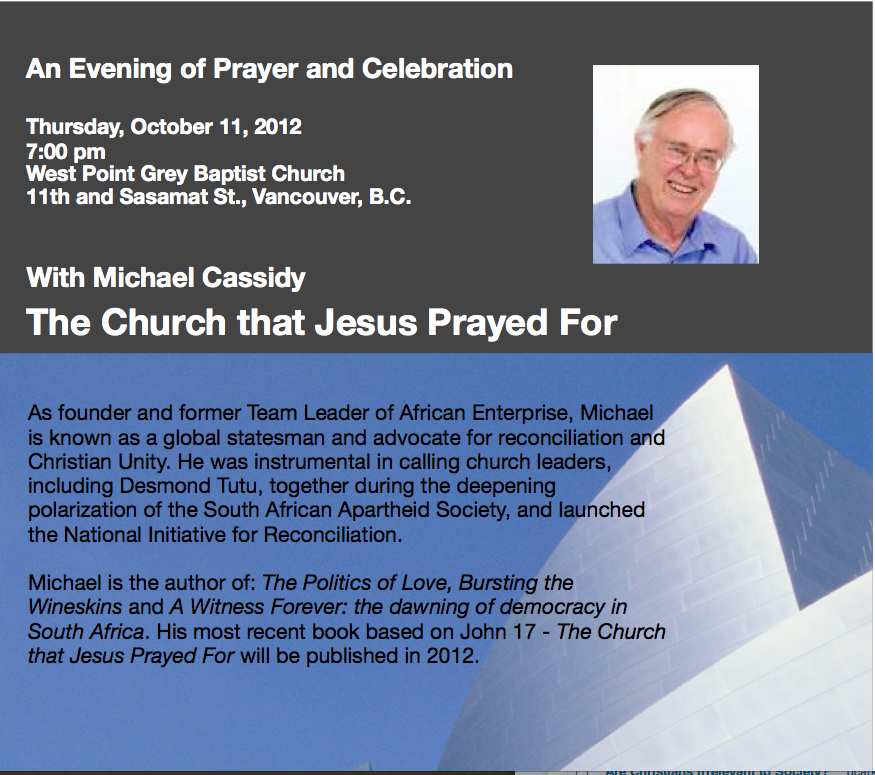
Michael Cassidy: Out of South Africa

5o Years of Work in Africa: Michael Cassidy

Info: Contact Ute Carkner <ucarkner@shaw.ca>  Sponsored by Outreach Canada (http://www.outreach.ca)

« Newer Posts - Older Posts »

Categories